
 Need help?
Do you have a question about the TP-Link Archer C7 Series and is the answer not in the manual?
Steps for when no wireless network is detected, including OS-specific advice for Mac, Windows 7/8/10, and XP.
Guidance on detecting networks other than your own, checking router status and settings.
Resolving issues with connecting or authenticating to an existing network, including password mismatch.
How to reset your cloud account password using the router's web interface.
Steps to reset your TP-Link cloud account password via the mobile application.
Instructions for resetting account password via the TP-Link cloud login portal.
Procedure for resetting password using a link sent to your registered email.
Overview of intrinsic and extrinsic factors affecting wireless signal strength and speed.
Guidance on placing the router and antennas for optimal coverage.
Strategies to minimize interference from other devices and networks.
Tips for configuring device settings to improve wireless performance.
This document provides a comprehensive FAQ and guide for TP-Link wireless routers, covering troubleshooting wireless connectivity, setting up parental controls, resetting cloud account passwords, and improving wireless speed and range.
If you are unable to find or connect to your wireless network, several steps can be taken to diagnose and resolve the issue. First, ensure that the wireless function on your device (especially laptops with built-in wireless adapters) is enabled. If you are using a laptop, consult the manufacturer's documentation or contact them directly for instructions on enabling the wireless adapter. Additionally, verify that the wireless adapter driver is successfully installed and enabled on your device.
For Mac users, a simple troubleshooting step is to turn Wi-Fi/Airport off and then back on. If the problem persists, reinstalling or updating the driver for your wireless adapter may be necessary.
Windows users (7/8/10) who encounter the message "No connections are available" should check if the wireless function has been disabled or blocked. Clicking "Troubleshoot" can often allow Windows to automatically identify and fix the problem. For Windows XP users seeing "Windows cannot configure this wireless connection," this typically indicates that the Windows configuration utility is disabled or another wireless configuration tool is active. In such cases, exiting any other wireless configuration tools (like the TP-Link Utility) is recommended. Further steps for Windows include selecting "My Computer" on the desktop, right-clicking, and choosing "Manage" to open the Computer Management window. From there, expand "Services and Applications" > "Services," locate "Wireless Zero Configuration," right-click it, and select "Properties." Change the "Startup type" to "Automatic," click "Start," ensure the "Service status" is "Started," and then click "OK."
If you can detect other wireless networks but not your own, begin by checking the WLAN LED indicator on your wireless router/modem to ensure it's active. Confirm that your computer or device is within the range of your router/modem; if it's too far, move it closer. Access the router's web management page (usually via http://tplinkwifi.net or http://192.168.0.1) and navigate to "Advanced" > "Wireless" > "Wireless Settings." Double-check that your Wireless Network Name (SSID) is not hidden.
When you can find your wireless network but fail to connect, it often points to an authentication problem or password mismatch. Sometimes, during the initial connection, you might be prompted for an 8-digit PIN, which is distinct from the Wireless Password/Network Security Key and is typically found on your router's label. If the PIN is unavailable or fails, choose "Connecting using a security key instead" and enter the Wireless Password/Network Security Key. Remember that the Wireless Password/Network Security Key is case-sensitive. If the "Network Security Key Mismatch" error persists, reconfirm the wireless password of your router.
If Windows is unable to connect, cannot join the network, or takes an unusually long time to connect, assess the wireless signal strength. A weak signal (1-3 bars) suggests moving the router closer. Changing the wireless channel of the router to 1, 6, or 11 can help reduce interference from other networks. Reinstalling or updating the driver for your computer's wireless adapter is also a viable solution.
TP-Link wireless routers offer parental control features through the Tether APP, allowing you to manage the types of websites your children or other network users can access and the specific times they are permitted to use the internet. For instance, you can configure settings to allow children's devices (e.g., computers or tablets) to access all websites except specific ones like www.tp-link.com and amazon.com during defined hours (e.g., 08:00 to 20:00 daily).
To set up parental controls, first launch the Tether APP. Log in with your TP-Link ID; if you don't have one, you can create a new TP-LINK Cloud ID by clicking "Sign Up." Once logged in, tap on the icon representing your TP-LINK device, then navigate to "Tools." From there, tap on "Parental Controls" and enable it.
The next step involves adding the devices you wish to control and setting a schedule for them. This schedule defines the "Effective Time" for the Parental Control Rules, not the internet access time for the controlled devices. After adding devices and setting the schedule, you can define the restriction policy. There are two main rules: "Blacklist" and "Whitelist." By clicking "Blocked Websites," you can add keywords or specific websites (e.g., TP-Link.com or Amazon.com). In "Blacklist" mode, controlled devices are prevented from accessing any websites containing the specified keywords during the Effective Time. Conversely, in "Whitelist" mode, controlled devices can only access websites containing the specified keywords during the Effective Time. After configuring these settings, click "Save" to apply the parental control rules.
If you forget the password for your TP-Link cloud account, which is bound to your TP-Link wireless router for remote management, you can reset it through the web management page or the Tether APP. This feature is applicable to TP-Link wireless routers with cloud functions, such as Archer C8 V3, Archer C9 V3/V4, and similar models. Note that while most applicable models support online upgrades, other cloud functions may be added in future firmware updates. For Archer C5400 V1, only the EU version supports cloud services; verify your hardware version on the router's label.
To reset the password via the web management page: Connect your computer to the router either via Ethernet or wirelessly. Open a browser and type http://tplinkwifi.net in the address bar, then press Enter. On the TP-Link router's web management page, click "Forgot password." Enter the email address associated with your TP-Link cloud account and click "Next." A request email will be sent to your mailbox. If you don't receive it, tap "Resend." Follow the instructions in the email to reset your password.
To reset the password via the Tether APP: Go to the "Login" page of the Tether APP and click "Forgot Password." Enter the email address used for your TP-Link cloud account in the "Email" box and tap "Submit." A request email will be sent to your mailbox. If you don't receive it, tap "Resend" after one minute. Follow the instructions in the email to reset your password.
On the TP-Link cloud website: Open a browser, type https://www.tplinkcloud.com in the address bar, and press Enter. On the login page, click "Forgot password." In the pop-up window, enter your registered email address and click "OK." A request email will be sent to your mailbox.
To complete the password reset via email: Open the request email and tap "Click to Reset Password." On the subsequent webpage, enter and confirm your new password, then click "Save." You can now log in to the router with your new password.
To enhance wireless speed or range, consider these common solutions: choosing the best location for your router and optimizing its configuration.
Symptom: Weak wireless signal, low wireless speed, or limited range.
Wireless signal strength is primarily affected by intrinsic and extrinsic factors.
http://tplinkwifi.net). Navigate to "Wireless" > "Wireless settings." Change the channel settings. While the default is "Auto," selecting channels 1, 6, or 11 is recommended if you experience high wireless interference.In older firmware versions, default SSIDs like "TP-Link_2.4GHz_130918" and "TP-Link_5GHz_130917" were used. This naming convention sometimes caused issues with smart phones, which couldn't display the entire SSID, making it difficult to distinguish between 2.4GHz and 5GHz networks. Newer firmware versions have shortened the default SSIDs to resolve this problem.
The new default SSIDs are derived from the last four digits of the router's LAN MAC address. For example, if the LAN MAC address is "E8-DE-27-83-4C-AA," the last four digits are "4CAA" (where 'A' stands for 10 in hexadecimal).
If you are unsure how to log in, refer to the relevant FAQ ID (e.g., [FAQ ID: 87]). Once logged in, click "Wireless 2.4GHz/5GHz" to view the new SSID.
 General
| Wireless Standards | IEEE 802.11ac/n/a 5GHz, IEEE 802.11b/g/n 2.4GHz |
|---|---|
| Frequency | 2.4 GHz & 5 GHz |
| Ports | 4 x Gigabit LAN, 1 x Gigabit WAN |
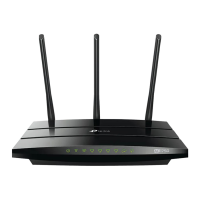
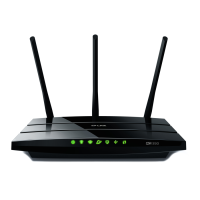
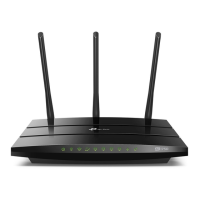
| Antenna | 3 x Detachable External Antennas |
| USB Ports | 1 x USB 2.0 Port |
| Security | WPA/WPA2, WPA-PSK/WPA2-PSK |
| Memory | 128MB RAM |
| Signal Rate | 450 Mbps (2.4 GHz) + 1300 Mbps (5 GHz) |
| Wi-Fi Speeds | 1300 Mbps at 5 GHz, 450 Mbps at 2.4 GHz |

 To Next Page