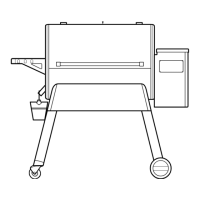
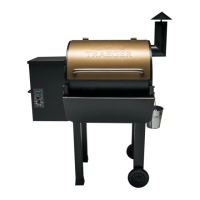
Need help?
Do you have a question about the Traeger TFB29LZA and is the answer not in the manual?
Lists the tools required for assembling the Traeger grill.
Step-by-step guide for attaching the legs and wheels to the grill frame.
Instructions for connecting the pellet hopper and burner assembly to the grill body.
Steps to attach the door handle to the grill's door.
Guide on positioning the heat baffle inside the grill over the firepot.
Instructions for installing the grease drain pan for easier cleanup.
How to place the porcelain grill grates correctly within the grill body.
Instructions for hanging the grease bucket on its designated hook.
Steps for manually lighting the grill if the automatic ignition fails.
Explanation of the automatic shutdown process for the grill.
Details on the grill's built-in safety features and alarms.
How to adjust and use the digital thermostat and P-settings for cooking.
Safety guidelines to prevent carbon monoxide poisoning.
How to prevent and handle grease fires during grilling.
Information on creosote and grease formation and the need for removal.
How to properly clean the exterior of the grill.
Recommendations for storing the grill, especially during off-seasons or rainy weather.
Best practices for cleaning the grill grates.
Steps for cleaning ash from the firepot and surrounding areas.
Safe procedures for disposing of collected ashes from the grill.
Steps to diagnose and fix problems related to the grill not igniting.
Solutions for when pellets are not being delivered to the firepot.
Step-by-step guide to safely remove a jammed auger.
Reasons and fixes for the grill fire extinguishing on the smoke setting.
Recommended dial setting for starting the grill using the digital control.
Guide to match cookbook settings with digital thermostat controls.
Tips for maintaining the grill's exterior paint and finish.
Information on where and how to order new parts for the grill.
This document is an owner's manual for a Traeger Wood Pellet Grill, model TFB29LZA, designed for residential outdoor use. The grill functions as both a pellet grill and smoker, emphasizing a "Taste the Difference" experience.
The Traeger TFB29LZA is a wood pellet grill and smoker that uses wood pellets as fuel to cook food. It features a digital thermostat control that allows users to set and maintain desired cooking temperatures, ranging from smoking to high-temperature grilling. The core components include a pellet hopper for fuel storage, an auger system to feed pellets into the firepot, a hot rod igniter to start the pellets, a draft inducer fan to regulate airflow and maintain combustion, and an RTD (Resistance Temperature Detector) sensor to monitor the internal grill temperature. The grill is designed to operate with the door closed for optimal performance and temperature control. It also includes a grease management system with a grease drain pan and a grease bucket to collect drippings, minimizing flare-ups and simplifying cleanup.
The grill offers versatile cooking options, from low-and-slow smoking to high-heat grilling. The digital thermostat control allows for precise temperature adjustments. The "Smoke" setting is specifically designed for smoking and adding flavor, maintaining temperatures between 150-180 degrees F. Medium and High settings are available for other cooking needs, corresponding to 225-275 degrees F and 350-400 degrees F, respectively.
Initial setup involves assembling the legs, wheels, pellet hopper, and handles, followed by positioning the heat baffle, grease drain pan, and porcelain grill. The manual provides detailed step-by-step instructions for assembly.
For initial firing or when the grill runs out of pellets, a specific "charging" procedure is required to ensure the auger tube is filled with pellets. Users are instructed to open the door, remove internal components, plug in the power cord, and turn the switch to "ON" and the temperature dial to "Smoke" to observe the auger turning and the hot rod heating. After pellets begin to fall into the firepot, the dial is set to "Shut Down Cycle." Once pellets are in the firepot, the grill is set to "Smoke" to allow them to come to full flame, then shut down again. After reassembling the internal components, the grill is started on "Smoke" with the door open until pellets ignite, then the door is closed, and the desired cooking temperature is set. Before cooking any food, the grill must be seasoned by running it on "HIGH" for 45 minutes with the door closed. The grill should also be preheated for approximately 10 minutes with the door closed before placing food inside.
For subsequent start-ups, the process is similar: open the door, turn the switch "ON" and the temperature dial to "Smoke." Once whitish-gray smoke appears, indicating pellet ignition, close the door and set the desired cooking temperature. Preheating for 10 minutes is recommended.
The manual also outlines a manual lighting procedure if the hot rod igniter is not functioning. This involves disconnecting the hot rod, manually adding 1/2 cup of Traeger BBQ pellets to the firepot, squirting 2 tablespoons of alcohol gel fire lighter onto the pellets, and carefully lighting it with a long-reach lighter. After about 4 minutes, once the pellets have ignited, the heat baffle, grease drain pan, and porcelain grills are reinstalled, and the grill is turned on to the desired setting.
A control shutdown cycle is built into the system. When cooking is complete, setting the temperature dial to "Shutdown Cycle" will keep the draft induction fan running for ten minutes to burn off excess pellets in the firepot before powering down the controller and fan.
Safety features include low and high-temperature alarms. If the grill stays below 125 degrees F for 10 minutes, it enters an alarm state ("LEr") and shuts off power to internal components. Similarly, if the internal temperature reaches 550 degrees F, it enters an alarm state ("HEr") and cuts power. In both cases, the main power switch must be turned off to reset.
Regular maintenance is crucial for safe and efficient operation. The manual emphasizes the importance of cleaning creosote and grease buildup. Creosote, a byproduct of slow wood pellet burning, accumulates in the flue exhaust and can cause extremely hot fires if ignited. Airborne grease particles also accumulate in the cooking chamber and flue. Grease drippings are collected in the grease drain pan, channeled into the grease drain, and then into the grease bucket. These areas should be inspected and cleaned at least twice a year, or more frequently depending on usage, to reduce fire risk.
Cleaning instructions include turning off the grill and disconnecting the power cord. Accumulated grease is easier to clean when the grill is still warm (not hot), and gloves are recommended. The grease drain pan assembly and grease drain tube should be cleaned periodically. Lining the grease drain pan with heavy-duty aluminum foil is recommended for easier cleanup, and the foil should be changed frequently. The grease bucket should also be lined with aluminum foil and emptied occasionally.
For cleaning outside surfaces, a disposable rag or cloth dampened with warm soapy water is recommended. Oven cleaner, abrasive cleansers, or abrasive cleaning pads should not be used.
For outdoor storage, it's important to prevent water from entering the pellet hopper, as wet pellets expand and can jam the auger. A Traeger grill cover is highly recommended for protection.
Porcelain grills are best cleaned while still warm using a long-handled cleaning brush.
Cleaning ash from inside and around the firepot is essential, as excess ash can cause the fire to go out, especially on the "Smoke" setting. This should only be done when the grill is cold. The porcelain grills, grease drain pan, and heat baffle must be removed to access the firepot. A small whisk broom and metal fireplace shovel can be used to sweep ash to an open area for removal. A utility-type vacuum cleaner with a metal collection canister (without a bag) is recommended for thorough ash removal from the firepot. If using a bagless vacuum, the collection chamber must be emptied immediately into a metal container after cleaning. If using a disposable bag vacuum, an unused bag should be installed, and the bag removed and placed in a metal container immediately after cleaning.
Disposal of ashes must be done safely by placing them in a metal container with a tight-fitting lid, on a non-combustible surface, away from all combustible materials, until all cinders have thoroughly cooled.
Troubleshooting tips are provided for common issues such as the grill not igniting or pellets not being delivered to the firepot. These include checking power, fuses, and motor operations. Instructions are also given for removing a jammed auger, which involves disconnecting power, allowing the grill to cool, removing covers, disconnecting the auger drive motor, and carefully turning the auger counter-clockwise to free it, then cleaning all pellets, ash, or foreign objects. Sanding the auger and auger tube may be necessary to ensure free rotation.
To protect the paint finish, a protective cover is recommended, and touch-up paint is available. Applying high-quality car wax to the outside surfaces every 90 days (when the grill is cold) is also suggested.
 General
| Model | TFB29LZA |
|---|---|
| Category | Grill |
| Type | Pellet Grill |
| Cooking Area | 300 sq in |
| Hopper Capacity | 8 lbs |
| Weight | 62 lbs |
| Fuel Type | Wood Pellets |
| Power Source | Electric |
| Ignition | Electric |

 To Next Page