Need help?
Do you have a question about the Trane CCAF and is the answer not in the manual?
Details on unit identification, nameplates, and the information they provide.
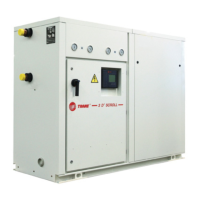
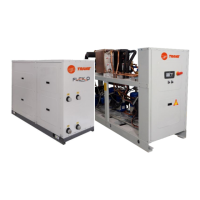
Procedure for inspecting units upon arrival and description of the chiller.
Explanation of the unit model number coding and available options.
Summary of installation responsibilities and general requirements for units.
Guidelines for unit location, foundation, ventilation, drainage, and rigging procedures.
Detailed procedures for safely lifting 20-50 ton and 60-ton units.
Methods for unit mounting, isolation, and leveling to reduce vibration.
Recommendations for evaporator, condenser, and general water piping systems.
Adjusting setpoints for operation at low ambient or low leaving water temperatures.
Guidelines for selecting and installing refrigerant piping for CCAF units.
Electrical installation must comply with NEC, local codes, and use copper conductors.
Instructions for connecting the main power supply and unit wiring.
Ensuring correct electrical phase sequence for scroll compressor rotation.
Requirements for voltage supply and allowable phase imbalance.
Operation of flow switches, pump controls, and programmable relays.
Connecting external signals for operation, sensors, setpoints, and BAS communication.
Control logic for condenser fans based on ambient temperature and load.
Schematic representation of the 20-30 and 40-60 ton system configurations.
Components and communication architecture of the CH530 control system.
Description of the DynaView and TechView interfaces for chiller control.
Using touch screen functions, buttons, and display screens for operation.
Enabling lockout feature and overview of the main screen dashboard.
Explanation of various chiller and circuit level operating modes.
Selecting reports and adjusting chiller settings via the interface.
Accessing and interpreting active diagnostics and their severity.
Using TechView for service and downloading software.
Explanation of diagnostic severity, persistence, criteria, and reset levels.
Diagnoses for loss of communication with system components.
Diagnoses related to sensor failures or input signal issues.
Diagnoses indicating issues with water flow detection.
Diagnoses for abnormal temperature or pressure readings.
Diagnoses related to compressor overload or motor issues.
Comprehensive checklist to ensure the unit is ready for operation.
Verifying stable operation and completing checkout procedures after start-up.
Measuring and adjusting superheat and subcooling for optimal performance.
Procedures for normal and extended unit shutdown and system restart.
Procedure to safely restart the system after an extended period of inactivity.
Recommended intervals and procedures for periodic, weekly, monthly, and annual maintenance.
Methods for cleaning condenser/evaporator tubes and water treatment importance.
Using the chiller log and accessing settings for recording and configuration.
Detailed electrical schematics for the CGWF/CCAF units.
Diagrams showing component locations, field wiring, and layout.

 To Next Page

 General