
 Need help?
Do you have a question about the Trane SRUB and is the answer not in the manual?
Unit delivery inspection and damage reporting procedures.
Inspecting unit for shipping damage and verifying nameplate data.
Verification steps for proper installation procedures.
Guidelines for safe unit lifting and movement.
Factors for proper unit placement and environmental setup.
Important safety and handling notes for refrigerants.
Step-by-step guide for charging and evacuating refrigerant.
Importance of correct phase sequence for compressor operation and longevity.
Steps to identify and rectify incorrect phase rotation.
Requirements for unit power supply voltage and tolerances.
Voltage imbalance effects on motor life and allowable limits.
Pre-operational checks and sequence for initial unit activation.
Guidelines for unit operation and seasonal startup procedures.
Routine checks performed weekly for optimal performance.
Tasks to be performed monthly for unit upkeep.
Maintenance tasks to be performed every six months.
Comprehensive maintenance procedures performed annually.
Procedures for cleaning, inspecting, and replacing belts.
Fan and motor alignment, tension, and rotation checks.
Instructions for cleaning coils and external surfaces for performance.
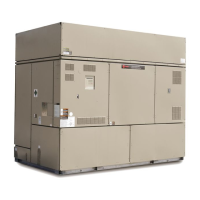
This document provides installation, operation, and maintenance instructions for Trane Air-Cooled Self-Contained Air Conditioners, specifically the SRUB Model 50Hz, ranging from 7.5 to 20 tons. These units are designed for efficient cooling in various applications, offering both single and dual compressor configurations to suit different capacity requirements. The manual emphasizes proper installation and regular maintenance to ensure optimal performance, reliability, and longevity of the equipment.
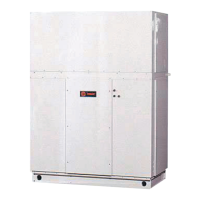
The Trane SRUB Air-Cooled Self-Contained Air Conditioner is a packaged unit designed to provide cooling by circulating refrigerant through a closed system. It integrates all major components—compressors, condenser coils, evaporator coils, and fans—within a single cabinet, making it a self-contained solution for air conditioning needs. The unit operates on a 50Hz power supply and is available in various nominal gross cooling capacities, from 85 MBh to 250 MBh.
The cooling process begins with the evaporator coil, where warm return air from the conditioned space passes over the coil, transferring its heat to the refrigerant. The cooled air is then supplied back into the building. The refrigerant, now in a gaseous state, is compressed by scroll compressors, increasing its temperature and pressure. It then moves to the condenser coil, where heat is rejected to the ambient air, facilitated by the condenser fans. The refrigerant condenses back into a liquid and flows through an expansion device before returning to the evaporator, completing the cycle.
The SRUB models offer flexibility in application with different arrangements for air supply and return, including units located inside or remote from the equipment room, and options for using the equipment room as a return air plenum. This adaptability allows for integration into diverse building layouts and HVAC system designs. The units are equipped with either single or dual scroll compressors, providing staged cooling capacity and improved efficiency, especially in dual compressor models where partial load operation can be optimized.
Electrical characteristics are crucial for proper operation, with units designed for 380-415V, 3-phase, 50Hz power. The control system manages the operation of compressors, fans, and other components to maintain desired temperature settings and ensure safe operation. Safety features include internal overload protection for compressors and high/low pressure switches to prevent damage from abnormal operating conditions.
The Trane SRUB Air-Cooled Self-Contained Air Conditioner is designed for straightforward operation once properly installed. The unit's self-contained nature simplifies integration into a building's HVAC system, requiring connections for supply air, return air, and electrical power.
For initial startup, several checks are recommended to ensure the unit is ready for operation. These include verifying the removal of shipping spacers from the compressor base, ensuring sufficient cooling load is available (at least 50% design load), and confirming that ductwork is securely connected with flexible duct connectors that are loose to prevent strain. It's also important to check that balancing dampers are open, fan belts are in good condition and tensioned correctly, and compressor oil is visible in the sight glass. Electrical checks involve verifying voltage at compressor terminals and ensuring voltage imbalance is within the maximum allowable 2% phase-to-phase.
To start the unit, the power switch is turned on, and the fan's direction of rotation is checked. The thermostat (field supplied) is then set to the "cool" position. The unit will begin its cooling cycle, and the system's operation can be monitored.
Seasonal startup procedures involve a more comprehensive review, including performing annual maintenance tasks, testing the entire refrigerant system for leaks, and checking the operation of all interlocked equipment. After the system stabilizes (typically 15-20 minutes), the compressor oil level and system operating pressures should be checked. Observing the refrigerant flow through the sight-glass is also important; the appearance of bubbles may indicate a leak, requiring further investigation. Adequate subcooling should also be verified.
The unit's design, with options for various factory-installed arrangements, allows for flexible integration into different building configurations. For instance, units can be installed inside an equipment room with ducted return and supply air, or remotely with condenser air supply and return ducted to the outside. Some arrangements allow the equipment room to serve as a return air plenum, simplifying ductwork.
The control panel, typically located on the unit, provides access for electrical connections and diagnostic checks. The manual includes detailed wiring diagrams for single and dual compressor models, which are essential for electrical installation and troubleshooting. Proper electrical phasing is critical for scroll compressors, and a phase sequence indicator is recommended to confirm correct ABC phasing, ensuring the compressor rotates in the intended direction. Incorrect phasing can lead to reduced performance and potential damage to the compressor.
Effective maintenance is crucial for the long-term performance and reliability of the Trane SRUB Air-Cooled Self-Contained Air Conditioner. The manual outlines a comprehensive maintenance schedule, including weekly, monthly, six-month, and annual tasks. A key warning emphasized throughout the manual is to always disconnect and lock out electrical power before performing any service or inspection to prevent injury or death from electric shock or contact with moving parts.
Weekly Maintenance:
Monthly Maintenance:
Six-Month Interval:
Annual Maintenance:
Fan Drive Maintenance:
Coil Fins and External Surface Cleaning:
The manual also specifies required unit service envelopes, which are minimum space requirements around the unit for proper service access. These envelopes account for general maintenance, removal of fans, fan motors, and compressor servicing, and cleaning of condenser tubes. The clearance on the control panel side is for general servicing and may not meet local electrical codes.
 General
| Refrigerant | R-410A |
|---|---|
| Phase | 1 |
| Product Type | Split System Air Conditioner |
| Voltage | 208-230V |
| Dimensions | Varies by model |
| Weight | Varies by model |

 To Next Page