Need help?
Do you have a question about the Trane YCX024G1L-M and is the answer not in the manual?
This document outlines the installation, operation, and maintenance procedures for a Single Package Gas/Electric 12 SEER Convertible unit, designed for 2 to 5-ton applications. It emphasizes adherence to national, state, and local codes throughout all phases of installation.
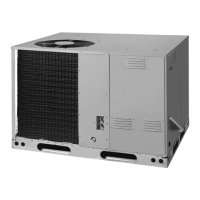
The YCX-G heating/cooling units are engineered for outdoor mounting with a vertical condenser discharge, suitable for ground-level or rooftop installation. These units are designed exclusively for outdoor operation, eliminating the need for additional flue venting systems. Each unit is shipped with an operating charge of Refrigerant-22 and is configured for natural gas use from the factory. The system provides both heating and cooling functions, controlled by a room thermostat. In cooling mode, the compressor, outdoor fan motor, and indoor fan motor operate to maintain the desired temperature. In heating mode, a solid-state ignition control lights the burners when the thermostat calls for heat, with the combustion blower, gas valve, and indoor blower motor engaging in sequence. Safety sequences and limit controls are integrated to protect against overheating, flame rollout, and gas interruptions, ensuring safe and reliable operation.
The unit is designed for flexible installation, accommodating both horizontal airflow and downflow applications with appropriate ductwork and mounting. For horizontal airflow, units can be installed directly on wood flooring or Class A, B, or C roof covering material, ensuring unrestricted discharge air from condenser fans for at least 3 feet above the unit. For downflow applications, a roof mounting curb (such as BAYCURB030,038,033,034A) or a field-fabricated curb is required, providing a level mounting surface on the roof. The unit is shipped for horizontal installation and can be converted to downflow by repositioning the supply and return air covers.
Proper clearances are crucial for optimal performance and serviceability, with specific recommendations for the back, left, right, and front sides, as well as clearance to combustible materials. The unit incorporates an economizer/filter access panel, and filters are to be installed in the return air system, either within an optional filter frame accessory or a field-installed filter rack. Electrical connections must comply with local and national codes, with proper grounding essential for ignitor operation. A weatherproof disconnect switch should be provided, and branch circuits must be protected as indicated on the unit rating plate. Low voltage control wiring for the thermostat should be routed carefully to avoid interference with power wiring and to prevent voltage drop, ensuring proper control functionality.
The unit's operation is managed by a room thermostat, which controls the heating or cooling cycles and can provide continuous evaporator fan operation. Before starting the compressor, the crankcase heater should be energized for eight hours to vaporize any liquid refrigerant, preventing potential damage. Gas piping installation requires careful attention to line pressure, with a pressure regulator needed if the supply pressure is excessive. A drip leg is required in the gas supply line to collect sediment, and the piping must be tested for leaks using a soap and water solution. Manifold pressure adjustments are made via a screw on the gas valve to ensure the correct gas flow rate. For high altitude installations (2000-4500 feet elevation), burner orifices must be changed to noted sizes.
Routine maintenance is crucial for the safe and efficient operation of the unit. Owners can perform several periodic tasks, including replacing disposable air filters or cleaning permanent ones. Filters should be checked weekly in new homes for the first four weeks and regularly thereafter. The condenser coil should be cleaned periodically by stroking its surface with a soft-bristled brush to remove dust and dirt, and vegetation should be kept clear from the coil area.
Serviceman-performed maintenance is recommended at least once a year, ideally at the beginning of each cooling and heating season. During the cooling season, a qualified serviceman should inspect and service filters, motors and drive system components, economizer gaskets, safety controls, electrical components and wiring, condensate drain, unit duct connections, unit mounting support, and the unit for any obvious deterioration.
For the heating season, inspections include verifying unobstructed airflow for combustion and condenser coil, checking control panel wiring for tight connections and intact insulation, and testing the gas ignition system. Burners and burner ports should be visually inspected for deposit buildup and corrosion, cleaned with a dry cloth, and replaced if excessive buildup or corrosion is present. Flue cleaning is also a critical maintenance task, involving the removal of the flue cap, access panels, combustion blower assembly, flue box, and restrictors to clean soot and rust deposits. All gaskets should be replaced with new ones, and damaged turbulators should be replaced. After reassembly, all gas line connections must be leak-tested, and the unit's electrical wiring checked for correct installation. The unit should not be operated without the evaporator fan access panel properly installed to prevent personal injury or death.
 General
| Model Number | YCX024G1L-M |
|---|---|
| Category | Heating System |
| Heating Capacity | 24, 000 BTU/H |
| Hertz | 60 Hz |
| Stages | 1 |
| Phase | 1 |
| Warranty | Limited Warranty |

 To Next Page