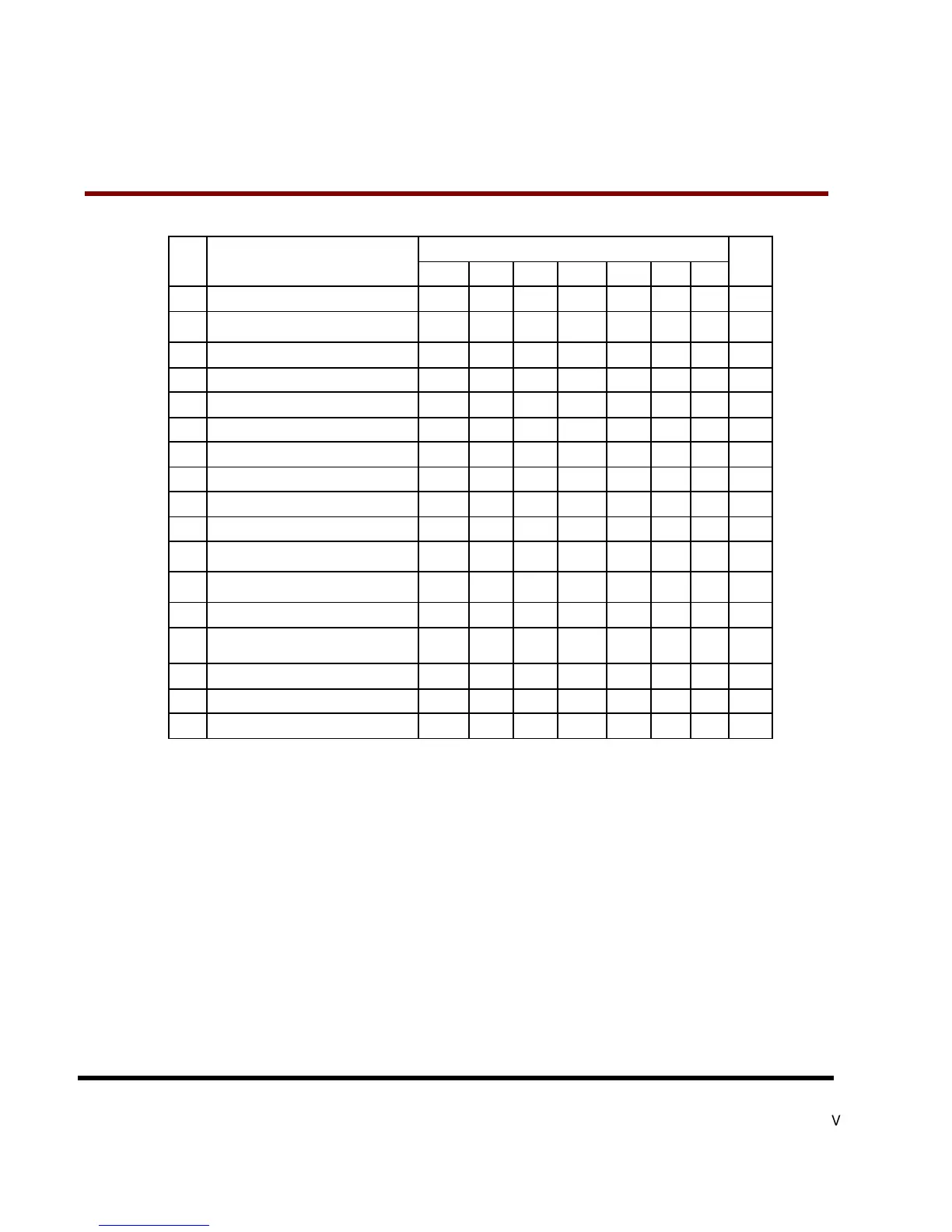
Notes: All timings are in nanoseconds. The maximum load on -IOCS16 is 1 LSTTL with a 50 pF (40pF below 120nsec Cycle Time) total load.
All times are in nanoseconds. Minimum time from -IORDY high to -HIOE high is 0 nsec, but minimum -HIOE width shall still be met.
1) t0 is the minimum total cycle time, t2 is the minimum command active time, and t2i is the minimum command recovery time or
command inactive time. The actual cycle time equals the sum of the actual command active time and the actual command inactive
time. The three timing requirements of t0, t2, and t2i shall be met. The minimum total cycle time requirement is greater than the
sum of t2 and t2i. This means a host implementation can lengthen either or both t2 or t2i to ensure that t0 is equal to or greater than
the value reported in the device’s identify device data. A CompactFlash Storage Card implementation shall support any legal host
implementation.
2) This parameter specifies the time from the negation edge of -HIOE to the time that the data bus is no longer driven by the
CompactFlash Storage Card (tri-state).
3) The delay from the activation of -HIOE or -HIOW until the state of IORDY is first sampled. If IORDY is inactive then the host shall
wait until IORDY is active before the PIO cycle can be completed. If the CompactFlash Storage Card is not driving IORDY negated
at tA after the activation of -HIOE or -HIOW, then t5 shall be met and tRD is not applicable. If the CompactFlash Storage Card is
driving IORDY negated at the time tA after the activation of -HIOE or -HIOW, then tRD shall be met and t5 is not applicable.
4) t7 and t8 apply only to modes 0, 1 and 2. For other modes, this signal is not valid.
5) IORDY is not supported in this mode.


 To Next Page
 Loading...