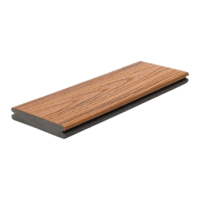
The Trex RainEscape Deck Drainage System is designed to create a dry, usable space beneath an elevated deck, protecting it from rain, sun, and other elements. This system directs water away from the deck and into a drainage system, effectively expanding outdoor living space.
Function Description:
The core function of the Trex RainEscape system is to channel water that falls through the deck boards into a gutter system, preventing it from reaching the area below. This is achieved through a series of troughs and downspouts installed between the deck joists. The troughs are designed with a smooth, shiny side facing up to facilitate water flow and are installed with a slight pitch (1/4" fall per foot) to ensure proper drainage towards the downspouts. Water is then directed into a standard gutter system (not included) that collects and diverts it away from the deck structure. The system is particularly beneficial for elevated decks, allowing homeowners to create a dry patio, storage area, or additional living space underneath.
Usage Features:
The Trex RainEscape system is primarily installed on elevated decks, ideally during new construction, though it can be installed on existing decks by removing the deck boards. Installation is more easily accomplished with two people.
Key components include:
- Downspouts: These are cut to size based on joist spacing (12" or 16" center) and installed along the rim joist or ledger board. They should extend about 1" into the gutter for effective water collection.
- Troughs: Made of a durable material, these are unrolled and stapled to the joists, forming a channel for water. They are installed with the smooth/shiny side facing up. A soft crease can be folded down the center of the trough to ease installation, especially for 12" joist bays where an offset is needed. The trough material must cover all exposed wood on the deck surface.
- Flashing: Three types of flashing methods are described: with flashing, no flashing with brick or stucco (caulking method), and flashing with brick or stucco (cutting into mortar joint). When using flashing, butyl caulk is applied at the ledger board and between the flashing and trough, and then taped over.
- Tape: Trex RainEscape butyl tape (4" wide) is used to seal all seams, joints, and the perimeter, ensuring a watertight seal. It works off compression and must be pinched between decking and joist. Double-sided tape (2.5" wide) is also used in steel joist installations.
- Wall Flash: A self-adhesive wall flash is cut to the width of the deck and adhered to the edge of the decking, then compressed by the first deck board.
- Fascia: Deck boards go over the fascia, which is installed with butyl caulk.
- Gutter System: A standard gutter system (not included) is attached to collect water from the Trex RainEscape downspouts. An access panel (2x4 or 2x6) is suggested for checking the gutter line.
The manual also covers modifications and special cases:
- Single Picture Frame or Breaker Board: Horizontal nailers are placed flush with the top of the joist, covered with trough material, and all seams are taped.
- Double or Triple Picture Frame (2x4 Shims): Trex RainEscape is installed as usual, then 2x4 pressure-treated shim blocking is screwed on top of the system over the joists to support deck boards. Fasteners should not penetrate through the shim and puncture the trough material where it's not taped or sealed.
- Double or Triple Picture Frame (Ladder Box): This method involves placing 11" blocking horizontally on the ends of the bay and installing a 2x4 ladder box to support downspouts. Trough material covers the blocking, and downspouts are placed into the ladder box without removing their openings.
- Cantilevered Downspout: The front panel of the downspout is torn off, and a line is drawn on the back side to cut the downspout for extension. Trough material is stapled from the end of the cantilever over the existing trough.
- Obstructions & Posts: For posts or obstructions on the inside rim joist, the trough is marked and cut diagonally. Tabs are pulled up, the post is installed, and remaining trough is stapled. Tape is wrapped around the post, overlapping layers to create a watertight seal.
- 4x4 Post Flash: This specialized flash is used for 4x4 posts. Butyl caulk is applied around the post, the flash is slid down, and flanges are taped to the trough and the post.
- Surface Mount Post: Pre-drilled holes are used with a small amount of butyl caulk on screw threads to seal holes. Stainless steel barrier strips are inserted under mounting bolt holes if attaching directly to pressure-treated framing.
- Trough Over a Double or Triple Beam: Butyl caulk is applied between beams, and trough material covers the top of the beam, overlapping into adjacent bays. Tape seals seams and areas of screw penetration.
- Modified Downspouts: For odd joist spacing, downspouts can be modified by tearing or cutting out the front opening and cutting through the back to fit the bay.
- Double Extended Decks (over 19'): Downspouts are placed on opposite ends from where the existing deck and extension meet, and troughs are installed from the blocking of the extension to the downspout.
- Running Wires or Obstructions Through Trough or Downspout: Wires can penetrate the trough by poking a hole large enough for the wire, ensuring it's at the highest point of the trough and near a joist for connection. Butyl caulk and tape are used to seal around the wire.
- Low Profile Can Lights: When installing these lights below the trough, ensure they do not contact the trough material.
- Deck Step Installation: Downspouts and troughs are installed on the lower deck, then trough material is installed from the lower deck up the stair tread to the upper deck, overlapping materials.
- Steel Joist System Installation: This method requires two people. Mid-span blocking is installed. Instead of staples, 3-4" strips of Trex butyl tape hold downspouts to deck joists, and trough material is attached with tape in the same pattern as wood joists. Double-sided tape strips (3"-6") are placed along joists and perimeter, staggered on the second layer of trough to keep it flush.
Maintenance Features:
The Trex RainEscape system is designed for low maintenance.
- Snow Build-up: Snow will sit on the decking until it melts, then it will run through the system.
- Leaves and Debris: If leaves and debris accumulate in the troughs, a standard washing or a hard rain will clean out the system.
- Cleaning: The system is designed to be self-cleaning for most small debris. For any larger build-up, a 2x4 access panel can be used to clear the gutter line.
- Troubleshooting: If the tape does not stick in certain areas (e.g., perimeter, brick, stucco), Trex RainEscape butyl caulk can be used to adhere the material. If trough material is spliced, it must be replaced.
- Water Testing: Before installing a gutter system, a water test should be performed to clean out the system and check for any leaks.
- Temperature Swings: Trough material will expand and contract with extreme temperature swings. Some wrinkling is acceptable as long as it does not impede water flow.
The system is made with durable poly and ultra-violet inhibitors to protect it from sun, snow, and rain. The manufacturer provides a 20-year warranty, covering defects in material and manufacture, and ensuring the system will not leak if installed and maintained according to instructions.

 Need help?
 General

 To Next Page