RUNNING ADJUSTMENTS-Engine
A
new gasket must be fitted each time the cylinder head is removed.
The plain side of the gasket must be downwards against the cylinder
block and should be coated on both sides
with
cc
WELLSEAL" or
similar non-setting sealing compound.
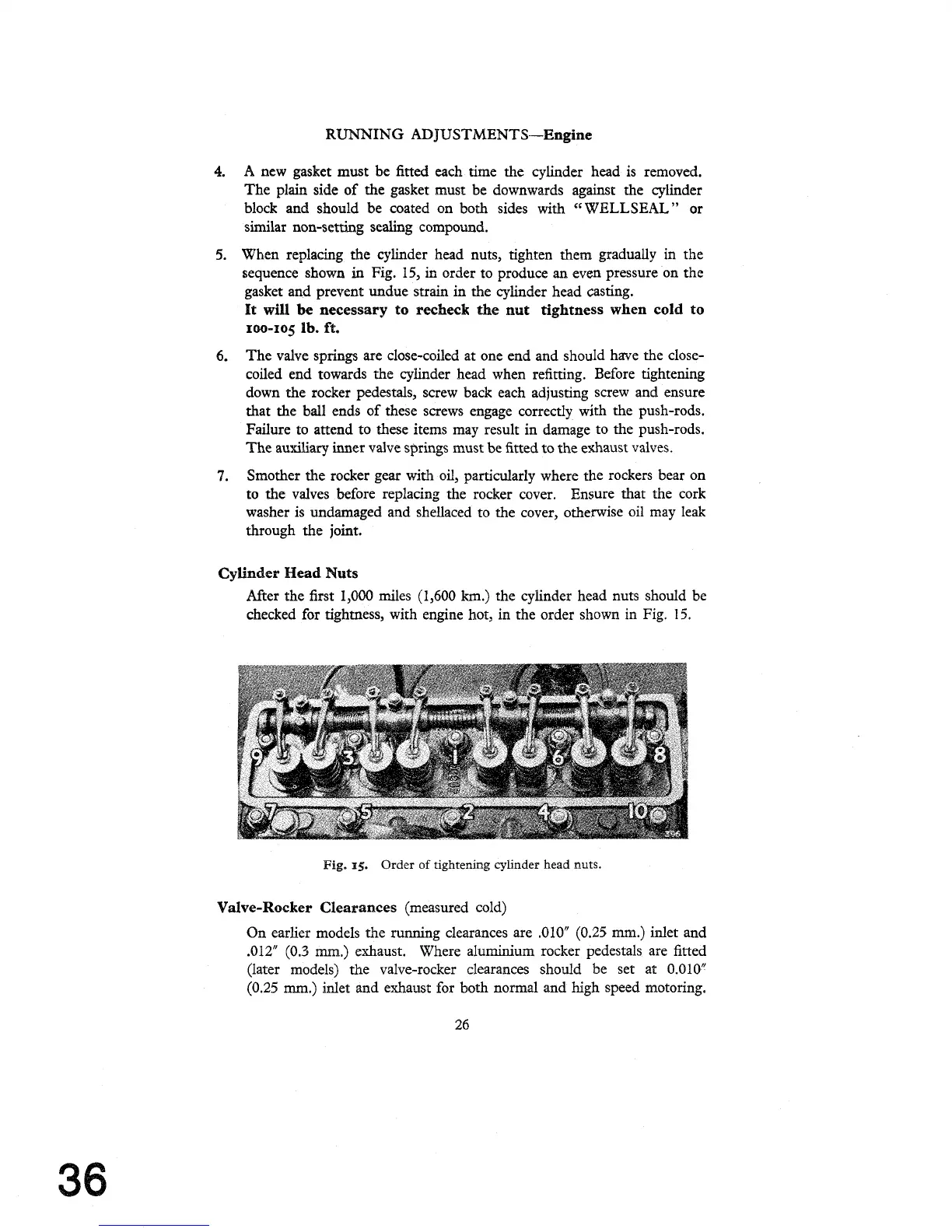
When replacing the cylinder head nuts, tighten them gradually in the
sequence shown in Fig.
15,
in
order to produce
an
even pressure on the
gasket and prevent undue strain in the cylinder head casting.
It
will
be necessary to
recheck
the nut tightness when cold to
loo-105
lb.
ft.
The valve springs are close-coiled at one end and should have the close-
coiled end towards the cylinder head when refitting. Before tightening
down the rocker
pedestals, screw back each adjusting screw and ensure
that the ball ends of these screws engage correctly with the push-rods.
Failure to attend to these items may result in damage to the push-rods.
The
adary her valve springs must
be fitted to the exhaust valves.
Smother the rocker gear with oil, particularly where the rockers bear on
to
the valves before replacing the rocker cover. Ensure that the cork
washer is undamaged and
shellaced to the cover, otherwise oil may leak
through the joint.
After the first 1,000 miles (1,600
km.) the cylinder head nuts should be
checked for tightness, with engine hot, in the order shown in Fig.
15.
Fig.
15.
Order
of
tightening cylinder
head
nuts.
Valve-Rocker Clearances (measured cold)
On
earlier models the running clearances are .010" (0.25 mm.) inlet and
.012" (0.3
mm.) exhaust. Where aluminium rocker pedestals are fitted
(later models) the valve-rocker clearances should be set at 0.010"
(0.25
mm.) inlet and exhaust for both normal and high speed motoring.



 To Next Page