Qperation
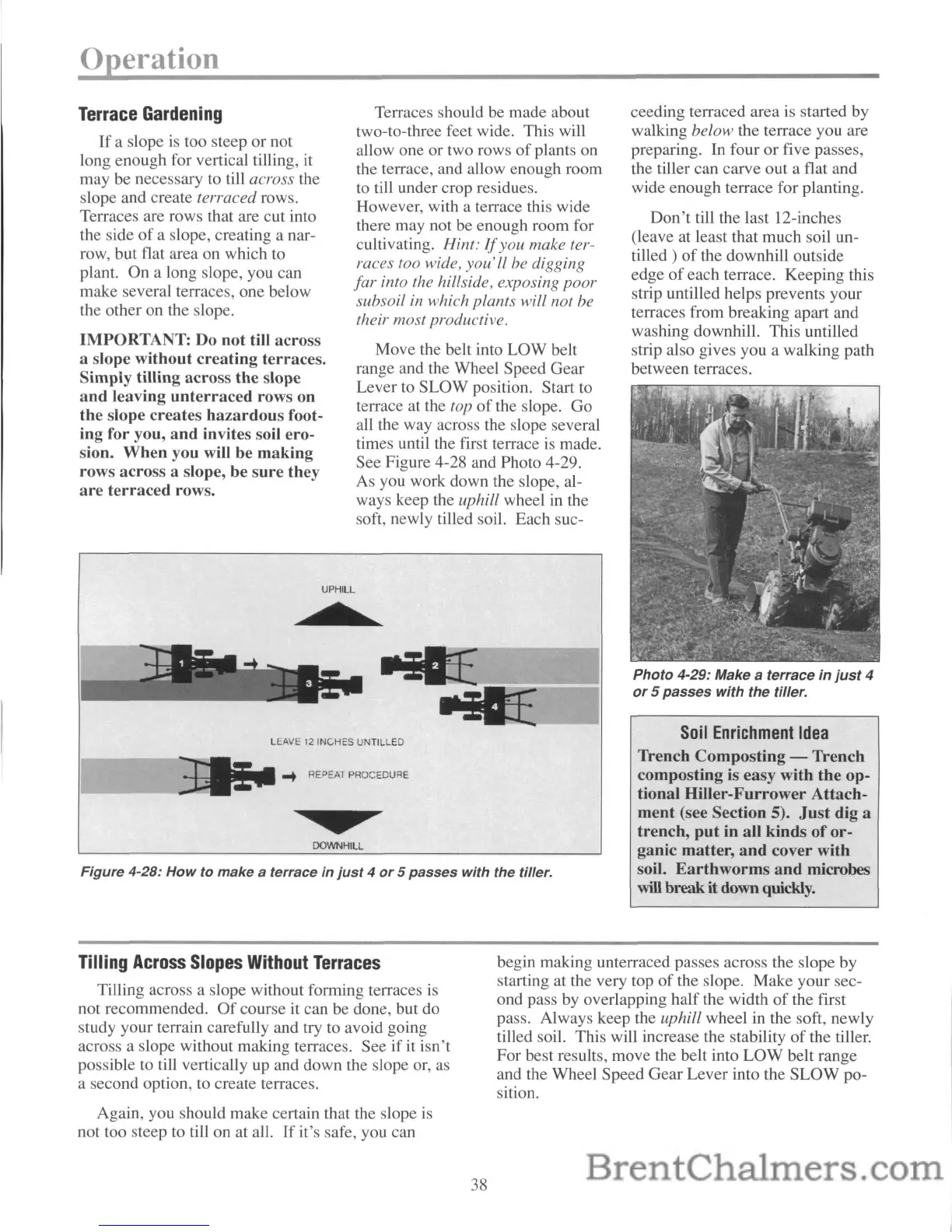
Photo 4-29: Make a terrace
in
just
4
or
5
passes
with the tiller.
Soil
Enrichment
Idea
Trench Composting - Trench
composting is easy with the op-
tional Hiller-Furrower Attach-
ment (see Section 5).
Just
dig a
trench,
put
in all kinds
of
or-
ganic matter,
and
cover with
soil.
Earthworms
and
microbes
will
break
itdown quickly.
ceeding terraced area is started by
walking
below the terrace you are
preparing. In four
or
five passes,
the tiller can carve out a flat and
wide enough terrace for planting.
Don't
till the last 12-inches
(leave at least that much soil un-
tilled)
of
the downhill outside
edge
of
each terrace. Keeping this
strip untilled helps prevents your
terraces from breaking apart and
washing downhill. This untilled
strip also gives you a walking path
between terraces.
Terraces should be made about
two-to-three feet wide. This will
allow one
or
two rows
of
plants on
the terrace, and allow enough room
to till under crop residues.
However, with a terrace this wide
there may not be enough room for
cultivating.
Hint:
If
you make ter-
races too wide, you'll be digging
far
into the hillside, exposing
poor
subsoil
in
which plants will not be
their mostproductive.
Move the belt into
LOW
belt
range and the Wheel Speed Gear
Lever to
SLOW
position. Start to
terrace at the
top
of
the slope. Go
all the way across the slope several
times until the first terrace is made.
See Figure 4-28 and Photo 4-29.
As you work down the slope, al-
ways keep the
uphill wheel in the
soft, newly tilled soil. Each suc-
..
REPEAT PROCEDURE
LEAVE
12
INCHES UNTILLED
DOWNHILL
UPHILL
Figure 4-28:
How
to
make a terrace
in
just
4
or
5
passes
with the tiller.
Terrace
Gardening
If
a slope
is
too steep or not
long enough for vertical tilling, it
may be necessary to till
across the
slope and create
terraced rows.
Terraces are rows that are cut into
the side
of
a slope, creating a nar-
row, but flat area on which to
plant. On a long slope, you can
make several terraces, one below
the other on the slope.
IMPORTANT: Do not till across
a slope without creating terraces.
Simply tilling across
the
slope
and
leaving
unterraced
rows on
the slope creates hazardous foot-
ing for you,
and
invites soil ero-
sion. When you will be making
rows across a slope, be sure they
are
terraced
rows.
Tilling
Across
Slopes
Without
Terraces
Tilling across a slope without forming terraces
is
not recommended.
Of
course it can be done, but do
study your terrain carefully and try to avoid going
across a slope without making terraces. See if it
isn't
possible to
ti.ll
vertically up and down the slope or, as
a second optIOn, to create terraces.
Again, you should make certain that the slope is
not too steep to till on at all.
If
it's safe, you can
begi~
making unterraced passes across the slope by
startmg at the very top
of
the slope.
Make
your sec-
ond pass by overlapping half the width
of
the first
~ass.
A~ways
.kee~
t~e
uphill wheel in the soft, newly
tilled soIl.
ThIS
WIll
mcrease the stability
of
the tiller.
For best results, move the belt into
LOW
belt range
a??
the Wheel Speed Gear Lever into the
SLOW
po-
sitIOn.
38


 To Next Page
 Loading...