WARNING
To
help
avoid
personal
injury,
be
sure
the
battery
vent
tube
is not crimped
or
pinched
anyWhere
along its length.
Improper
venting
could
result
in
an
explosion
of
battery
gases.
DANGER
•
While
the
battery
is
being
charged,
do
not
leave
it
unat-
tended.
Charging
time
does
not
have
to
be
continuous.
•
Carefully
follow all
charg-
ing
instructions
and
safety
rules
provided
by
the
manu-
facturer
of
the charging
equipment.
• Never attempt
to
"jump
start"
the
battery
with
an
au-
tomobile
battery
or
its
charg-
ing
system.
This
could
result
in
serious
personal
injury
or
property
damage
from
causes
such
as
a
battery
explosion,
or
acid
or
electrical
burns.
jelly or silicone grease to prevent
further corrosion.
3. Periodically check entire elec-
trical system for loose connections
or loose hardware.
4. Check hardware securing the
battery holddown clamp. It should
be secure, but not overly tight.
5. Check the vent tube. It must
not be crimped or bent.
B.
Battery
Care
in
Storage
Your engine has a recharging
circuit that will properly maintain
the battery's state
of
charge during
the normal tilling season.
However, prior
to
storing your
tiller away during the off-season,
we recommend the battery be fully
charged. At the end
of
the storage
period, the battery should be
recharged again.
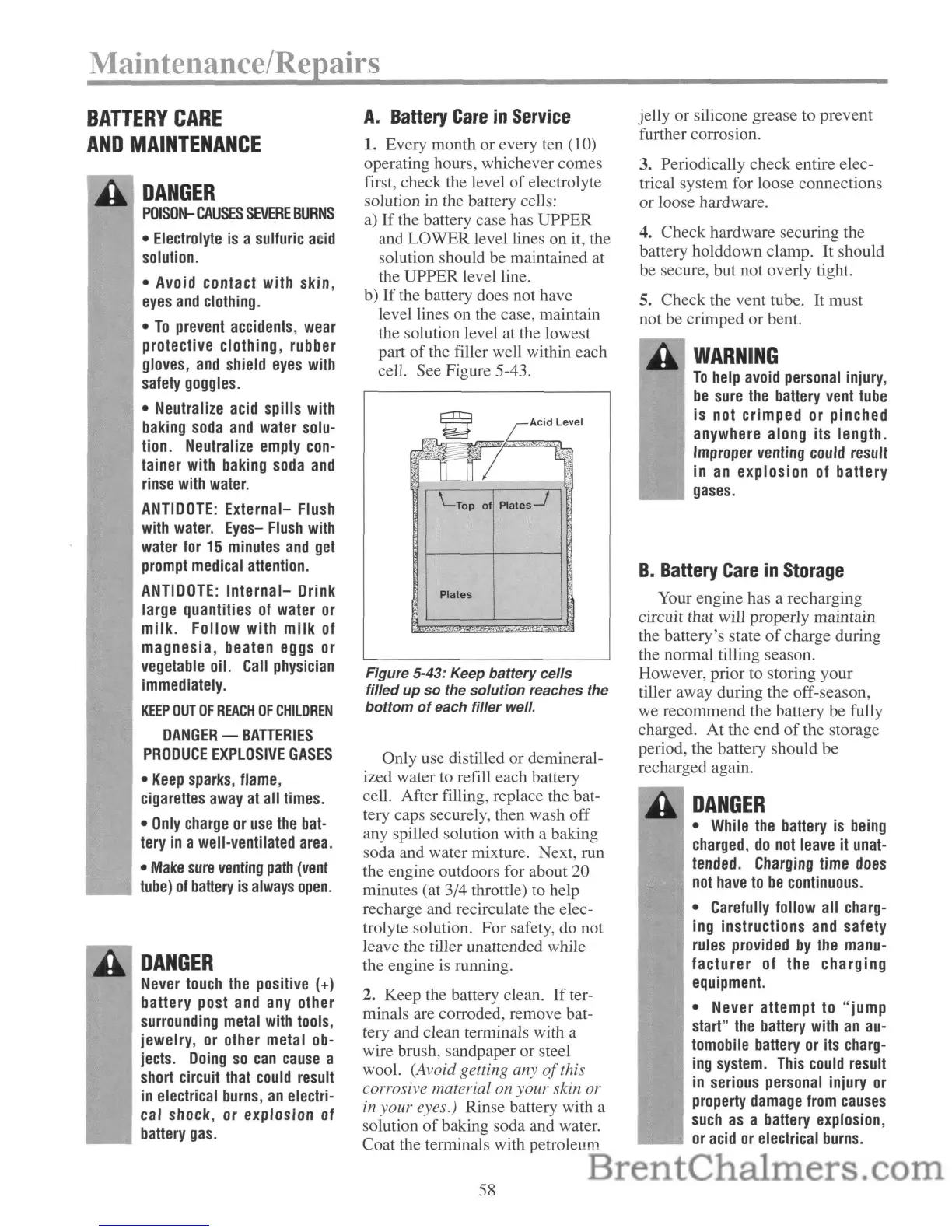
Plates
Figure 5-43: Keep battery
cells
filled
up
so
the
solution
reaches the
bottom
of
each filler well.
A.
Battery
Care
in
Service
1. Every month or every ten (10)
operating hours, whichever comes
first, check the level
of
electrolyte
solution in the battery cells:
a)
If
the battery case has UPPER
and LOWER level lines on it, the
solution should be maintained at
the UPPER level line.
b)
If
the battery does not have
level lines on the case, maintain
the solution level at the lowest
part
of
the filler well within each
cell. See Figure
5-43.
Only use distilled or demineral-
ized water to refill each battery
cell. After filling, replace the bat-
tery caps securely, then wash off
any spilled solution with a baking
soda and water mixture. Next, run
the engine outdoors for about 20
minutes (at 3/4 throttle) to help
recharge and recirculate the elec-
trolyte solution. For safety, do not
leave the tiller unattended while
the engine is running.
2. Keep the battery clean.
If
ter-
minals are corroded, remove bat-
tery and clean terminals with a
wire brush, sandpaper or steel
wool.
(Avoid getting any
of
this
corrosive material on your skin or
in your eyes.) Rinse battery with a
solution
of
baking soda and water.
Coat the terminals with petroleum
DANGER
Never
touch
the
positive (+)
battery post
and
any
other
surrounding
metal
with
tools,
jewelry,
or
other metal
ob-
jects.
Doing
so
can
cause
a
short
circuit
that
could
result
in
electrical
burns,
an
electri-
cal shock,
or
explosion
of
battery
gas.
DANGER
POISON-
CAUSES
SEVERE
BURNS
•
Electrolyte
is
a sulfuric
acid
solution.
• Avoid contact with skin,
eyes
and
clothing.
•
To
prevent
accidents,
wear
protective clothing, rubber
gloves,
and
shield
eyes
with
safety
goggles.
• Neutralize
acid
spills
with
baking
soda
and
water
solu-
tion.
Neutralize
empty
con-
tainer with
baking
soda
and
rinse
with
water.
ANTIDOTE:
External-
Flush
with
water.
Eyes-
Flush
with
water
for
15
minutes
and
get
prompt
medical
attention.
ANTIDOTE:
Internal- Drink
large quantities
of
water
or
milk. Follow with milk
of
magnesia, beaten
eggs
or
vegetable
oil.
Call
physician
immediately.
KEEP
OUT
OF
REACH
OF
CHILDREN
DANGER
-
BATTERIES
PRODUCE
EXPLOSIVE
GASES
•
Keep
sparks,
flame,
cigarettes
away
at
all
times.
•
Only
charge
or
use
the
bat-
tery
in
awell-ventilated
area.
•
Make
sure
venting
path
(vent
tUbe)
of
battery
is
always
open.
Maintenance/Repairs
--------------
BATTERY
CARE
AND
MAINTENANCE
58


 To Next Page
 Loading...