EasyManua.ls Logo

Troy-Bilt 12097 - ENGINE OPERATION AND TECHNIQUES; Starting and Stopping the Engine; Basic Operation and Tilling Techniques

Troy-Bilt 12097
24 pages
Print Icon
To Next Page IconTo Next Page
To Previous Page IconTo Previous Page
Loading...
OPERATION
STOPPING
AND
STARTING
THE
ENGINE
ik
WARNING
Do
not
touch
Engine
Throttle
Lever
while
starting
the
engine.
Tines
may
propel
the
machine
forward
if
the
engine
speed
is
advanced
from
idle.
Failure
to
comply
can
result
in
personal
injury
or
property
damage.
Stopping
the
Engine
To
stop
the
engine,
move
On-Off
Switch
to
OFF
position.
NOTE:
The
on-off
wire
must
always
be
securely
con¬
nected
at
both
ends.
Check
regularly
to
see
this
wire
is
firmly
attached
to
its
connecting
points.
Starting
the
Engine
Move
the
On-Off
Switch
to
the
ON
position.
Deter¬
mine
which
of
the
three
starting
conditions
described
next
applies
to
you:
Priming
When
First
Time
Starting:
Use
this
priming
method
to
start
a
new
engine
for
the
first
time,
after
running
out
of
gas,
or
after
extended
stor¬
age.
Prime
the
engine
using
High-Volume
priming.
See
Figure
8.
Use
thumb
and
forefinger
to
squeeze
side
of
primer
bulb
that
is
in
line
with
the
light-colored
rib
on
the
primer
body.
As
fuel
enters
the
priming
system,
the
priming
action
will
feel
more
firm.
Squeeze
the
primer
bulb
6
times.
This
process
removes
air
from
the
priming
system.
Priming
When
Cold
Starting:
To
prime
the
engine
after
it
has
been
sitting
idle
or
has
been
in
brief
storage
and
has
fuel
in
the
tank,
use
the
Standard
Volume
method
(Figure
8).
Push
in
top
of
primer
bulb
twice
if
above
55°F,
or
three
times
if
below
55°F.
When
Warm
Starting:
Do
not
use
the
primer
bulb
to
restart
the
engine
after
it
has
been
stopped
after
running,
still
has
fuel
in
the
tank,
and
has
not
cooled
completely.
Pull
Out
Starting
Rope:
After
priming
the
carburetor,
assume
the
starting
posi¬
tion,
keeping
your
feet
positioned
safely
away
from
the
tines.
See
Figure
11.
Start
the
engine
using
one
hand
to
pull
out
the
recoil
start
rope
while
the
other
hand
stabilizes
the
machine.
To
stabilize
the
machine,
put
one
hand
on
the
foam
part
of
the
upper
handlebar.
Use
your
other
hand
to
slowly
pull
out
the
recoil
start
rope
until
you
feel
resistance.
Let
the
rope
rewind.
Then,
with
a
quick
arm
motion,
pull
the
rope
all
the
way
out,
up
to
10
times.
Let
the
start
rope
rewind
slowly.
Allow
the
engine
to
warm
up
for
several
seconds.
If
engine
either
fails
to
start
or
to
continue
run¬
ning,
push
in
primer
bulb
two
times.
Grasp
start
rope
and
pull
with
a
rapid,
full
stroke,
up
to
10
times.
TROUBLESHOOTING:
Push
the
primer
bulb
in
2
more
times.
Using
a
rapid
full
stroke,
pull
out
the
starting
rope
up
to
10
times.
If
engine
still
does
not
start,
wait
15
min¬
utes.
Do
not
prime
engine
fur¬
ther.
Grasp
start
rope
and
pull
with
a
rapid,
full
stroke
up
to
10
times.
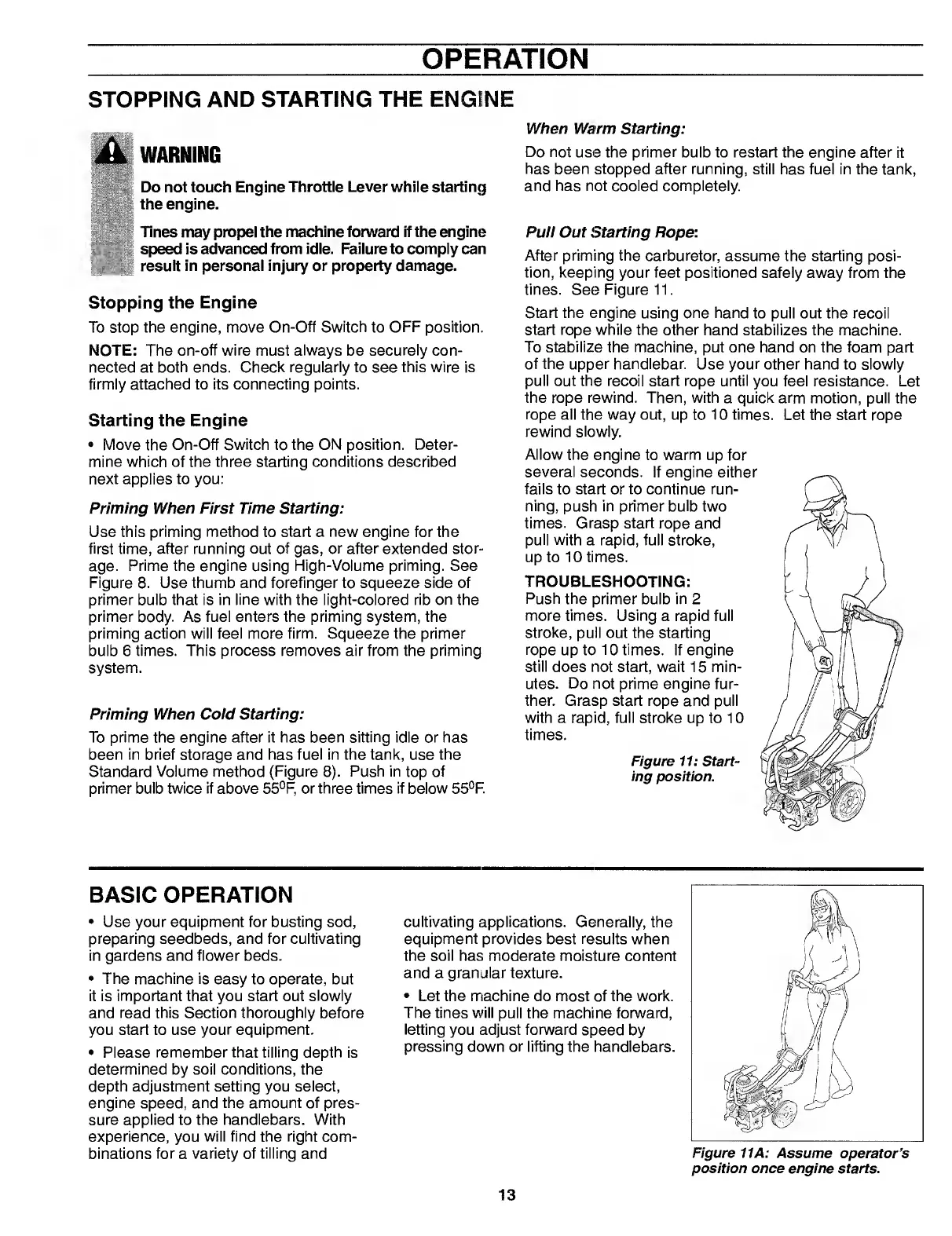
Figure
11:
Start¬
ing
position.
BASIC
OPERATION
Use
your
equipment
for
busting
sod,
preparing
seedbeds,
and
for
cultivating
in
gardens
and
flower
beds.
The
machine
is
easy
to
operate,
but
it
is
important
that
you
start
out
slowly
and
read
this
Section
thoroughly
before
you
start
to
use
your
equipment.
Please
remember
that
tilling
depth
is
determined
by
soil
conditions,
the
depth
adjustment
setting
you
select,
engine
speed,
and
the
amount
of
pres¬
sure
applied
to
the
handlebars.
With
experience,
you
will
find
the
right
com¬
binations
for
a
variety
of
tilling
and
cultivating
applications.
Generally,
the
equipment
provides
best
results
when
the
soil
has
moderate
moisture
content
and
a
granular
texture.
Let
the
machine
do
most
of
the
work.
The
tines
will
pull
the
machine
forward,
letting
you
adjust
forward
speed
by
pressing
down
or
lifting
the
handlebars.
Figure
11
A:
Assume
operator’s
position
once
engine
starts.
13

Other manuals for Troy-Bilt 12097

Related product manuals