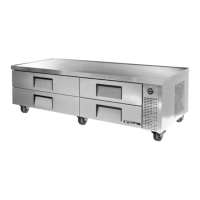
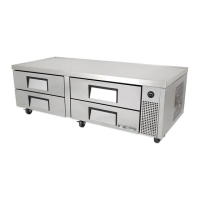
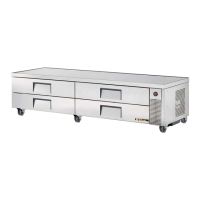
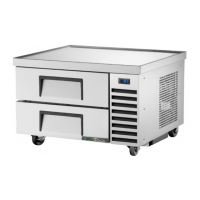
Need help?
Do you have a question about the True TRCB-52-60 and is the answer not in the manual?
Essential safety guidelines for operating the appliance.
Guidelines for safe electrical connections and unit disposal.
Instructions for unit ownership, uncrating, and electrical connection.
Reference chart for selecting appropriate wire gauges.
Procedures for positioning and leveling the unit for optimal performance.
Instructions for leveling units with castors on uneven floors.
Details about the standard accessories included with the unit.
Initial steps for starting the unit and using mechanical temperature controls.
Detailed sequence for mechanical temperature control operation.
Step-by-step guide to cleaning the condenser coil for efficient operation.
Overview of the LAE electronic control's operation and functions.
Instructions for operating the LAE electronic control, including lock/unlock.
Procedures for turning the LAE electronic control on and off.
Guide to adjusting the temperature set point on the LAE control.
Steps to manually start the defrost cycle using the LAE control.
Instructions for switching the display between Fahrenheit and Celsius.
Clarification that condenser cleaning is not a warrantable service.
Factors that can damage stainless steel's protective layer.
Guidance on appropriate cleaners for stainless steel and rust prevention.
Details of the 3-year parts and labor warranty.
Information on the extended compressor warranty and items not covered.
This document serves as an installation and operation manual for True Manufacturing Co., Inc.'s TRCB Chef Base Equipment, a line of commercial refrigerators designed for professional kitchen environments. The manual emphasizes proper installation, usage, and maintenance to ensure optimal performance and longevity of the unit.
The True TRCB Chef Base is a commercial refrigerator designed to store food products at controlled temperatures, typically around 35°F for refrigerators and -10°F for freezers, though these are factory-set and can be adjusted. Its primary function is to provide reliable refrigeration for culinary operations, often serving as a base for countertop cooking equipment. The unit is built with robust materials and quality controls to withstand the demands of a commercial kitchen. It incorporates a cooling system that utilizes refrigerants like R134a, R404a, or R-290 (hydrocarbon), with specific handling instructions provided for each type, especially R-290 due to its flammability. The refrigeration process is managed by either mechanical or electronic temperature controls, which regulate the compressor and evaporator fans to maintain the desired internal temperature and initiate defrost cycles. The design also considers ventilation and air circulation, which are critical for efficient operation and condensate removal.
The manual provides detailed instructions for the proper setup and operation of the TRCB Chef Base. Upon receiving the unit, users are advised to carefully inspect it for freight damage and follow uncrating procedures, including removing the outer packaging and the wooden skid. It is crucial to allow the cabinet to remain upright for 24 hours before plugging it into a power source to allow refrigerants to settle.
Connecting the unit to electricity requires adherence to strict safety guidelines. The appliance must be properly grounded, and users are explicitly warned against cutting or removing the ground prong from the power cord, using adapter plugs (unless UL listed and properly grounded), or extension cords, as these can void the warranty and pose safety hazards. The unit should be plugged into its own individual electrical circuit with a voltage rating matching the rating plate to prevent overloading and fire hazards.
Leveling the unit is another critical step for optimal operation, especially for non-mobile models, as it affects condensate removal and door operation. The manual details how to install castors or optional legs, including the use of shims for uneven floors, ensuring the cabinet makes full contact with the floor.
Drawer removal and installation are explained for two different drawer configurations, ensuring users can easily access and maintain the internal compartments. For Drawer Set 1, users rotate roller clips upward to lift and remove the drawer, reversing the process for installation. For Drawer Set 2, a white drawer retainer is pushed towards the front panel, pulled up, and disengaged to remove the drawer, with installation being the reverse.
The startup process involves plugging in the cooler and allowing it to cool for several hours before loading products. Factory-set temperatures are provided as a starting point, with instructions on how to adjust them if necessary. The manual highlights the importance of good air flow within the unit, cautioning against loading product in a way that obstructs the back wall or evaporator housing. It also recommends running the unit empty for two to three days after installation to confirm proper electrical wiring and functionality before loading products, as product loss due to installation issues is not covered by warranty.
Temperature control adjustments are detailed for both mechanical and electronic systems. For mechanical controls, adjustments for high altitude applications are explained, involving specific turns of a calibration screw to achieve warmer operating temperatures. For electronic controls (LAE), the manual describes how to navigate the display, including locking/unlocking the display, turning the control on/off, changing the set point temperature, initiating a manual defrost, and changing the display readout from Fahrenheit to Celsius. These steps involve specific press-and-hold actions on the control buttons, with visual cues on the display to guide the user.
Regular maintenance is crucial for the efficient and trouble-free operation of the TRCB Chef Base, and the manual provides comprehensive instructions, particularly for cleaning the condenser coil and caring for stainless steel surfaces.
The condenser coil, which accumulates dirt, lint, and grease over time, requires cleaning every 30 days or as needed. Failure to do so can lead to compressor failure, product loss, and increased electrical costs, none of which are covered by warranty. The cleaning process involves disconnecting power, removing the front grill, sliding out the compressor assembly (noting that tube connections are flexible), and then using a stiff bristle brush, vacuum cleaner, or compressed air (with eye protection recommended) to remove accumulated dirt from the coil and fan. After cleaning, the cardboard cover, compressor assembly, and front grill are reinstalled, and power is reconnected.
For stainless steel equipment care, the manual warns against using abrasive tools like steel wool, wire brushes, or scrapers, as these can damage the passive layer and lead to corrosion. It also advises against chlorine-based products and cleaners containing quaternary salts, which can cause pitting and rusting. Instead, it recommends using non-abrasive tools like soft cloths and plastic scouring pads.
The manual outlines eight steps to prevent rust on stainless steel:
Recommended cleaners for specific situations include soap, ammonia, and detergent for routine cleaning; Arcal 20, Lac-O-Nu Ecoshine for barrier film against fingerprints; Cameo, Talc, Zud First Impression for stubborn stains; Easy-off and De-Grease It oven aid for grease and burnt-on foods; and Benefit, Super Sheen, Sheila Shine for restoration/passivation. It also notes that warm soap and water suffice for plastic parts.
The warranty information specifies a three-year parts and labor warranty and an additional two-year compressor warranty, with specific conditions and exclusions. Notably, compressor warranties are void if due to low voltage or if specific procedures for hydrocarbon refrigerants (R404A/134A/R290) are not followed, such as drier replacement and achieving micron-level vacuums. The warranty does not cover economic loss, product spoilage, or damages resulting from improper usage, installation, lack of maintenance, or the use of non-OEM parts. It also clarifies that the cleaning of the condenser is not covered by the warranty.
 General
| Model | TRCB-52-60 |
|---|---|
| Energy Source | Electric |
| Voltage | 115V |
| Color | Stainless Steel |
| Reversible Door | No |
| Adjustable Thermostat | Yes |
| Frequency | 60 Hz |
| Category | Refrigerator |
| Type | Commercial Refrigerator |
| Capacity | 52 cu. ft. |
| Temperature Range | 38°F |
| Door Type | Solid |
| Cooling System | Forced-air |
| Door Storage | No |

 To Next Page