SECTION 3 CIRCUIT DESCRIPTION
GENERAL INFORMATION
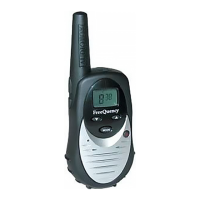
The TX-446 has four printed circuit boards. (Main PCB, SW PCB and two BATT PCB in battery pack.)
Circuitry is described in the following order: Microprocessor/Control Section, VCO/Synthesizer Section,
Transmitter Section, Receiver Section and Battery Section. Refer to the Block Diagram and the Schematics.
3-1 MICROPROCESSOR / CONTROL SECTION
The microprocessor Q106 is constantly operating when the radio is turned ON. It is continuously monitoring the
keyboard, the PTT line and other internal inputs such as the squelch detect, etc. When a change occurs, the
microprocessor makes the appropriate response. The microprocessor is used for control. The Radio emits a beep on
channel change and the synthesizer is loaded with the correct frequency information. The microprocessor runs
off a 4.19304 MHz oscillator which is composed of X101, C117, C118, and R135.
When the radio is first turned on, the microprocessor reads the radio status from the EEPROM Q109.
The microprocessor determines the receive frequency codes, then loads the synthesizer via its pins 17, 18 and 19.
3-2 VCO / SYNTHESIZER SECTION
This section consists of the Temperature-Compensated Crystal Oscillator (TCXO), Voltage Controlled Oscillator
(VCO), Synthesizer and the Loop Filter.
Temperature-Compensated Crystal Oscillator (TCXO)
The reference oscillator(X301) is a temperature compensated crystal- oscillator, CV301 is used to adjust the oscillator
on frequency (21.25MHz) at room temperature (22°C). Q311, Q310, R314, R316, R319, R333, R334, R335 etc.
Temperature compensated is held within the specified
2.5 KHz from -20 to +50°C.
Voltage-Controlled Oscillators
The VCO of oscillates 446.00625 MHz to 446.09375 MHs under the transmission condition and 424.30625 MHz to
424.39375 MHz under the reception condition. The VCO consist of the clip oscillator of the Q305 and contaions the
oscillator frequency of approximately 21.7 MHz during the transmission/reception conversion. That is since the VCO
should oscillate relatively low frequency during reception compared to transmission, the Q307 is biased by the Q309.
Therefore as a result, the C312 is added in parallel to the resonance circuit of the VCO to oscillate a low frequency.
During transmission, a relatively high frequency should be oscillate compared to receprion. Therefore, the Q307 is
adversely biased by the Q309, and as a result, the C312 which is added unparalleled to the circuit of the VCO is
removed the desired transmission frequency.
Synthesizer
The PL synthesizer of the signal loop PLL circuit with the reference of 6.25 KHz. The Q303 PLL IC includeds all the
function such as the reference oscillator, the driver, the phase detector, the lock detector, and the programmable divider.
At the reference oscillator, the 21.25MHz TCXO is connected to the pin 1 of the Q303 to oscillate the frequency of
21.25 MHz. The TCXO (21.25 MHz) is the temperature compensation circuit to maintain the frequency within the
allowable error rang even under a low temperature of -20 . The phase detector send out the output power to the loop
filter through pin 14 of the Q303, If the oscillation frequency of the VCO is low compared to the reference frequency,
the phase detector send out output power in postive pulse. If the oscillation frequency of the VCO is high, phase
detector send out can maintain the frequency set. The progammable maintains the desired frequency with control from
the microprocessor Q106.
Loop Filter
The Loop Filter, a passive lead-lag filter consisting of C318-C320, R312, R313 and R317 integrates the charge pump
output to produce the DC turning voltage for the VCO. One parasitic pole, consisting of C318/R312 and RF choke
L305 prevent modulation of the VCO by the 6.25 KHz reference energy remaining at the output of the loop filter.
Direct FM is obtained for modulating frequencies outside the PLL bandwidthe by applying the CTCSS/DCS signals
and the pre-emphasized, limited microphone audio to the VCO modulation circuit.
The modulation circuit consists of Q315, C343, R309, R340 and R341.
4



 To Next Page