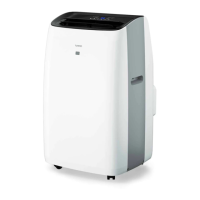
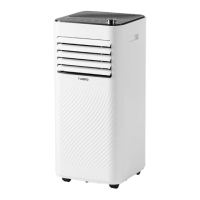
This document is a user manual for the TURBRO Finnmark FMP05AC and FMP06AC Portable Air Conditioners. It provides comprehensive information on the device's function, installation, operation, maintenance, and troubleshooting.
Function Description:
The TURBRO Finnmark FMP05AC and FMP06AC are portable air conditioners designed to cool and dehumidify rooms. They feature an auto-evaporation system, which automatically evaporates condensed water, reducing the need for frequent manual drainage, except in very humid conditions or when using the dry mode. The units utilize R32 fluoride refrigerant, which is described as non-polluting and having a lower impact on the ozonosphere and greenhouse effect compared to common refrigerants. R32 also boasts good thermodynamic features, leading to high energy efficiency and requiring less refrigerant filling.
Important Technical Specifications:
- Refrigerant: R32 (flammable gas, odorless)
- Power Supply: Fixed 115V AC ground outlet
- Minimum Room Area for Installation/Operation/Storage: 43ft² (4m²)
- Minimum/Maximum Window Openings for Window Panel Kit: 11 - 67 Inches
- Recommended Space from Wall (for efficient working): At least 19.7 inches / 50 cm
- Height from Exhaust Hose to Floor: 35.5 inches (90 cm)
- Remote Control Range: 23 feet / 7 meters (without obstacles)
- Temperature Range (Cool Mode): 61°F-90°F (16°C-32°C)
Usage Features:
The portable air conditioner offers multiple operating modes and functions accessible via both a control panel on the unit and a remote control.
Operating Modes:
- COOL Mode: Ideal for cooling and dehumidifying in hot, muggy weather. Users can select a desired temperature between 61°F-90°F (16°C-32°C) and adjust fan speed (Low or High). The unit will stop cooling but continue blowing air if the room temperature falls below the selected temperature.
- DRY Mode: Designed to reduce room humidity, suitable for spring, autumn, rainy periods, or damp rooms. In this mode, the unit runs at low fan speed, which cannot be adjusted. It requires the air exhaust hose to be connected for external moisture discharge and the drain hose to be attached to prevent leaks.
- FAN Mode: Circulates air without cooling. The air exhaust hose can be disconnected or left connected in this mode. Users can select between Low and High fan speeds.
Additional Functions:
- Timer Function: Allows users to set a delayed start-up or shut-down time, optimizing energy usage. The timer can be adjusted using the control knob or remote control buttons.
- Sleep Function: Available only in COOL mode, this function maintains an optimum room temperature at night without excessive fluctuations. The fan speed is automatically set to low. In sleep mode, the AC temperature increases by 2°F in the first hour, then by another 2°F after another hour, and maintains that temperature. The unit automatically shuts down after 12 hours in sleep function.
- Child Lock Function: Locks all buttons on the control panel to prevent accidental changes to settings.
- Temperature Scale Switch: Allows switching between Celsius and Fahrenheit temperature displays by long-pressing the Mode button for 3 seconds.
- Self-Diagnosis System: Identifies malfunctions and displays error messages (E0, E1, E2, FE) on the screen, accompanied by beep sounds.
Installation Features:
- Placement: The unit should be placed on a firm, stable, flat, and level floor to minimize noise and vibration. It must be installed near a properly rated grounded socket.
- Clearance: A minimum of 19.7 inches (50 cm) of space from the wall is recommended for efficient working. Obstacles should not block the air inlet or outlet.
- Exhaust Hose: The exhaust hose should be connected for COOL and DRY modes. It can be compressed or extended moderately, but keeping its length to a minimum and avoiding sharp bends or sags is desirable for optimal performance.
- Window Panel Kit: Designed for most standard vertical or horizontal windows. The kit includes a window panel, adjustment panel, extension panel, screws, nuts, and foam seals. Instructions are provided for assembly and securing the panel kit in the window.
Water Drainage Methods:
The unit features an auto-evaporation system, but manual drainage is sometimes necessary, especially in dry mode or humid conditions.
- Method A: Manual Drainage: Involves unplugging the unit, placing a receptacle pan under the lower drain port, removing the cap, and allowing water to flow out. The unit may need to be tilted slightly to ensure all water drains.
- Method B: Continuous Draining: Involves unplugging the unit, removing the cap from the lower or middle drain port, and inserting a drainage hose to continuously drain water to the floor or a bucket. It's crucial that the drain hose section is not higher than the drain outlet to ensure proper drainage.
Maintenance Features:
Regular cleaning and maintenance are essential for efficient operation and longevity.
- Cleaning the Outer Case: Clean with a slightly damp cloth and dry with a dry cloth. Avoid using water, petrol, alcohol, solvents, or insecticide liquids.
- Cleaning the Air Filters: Filters should be cleaned every three months. They can be removed, rinsed under running water, and replaced once completely dry. Users are warned not to touch metal fins inside the air conditioner, dry filters with hairdryers or heating elements, or operate the unit without the filter.
- Maintenance Checklists:
- Pre-Season Maintenance: Check power cord for damage, ground prong, clean air filter, and ensure hose adapters and exhaust hose are tightly installed.
- Post-Season Maintenance: Disconnect from power, clean air filter and exterior case, drain accumulated water, and wrap the unit in plastic to prevent dust accumulation.
- Long-Term Storage: Disconnect from power, clean air filter and exterior case, and wrap/cover the unit to prevent dust.
Troubleshooting:
The manual includes a troubleshooting chart to help users identify and resolve common issues, such as the unit not starting, stopping, not blowing air, not cooling enough, making noise, or producing a gurgling sound. For more complex issues or if the unit displays error codes (E0, E1, E2, E3, FE), users are advised to contact TURBRO Customer Support. Users are explicitly warned against attempting self-repair or retrofitting the air conditioner.


 To Next Page
 General