Need help?
Do you have a question about the TUTTOKool TK-721 and is the answer not in the manual?
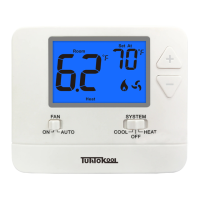
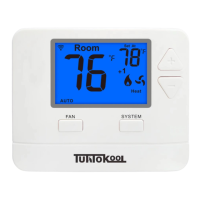
Explains the LCD screen elements and their meanings, including indicators for system status.
Details the operation of the Fan Switch, including ON and AUTO modes for fan control.
Explains the functions of the System Switch for HEAT, COOL, OFF, and EmH settings.
Describes how to use the plus and minus buttons to adjust the desired room temperature.
Indicates the location of the Battery Door, with further details on page 5.
Details the LCD display's indicators for room temperature, setpoint, and system operation status.
Instructions for installing batteries, including removing the activation tab and battery recommendations.
Advises immediate battery replacement when the battery icon appears to prevent system issues.
Details the 3-year limited warranty and the registration process via mail.
This document describes the operation, features, and maintenance of the TK-721 thermostat.
The TK-721 is a thermostat designed to control heating and cooling systems. It allows users to set a desired room temperature and manage the operation of the fan and the system mode (heat, cool, off, or emergency heat). The device displays the current room temperature, the setpoint temperature, and various operational indicators to provide clear feedback on its status.
1. LCD Display: The thermostat features an LCD display that shows important information such as the current room temperature, the setpoint temperature, and various system operation indicators.
2. System Switch: This switch allows users to select the desired operating mode for their HVAC system: * HEAT: Activates the heating system to raise the room temperature to the setpoint. * COOL: Activates the cooling system to lower the room temperature to the setpoint. * OFF: Turns off the HVAC system. * EmH (Emergency Heat): This mode is specifically for heat pump systems with auxiliary heat. Selecting EmH will lock out the compressor and activate the emergency heat, which is typically used when the heat pump is unable to provide sufficient heating or during very cold conditions.
3. Fan Switch: The fan switch offers two modes for controlling the system's fan: * ON: In this mode, the fan runs continuously, regardless of whether the heating or cooling system is actively operating. This can be useful for continuous air circulation. * AUTO: In this mode, the fan cycles on and off only when the heating or cooling system is actively running. This is the more energy-efficient option as the fan only operates when needed to distribute conditioned air.
4. Temperature Setpoint Buttons: The thermostat includes "+" and "-" buttons that allow users to easily adjust the desired room temperature (setpoint) up or down. Each press of a button typically changes the setpoint by one degree.
5. System Operation Indicators: The LCD display includes several icons that indicate the current status of the HVAC system: * COOL icon: Displays when the cooling system is active. * HEAT icon: Displays when the heating system is active. * EmH icon: Displays when emergency heat is active. * Fan icon: Displays when the fan is running. * Compressor Delay Feature: If the COOL, HEAT, or EmH icons are flashing, it indicates that the compressor delay feature is active. This is a built-in protection mechanism that prevents the compressor from short-cycling, which can damage the unit. The compressor will turn on after a 5-minute delay has elapsed. * Stage Indicators: For heating systems, the display may show "Stage 1" and "Stage 2" indicators. These indicate which stages of heating are active, particularly in multi-stage heating systems where the thermostat can activate additional heating capacity as needed to reach the setpoint.
1. Battery Door: The thermostat is powered by batteries, which are accessed via a battery door. The manual provides instructions for battery installation.
2. Battery Installation: To activate the thermostat, a tab between the batteries must be removed. The device recommends the use of high-quality alkaline batteries (1.5V AAA).
3. Low Battery Indicator: The thermostat is equipped with a low battery indicator icon on the LCD display. When this icon appears, it is crucial to replace the AAA batteries immediately. Failure to do so can lead to the heating and cooling system becoming frozen or overheating, potentially causing damage to the HVAC system or affecting its performance.
4. Warranty Registration: The TK-721 thermostat comes with a 3-year limited warranty. To ensure the warranty is active from the date of installation, users must register their thermostat within 60 days of installation. If not registered within this period, the warranty period will begin from the date of manufacture. The manual provides a form for warranty registration, which can be completed and mailed to the specified address. For any warranty-related issues, users are advised to contact the HVAC professional who installed the product.
 General
| Power Supply | 24V AC |
|---|---|
| Control Type | Digital |
| Display | LCD |
| Mounting | Wall-mounted |
| Accuracy | ±1°F |
| Compatibility | Compatible with most HVAC systems |

 To Next Page