
 Need help?
Do you have a question about the TXAM Pumps SPC1000 and is the answer not in the manual?
Lists nominal voltage, fuse type, dimensions, and operational ranges.
Highlights rotary control, display, protection, and connectivity features.
Describes physical controls like the rotary knob, LEDs, and power switch.
Explains power-on, parameter selection, adjustment, saving, and pump priming.
Covers safety, connecting battery/pump, and probe installation.
Discusses temperature control, voltage cutback, and display behavior.
Details how to select and set up Modbus operation and address.
Explains RS485 connection requirements and protocols.
Describes display indications, power interruption handling, and inhibit functions.
Lists Modbus registers for setting Cycles per Minute operation.
Lists Modbus registers for setting ON/OFF Timer operation.
Provides a detailed overview of Modbus registers and their functions.
Records changes and updates across different document revisions.
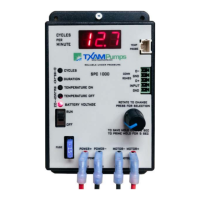
The SPC1000 Basic Pump Controller is a versatile device designed for managing pump operations with a focus on reliability and user-friendliness. Its primary function is to control pump cycles and duration, offering both manual and remote operational modes. The device is housed in a durable plastic enclosure, making it suitable for various environments.
One of the key usage features of the SPC1000 is its intuitive control interface. It incorporates a rotary knob for quick and easy adjustment of parameter settings. This knob allows users to cycle through different display parameters, including Cycles per Minute, Duration (on time), Temperature ON setpoint, Temperature OFF setpoint, and Battery Voltage/Temperature probe reading. A quick press of the rotary knob cycles through these parameters, indicated by corresponding LEDs. Once a parameter is selected, rotating the knob clockwise or counter-clockwise adjusts its value. To save a new setting, the user presses and holds the knob down for approximately three seconds until "SAV" is displayed. This ensures that accidental changes are not saved.
The device also includes an On/Off Power Switch, which initiates a quick self-test upon startup and then displays the battery voltage. This immediate feedback on battery status is crucial for maintaining continuous operation. For visual feedback, the SPC1000 features a three-digit seven-segment display, which is designed to be readable even in direct sunlight. This ensures that critical information is always visible to the user. Additionally, five LEDs are present to indicate the currently selected display parameter, further enhancing the user's understanding of the device's status.
Beyond manual control, the SPC1000 offers advanced remote control capabilities through an RS485 connection for Modbus. This allows for integration into larger control systems, enabling a Modbus Master to manage all pump operations. In Modbus mode, the rotary knob's primary function shifts to displaying information, as all operational control is handled remotely. The device supports RTU mode, 8 data bits, no parity, and a baud rate of 9600 bps, with a settable address range from 1 to 60 (defaulting to 20). This remote control feature is particularly useful for automated systems where manual intervention is minimized.
The SPC1000 also incorporates a pump prime feature. If the rotary knob is held down for a few more seconds after saving a parameter, a prime cycle will be initiated. The display will show "PRI" and then begin a 30-second countdown, during which the pump remains on. This is useful for priming the pump or clearing air from the lines. Pressing the knob again during a prime cycle extends the ON time by another 30 seconds. If a prime cycle needs to be aborted, the power switch must be turned off.
Temperature control is another significant feature, activated by plugging in an external temperature probe. When a probe is connected, the device can manage pump operations based on temperature setpoints. If no probe is connected, temperature control is not utilized. In Modbus mode, the probe connection is necessary for the Modbus Master to enable or disable temperature operation. The display will indicate the absence of a probe by showing a period in the ones digit for Temperature ON and OFF display selections.
The SPC1000 is designed with several maintenance features to ensure longevity and ease of service. It includes reliable solid-state protected circuitry, which enhances its durability and reduces the likelihood of component failure. A replaceable 15 Amp mini automotive blade fuse is integrated for circuit and motor protection. This fuse is easily accessible, and the manual suggests using pliers and gently rocking it to facilitate removal and installation, making fuse replacement a straightforward task.
Battery management is a critical aspect of the SPC1000's design. It continuously monitors battery voltage and will display "Lob" along with the voltage and temperature if the battery voltage drops below 10 volts, indicating that the voltage is too low for pump operation. This low battery voltage shutdown feature protects the pump and the battery from damage due to deep discharge. The device also features voltage cutback in Cycles per Minute (CpM) mode, which helps conserve power during low voltage conditions. A period under the 'c' (cycles selection) on the display indicates when voltage cutback is active.
The device's modular design includes a pluggable terminal block for Modbus connection and a pump inhibit input. A dry contact connected to the input can inhibit pump operation when closed, with "INH" displayed to indicate the inhibited status. This allows for external safety interlocks or control signals to halt pump operation. The four 0.250 spade lug connectors for attaching the battery and motor are color-coded, simplifying wiring and reducing the chance of incorrect connections.
For diagnostic purposes, the SPC1000 can display various operational parameters. Users can view the battery voltage, probe temperature, and the ON and OFF temperature setpoints. The display will blank after a timeout period to conserve power, but one of the LEDs will remain on. A quick press of the rotary knob will reactivate the display. In shutdown mode ("Sdn" on display), holding the switch down for about one second may be necessary to reactivate the display and cycle through selections.
The device's operational modes can be configured during power-up. By holding down the rotary encoder knob while powering up, users can cycle through "CYC" (cycles per minute), "ON OFF" (on time/off time), and "bUS" (Modbus control). Releasing the knob when the desired mode is displayed selects that mode. This flexibility allows the SPC1000 to adapt to different application requirements.
In Modbus mode, the timer's behavior after a power failure or power cycle is designed for continuity. If the timer was in a halt mode, it will resume in halt mode. If it was running, it will resume operation when power returns. This ensures that the system maintains its last commanded state, minimizing disruptions. The display will show "bUS" when running under Modbus control and "hLt" when commanded to stop. If Modbus is inhibiting operation, the display will flicker when it should be blank, or "hLt" will flash and toggle with the actual display selection reading, providing clear visual cues to the user.
Overall, the SPC1000 Basic Pump Controller is a robust and adaptable device, offering comprehensive control over pump operations through both direct user interaction and remote Modbus communication, all while incorporating essential maintenance and diagnostic features for reliable performance.
 General
| Category | Controller |
|---|---|
| Model | SPC1000 |
| Protection Class | IP65 |
| Dimensions | 150 x 100 x 50 mm |
| Weight | 0.5 kg |
| Output Current | 10A |
| Operating Temperature | -10°C to +50°C |

 To Next Page
