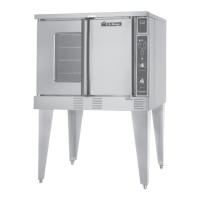
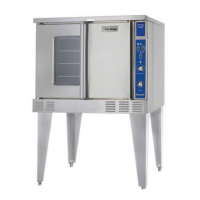
This document provides an installation, operation, and maintenance manual for the Summit Series Gas Convection Ovens, manufactured by U.S. Range, a Manitowoc Foodservice brand. The manual covers various models including SUMG-100, SUMG-200, SUMG-GS-10ESS, SUMG-GS-20ESS, SGM-100S1, SGM-100D1, SGM-200S1, and SGM-200D1. The SGM models were discontinued and manufactured up to June 2012.
Function Description:
The Summit Series Gas Convection Ovens are commercial cooking appliances designed for professional use. They utilize gas convection technology for efficient and even cooking. The ovens are available in single and double-deck configurations, with some models featuring a Solid State Control with Electromechanical Timer (Summit 20) and others equipped with an Electronic Control with Cook-N-Hold and Core Probe (Summit 45 and 45+). The Cook-N-Hold feature allows for precise temperature and time control, while the core probe (on 45+ models) enables cooking to a specific internal product temperature.
Important Technical Specifications:
The ovens are available in various dimensions and configurations.
- Internal Dimensions (W x H x D): 29" (736mm) x 24" (610mm) x 24" (610mm) for single-deck models, and 29" (736mm) x 24" (610mm) x 28" (711mm) for double-deck models (SGM series).
- External Dimensions (W x H x D): For SUMG-100/GS-10ESS, 38" (965mm) x 57-1/2" (1461mm) x 41-1/4" (1048mm). For SUMG-200/GS-20ESS, 38" (965mm) x 70-1/2" (1791mm) x 41-1/4" (1048mm). For SGM-100S1/D1, 38" (965mm) x 57-1/2" (1461mm) x 39-1/4" (997mm) or 43-1/4" (1099mm). For SGM-200S1/D1, 38" (965mm) x 70-1/2" (1791mm) x 39-1/4" (997mm) or 43-1/4" (1099mm).
- Input Ratings (BTU/hr / kW Equiv.): Single deck models are 60,000 BTU/hr (17.6 kW Equiv.), while double deck models are 120,000 BTU/hr (35.2 kW Equiv.).
- Gas Inlet: 3/4" NPT for single-deck, 1" NPT for double-deck.
- Operating Pressure: Natural gas: 4.5" WC (10 mbar); Propane gas: 10" WC (25 mbar). Maximum pressure is 13.8" WC at 70°F (21°C).
- Electrical Specifications: 120V/1Ph (9.8A) or 240V/1Ph (5.2A). Standard electrical specifications include motor requirements (115V 3/4 HP, 2-speed motor; 1140 and 1725 rpm 60Hz for 120V units, and 200-240V 3/4 HP, 2-speed motor; 1140 and 1725 rpm, 60Hz for 240V units). A 6ft line cord with a NEMA #5-15P plug is provided for each 120V deck. U.S. Range recommends a separate 15 AMP circuit for each 120V unit.
- Clearances: Minimum 1" (26mm) side clearance to combustible/non-combustible walls, 3" (77mm) rear clearance. For high heat producing equipment, 6" (153mm) side clearance. Recommended 12" (305mm) control side clearance for service.
- Ventilation: Can be vented via a canopy hood or direct flue. Direct venting requires a draft diverter.
Usage Features:
- Controls:
- Summit 20 (Electromechanical Timer): Features a Cook/Off/Cool Down rocker switch, fan speed control (high/low), light switch, and a temperature dial (150°F to 500°F / 66°C to 250°C). A timer (2 to 60 minutes) is also present but does not control heating.
- Summit 45/45+ (Electronic Control): Features ON/OFF, LIGHT, SETBACK, HIGH/LOW fan, COOL DOWN, PULSE COOK/HOLD, TEMP, HOLD TEMP, TIME, START/CANCEL, and SET buttons. The display shows "OFF" when idle, "LO" when heating, "LOAD" when ready, "HI" if temperature exceeds set point, and "HELP" if temperature exceeds 575°F (302°C) (safety feature). "DOOR" is displayed if the door is open during cooking.
- Safety Features: Automatic fan and heat shut-off when the door is opened in cook mode. Patented safety feature for optimal cool down with the door slightly open. Over-temperature protection with audible alarm.
- Cook-N-Hold (45/45+ Controllers): Allows programming of cook temperature, hold temperature, and cook time. The oven automatically switches to hold mode after the cook cycle is complete.
- Core Probe (45+ Controllers): Enables cooking to a desired internal product temperature. The display shows the core temperature and switches to hold mode once the target temperature is reached.
- Setback Feature (45/45+ Controllers): Allows setting a lower temperature and time for periods of inactivity to conserve energy.
- Performance Recommendations: Preheat thoroughly (approx. 20 minutes). Reduce temperature by 25°-50° from conventional oven settings. Keep records of cooking times and temperatures. Start with lowest temperature products first. Use COOL DOWN to quickly adjust temperature. Load oven quickly and evenly. Do not overload. Center pans on racks. Do not place anything directly on the oven cavity bottom.
Maintenance Features:
- Break-In Period: Operate the new oven at 375°F (191°C) for one hour before normal cooking operations. After cooling, clean the interior, including racks.
- Exterior Cleaning: Establish a regular schedule. Wipe spills immediately. Allow the oven to cool before cleaning. Use mild detergent and warm water. For stubborn spots, use a non-metallic scouring pad, rubbing with the grain of the metal. Avoid spraying water or steam into the perforated area or control panel.
- Interior Cleaning: Allow the oven to cool. Remove racks and rack guides. Racks and guides can be dishwashed. Clean the interior with soap, warm water, and a non-metallic scouring pad. For stubborn grease, use a mild ammonia solution or commercial oven cleaner.
- Fan Area Maintenance: If aluminum foil is routinely used for wrapping or cooking, preventive maintenance of the fan area is required. Turn power off, remove racks and guides, remove the air baffle, and clean any stains or deposits. Check blower wheel and air baffle for food particles.
- Motor Care: The convection oven motor is maintenance-free with self-lubricating sealed ball bearings. It is designed for long service life with proper maintenance. To protect the motor from premature failure, it is recommended to slightly open the oven door at the end of the cook cycle or period of inactivity to allow the oven cavity to cool down to 150°F (66°C). The Summit 45 series controllers have an automatic cool-down function that runs the fan until the oven reaches 150°F (66°C). The Summit 20 series controllers require manual activation of the cool-down function.

 Need help?
 General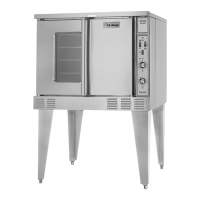

 To Next Page