ACM6000-MAN P. 5
WARNING!
Observe proper safety procedure for step 7. Be certain the vehicle
cannot move during the cranking portion of the test.
7. Crank the engine while observing the meter reading.
CAUTION!
Avoid overheating the starter limit cranking time to 15 seconds.
8. When testing is completed move the instrument power switch
to OFF.
Abnormally high current can indicate:
• Over-advanced engine timing
• Seized engine
• Faulty starter
Abnormally low current can indicate:
• Low compression engine
• High resistance in starter circuit or connections
• Faulty battery - to check the condition of the battery, use
the voltmeter to perform a cranking voltage test
Parasitic load
Parasitic Load is the small amount of current drawn from the battery
after the ignition switch is turned OFF and the various electronically
controlled devices have phased from "Awake" to "Asleep" mode.
Typically, the parasitic load will be under 20 milliamps. In some
applications parasitic load will reach 40 milliamps and still be normal.
Check the vehicle service manual for exact specifications.
Test procedure:
1. Turn the ignition switch and all accessories OFF.
2. Disable the under-hood light.
3. Allow sufficient time for all the electronic devices to be asleep.
• Some devices take hours
• Refer to the vehicle service manual for exact time
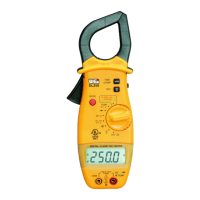
4. Turn the ACM6000 rotary function switch to 20A .
5. Slide the instrument power switch to ON.
6. Press the ACM6000 ZERO button. The display should read
approximately 00.0.
7. Place the jaws of the ACM6000 around the battery positive
cable(s) or the battery negative cable(s). Either way will work.
Be sure the jaws are closed.
8. Because the display readout can vary up to 60mA, add 60mA
to the highest expected reading for parasitic load of the vehicle
under test. If the display readout exceeds that amount, further
testing is recommended.
Example: Normal highest parasitic load for vehicle under test is
40mA. Add 60mA to the expected 40mA for a total of 100mA. If
the display is 0.10A (100mA) the parasitic load can be considered
normal. However, a reading of 0.11 A (110mA) or more would
be too high.
Alternator output
Problems involving hard starting because of low battery current can be
caused by a faulty alternator. The alternator is responsible for keeping
the battery charged. The ACM6000 provides an easy way to check alter-
nator current output.
Test procedure:
1. This test should be conducted with the battery fully charged.
• Charge the battery if necessary
2. Start engine and run at about 1800 RPM.
3. Allow sufficient time for all the electronic devices to be asleep.
4. Turn the ACM6000 rotary switch to 200A .
5. Slide the instrument power switch to ON.
6. Press the ACM6000 ZERO button. The display should read
approxiametly 00.0.
7. Using CAUTION to avoid moving belts, etc., place the jaws
of the ACM6000 around the alternator output wire. Be sure that
the jaws are closed.
8. Compare reading with manufacturers specifications.
9. When testing is completed move the instrument power switch
to OFF, and remove the meter from the wire.
Measuring amp output is only a partial indicator of alternator function
and ability to keep the battery charged. Performing a Regulator –
Operating Voltage test is also recommended.
Blower motor current draw
Modern automotive heating and air conditioning systems can be quite
complicated. Diagnosing these systems may require the use of a service
manual to help isolate the exact problem. However, it is often possible
to make quick work of pin-pointing some problems by using the
ACM6000 to measure current flow. Blown A/C fuses or insufficient
cooling/heating caused by a faulty blower motor are easy to find
using the ACM6000.
Test procedure:
1. To test the blower motor: disconnect the vehicles electrical
harness from the blower motor.
2. Connect a fused jumper lead set from the battery to the
blower motor.
3. Turn the ACM6000 rotary function switch to 200A .
4. Slide the instrument power switch to ON.
5. Press the ACM6000 ZERO button. The display should read
approximately 00.0.
6. Place the jaws of the ACM6000 around one of the two wires,
either one will work.


 To Next Page
 Loading...