Need help?
Do you have a question about the Unistellar eVscope Series and is the answer not in the manual?
Essential conditions for optimal use, including clear skies and stable ground.
Steps to assemble, adjust height, and ensure the tripod is stable.
Instructions for attaching the telescope to the tripod and initiating the power sequence.
Guide to obtaining the Unistellar App and establishing a wireless connection.
Steps to adjust focus for clear viewing through the telescope and app.
Using orientation features and the app to identify and move to celestial targets.
How to view real-time sky images and adjust settings for specific celestial bodies.
Activating and fine-tuning the Enhanced Vision feature for improved image quality.
Instructions for moving the telescope to a safe storage position and powering it down.
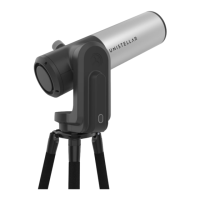
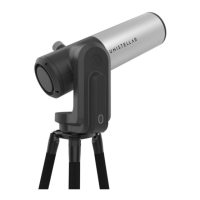
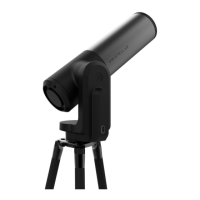
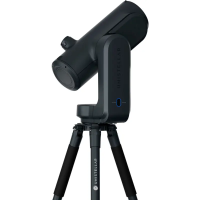
The Unistellar eVscope and eQuinox series are advanced smart telescopes designed to bring the wonders of the night sky closer to users, offering an accessible and enhanced astronomical observation experience. These devices combine sophisticated optics with intelligent software to simplify the process of locating, tracking, and observing celestial objects, making them suitable for both novice stargazers and experienced astronomers.
The primary function of the eVscope and eQuinox series is to provide a user-friendly platform for observing deep-sky objects that are typically faint and challenging to see with traditional telescopes. Unlike conventional telescopes that rely solely on optical magnification, these Unistellar devices employ a unique "Enhanced Vision" technology. This technology accumulates light over short periods, processing and stacking multiple images in real-time to reveal details and colors of nebulae, galaxies, and star clusters that would otherwise be invisible to the naked eye through an eyepiece.
The telescopes are designed for automated celestial navigation. Once set up and connected to the Unistellar App on a smartphone or tablet, the device can automatically recognize its orientation in the sky, locate specific celestial targets, and track them as they move across the night sky due to Earth's rotation. This eliminates the need for complex manual alignment procedures, making observation significantly easier.
Beyond personal observation, the eVscope and eQuinox also serve as tools for citizen science. Users can contribute to astronomical research by sharing their observation data with the Unistellar community and scientific partners. This collaborative aspect allows for the collection of valuable data on exoplanet transits, asteroid occultations, and other transient astronomical phenomena, fostering a sense of community and scientific contribution among users.
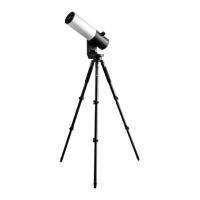
Setting up the eVscope/eQuinox is designed to be straightforward. The first step involves setting up the tripod on stable ground, ensuring the bubble level is within the black circle for proper leveling. It's crucial to avoid direct wind exposure and to operate the telescope under a clear sky, away from direct streetlights and a full moon for optimal results. The eVscope/eQuinox is then installed vertically onto the tripod, with screws tightened carefully to secure it without damaging the thread. Powering on the device involves pressing the On button for 2 seconds, indicated by a purple then red LED. Users are reminded to remove the cap covers from both the telescope tube and eyepiece before observation. A key recommendation is to reset the bubble level each time the eVscope/eQuinox is moved to maintain accurate alignment.
The eVscope/eQuinox connects wirelessly to the Unistellar App, available on both the Google® Play Store and Apple® App Store for smartphones and tablets. This app serves as the primary control interface for the telescope. Upon launching the app, it automatically detects nearby Unistellar instruments via WiFi, allowing users to control the device remotely. It's important to note that the app is not supported on FireOS devices, so users should check their smartphone's operating system for compatibility.
Achieving the right focus is critical for clear observations. From the app's main screen, users can access a telescope icon to bring up the control joystick. This joystick allows for precise movement of the telescope. By pressing and dragging a dot on the joystick, users can point the telescope in the desired direction. For eVscope models, the focus can be adjusted by turning a focus wheel at the base of the instrument until the image on the smartphone/tablet screen is clear. eVscope users also have an eyepiece lens to adjust, using a control knob next to the lens to find the best setting for their vision. The "eVscope orientation" button allows the device to instantly recognize objects in its field of view. Users can then select a recommended object from the app's catalog and use the "GoTo" button to automatically direct the telescope to that target, which may take up to one minute. Once the target is reached, users switch to "Enhanced Vision" mode for amplified views.
The Unistellar App features a "Catalog Tab" where users can explore and select celestial targets. For initial observations, recommended targets are provided. After selecting a target and initiating the "GoTo" function, the eVscope/eQuinox automatically points towards it. In "Observe live" mode, users can enjoy a real-time view of the sky, though many deep-sky objects may be faint. If a target is visible, it can be centered using the joystick. For brighter objects like planets and the Moon, manual adjustment of gain and exposure time settings is recommended. The zoom level can also be adjusted on the smartphone screen, which applies to the eyepiece if applicable.
The "Enhanced Vision" feature is a cornerstone of the Unistellar experience. By pressing a dedicated button in the app, this mode activates, accumulating light over several seconds to reveal amplified and clearer views of faint objects. The longer the observation in this mode, the better the image quality becomes, with most targets becoming clearly visible within the first minute. Users can further refine the observation quality by adjusting the Enhanced Vision settings (contrast/brightness) in the top-right settings menu of the app, waiting a few seconds for the changes to appear.
After each observation session, users should utilize the "Park" function, accessible through the "parameters/my eVscope" menu in the app. This function automatically moves the telescope to its zenith position and turns it off, preparing it for storage. Before storing, it's essential to replace the telescope cover and eyepiece cover. The eVscope/eQuinox can then be placed in its backpack or original shipping box. There's also an option to "Turn off" the telescope without moving it, if preferred.
While the manual primarily focuses on usage, it implicitly suggests several practices that contribute to the device's longevity and optimal performance, which can be considered maintenance-related:
Although not explicitly detailed, the instruction to "Remove the cap covers on both the eVscope/eQuinox tube and eyepiece" before observation implies that these covers are meant to protect the optics from dust and debris during storage. This suggests a need for regular cleaning of the optical surfaces, likely with appropriate lens cleaning materials, to maintain image clarity.
The instruction to "Replace your telescope cover and eyepiece cover before storing your eVscope/eQuinox in its backpack or in the original shipping box" is a direct maintenance recommendation. Proper storage protects the device from physical damage, dust, and environmental elements when not in use, extending its lifespan.
The manual encourages users to "Set your observing conditions in the Explore settings," "Use the Live settings (gain/exposure time)," and "Use the Enhanced Vision settings (contrast/brightness)." While these are primarily usage features, regularly checking and optimizing these settings ensures the telescope operates at its best performance, which can be seen as a form of software-based maintenance.
The manual explicitly advises users to "Check and adjust the mirror alignment" and "Adjust the eyepiece's diopter." These are crucial maintenance tasks for optical instruments. Proper mirror alignment (collimation) ensures the telescope's optics are correctly aligned for sharp images, while diopter adjustment customizes the eyepiece for individual vision, preventing eye strain and ensuring a clear view.
The manual mentions "thermalization" as part of the best practices for observations. Thermalization refers to allowing the telescope's optics to reach ambient temperature. This prevents air currents inside the telescope tube from distorting images, which is a critical aspect of maintaining optical performance in varying environmental conditions.
The mention of "dark frames" in the context of best practices indicates a feature or process within the telescope's software that helps reduce noise in images. Taking dark frames involves capturing images with the lens cap on to map and subtract sensor noise, a common practice in astrophotography that contributes to cleaner, higher-quality observations.
The manual highlights the importance of the Unistellar community and support resources. Users are encouraged to "Share your observations with the community by sending us your data" and "Contribute to science by joining eVscope/eQuinox observing campaigns." This fosters a collective knowledge base where users can learn from each other's experiences and troubleshoot issues. The "Help Center" at help.unistellar.com and the email support@unistellaroptics.com are provided for further assistance, serving as crucial resources for ongoing maintenance and problem-solving.
In summary, the Unistellar eVscope and eQuinox series offer an innovative and accessible approach to astronomy, blending advanced technology with user-friendly design. They empower users to explore the cosmos with unprecedented ease, contribute to scientific research, and continuously refine their observation skills through a combination of intuitive controls and supportive community resources.
 General
| Aperture | 114 mm |
|---|---|
| Focal Length | 450 mm |
| Type | Reflector |
| Focal Ratio | f/4 |
| Sensor | Sony IMX224 |
| Battery Life | 10 hours |
| Weight | 9 kg |
| Mount Type | Altazimuth |
| Connectivity | Wi-Fi |
| Dimensions | 65 cm x 23 cm x 22 cm |

 To Next Page