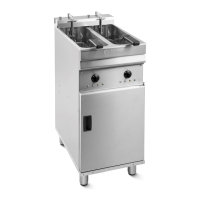
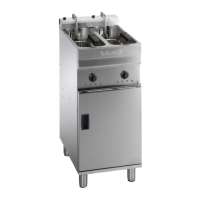
This document provides operating instructions for Valentine deep fat fryers, specifically models within the SERIES 2000 range, including V200(T), V250(T), V400(T), V600, V2200(T), and V2525(T). The manual emphasizes safe operation, maintenance, and troubleshooting for these commercial kitchen appliances.
Function Description:
Valentine deep fat fryers are designed for commercial use, primarily for deep-frying various food items such as chips, schnitzel, chicken legs, and fish. The fryers are equipped with heating elements to heat oil to specific temperatures for cooking. They feature control panels with indicators for different operational modes (melt, fry, heat), thermostats for temperature control, and safety mechanisms to prevent overheating and improper use. The design incorporates features for efficient oil management, including filtering and draining systems, to extend oil life and ensure food quality.
Important Technical Specifications:
The technical data table provides detailed specifications for each model, covering:
- Power (kW): Ranging from 7.2 kW (V200, V250) to 22 kW (V2200T, V2525T, V400T) and 21.6 kW (V600).
- Connection [A]: Current ratings from 10A to 32A.
- Frequency [Hz] - 3N400/415V: All models operate on a 50-60 Hz frequency with a 3-phase 400/415V connection.
- Connection cable: Specifies cable cross-sections (e.g., 5x1.5, 5x2.5, 5x4).
- Capacity in litres: Oil capacity ranges from 7-9 liters (V200, V200T, V2200, V2200T) to 25-28 liters (V600).
- Working thermostat: Number of thermostats (1 or 2).
- Safety thermostat: Number of safety thermostats (1 or 2).
- Timer: Indicates if a timer is included (1 or 2).
- Chips fried [kg/h]: Production capacity in kilograms per hour, from 19-23 kg/h (V200, V250) to 57-68 kg/h (V600).
- Protective system: All models are rated IP X4, indicating protection against splashing water.
- Weight [kg]: Fryer weights vary from 34 kg to 69 kg.
- Dimensions (cm): Provides overall dimensions (e.g., 20x58x85 cm for V200, V200T).
The document also lists specific spare parts with their article numbers, including control lamps, resistance for control lamps, safety temperature limiters, working thermostats, safety switches, main switches, connection terminals, switch relays, fuses, fuseholders, heating elements, timers, buttons, ball cocks, nuts, baskets, and metal filters. Heating elements are specified by power (e.g., HE 7.2/7.5kW 3N400/415V, HE 11/11.8kW 3N400/415V).
Usage Features:
- Installation: Fryers must be leveled using setscrews and not placed on combustible surfaces. Slimline models (V200, V200T, V250, V250T) require installation between furniture units or side support to prevent tipping. Electrical connection must be performed by experts, conforming to local regulations, and matching the fryer rating plate data. A mains plug or a mains switch with all-pole isolation is required for fixed connections. It is crucial never to heat the fryer without oil.
- Operation Modes:
- Melting: The main switch [7] is set to "Melt" position, activating the upper colorless signal lamp [8]. This mode uses reduced power for melting solid fat or economic heating of oil (approx. 10-15 minutes).
- Frying: The main switch [7] is turned to "Fry," and the thermostat is set to the desired temperature (e.g., 180°C). The yellow signal lamp indicates heating, and the green cook light signals readiness for immersing the basket.
- Oil Management:
- Pouring Oil: Peanut oil is recommended, filled up to the MAX level mark [24]. Solid fat must be melted in a separate pan, not on the heating element.
- Oil Level: Always top up oil after use. Operating below the "MIN" oil level mark leads to power drops and oil overheating, posing a fire risk.
- Oil Saving: Avoid heating the fryer for hours before or after service. Limiting oil temperature to 180°C instead of 200°C can extend oil life by approximately 40%. Filtering oil through a microfilter after each service retains microscopic waste.
- Basket Use: Never overfill the basket. Overfilling cools the oil excessively, extending frying time, and causing food to absorb more oil. The manual provides a table with recommended temperatures, frying times, and basket filling heights for various foods.
- Safety Features:
- Warning Symbols: The manual includes symbols for hot oil (severe burning risk), water/ice contact (spattering), and fire (never extinguish with water).
- Temperature Limiters: Fryers are equipped with breakage-proof temperature limiters and a security thermostat [15] with a reset button [16]. A red lamp [19] indicates when the safety thermostat has switched off (e.g., oil temperature over 230°C, damaged capillary tube, temperature below 0°C, heating without oil, low oil level, draining oil before switching off, incorrect heating element position, or melting a block of fat on the element).
- Safety Switch: A safety switch [36] interrupts power when the heating element is raised to the "drain" position.
- Periodic Inspections: Regular checks of the working and security thermostats are recommended.
Maintenance Features:
- Cleaning:
- Daily Cleaning: Filter the oil after each use at approximately 60°C. The oil cock [26] is opened, and oil flows through the filter [27] into the tank [28]. The filter and tank should be cleaned.
- Thorough Cleaning (Oil Change): When oil turns brown or smokes (after 20-40 operating hours), it must be changed. Waste oil must be disposed of properly, not poured into drains. The heating element is lifted to the "drain" position [L], oil is drained, and the tank and filter are removed and cleaned. Boiling water with a degreasing agent (soda) can be used to clean the oil pan and heating element. After cleaning, rinse thoroughly with hot water and wipe dry. The heating element interlock [35] is pushed back, and the element is tilted fully down.
- Fryer Cleaning: The fryer can be pulled forward [K] for cleaning the rear wall and bottom.
- Troubleshooting: The manual provides a table for simple faults (e.g., no heating, red lamp on, insufficient heating, sticking oil cock) and complex faults (e.g., signal lamps on but no heating, fuses blowing, fault current safety switch tripping, signal lamps not coming on/flashing). For complex faults, calling the service center is advised. When contacting service, provide the fryer type, unit number, voltage, amps, and kilowatts, found on page 1 and the rating plate.
- Resetting Safety Thermostat: If the safety thermostat trips, the fryer must be allowed to cool down before pressing the red reset button [16]. If it trips again, the fryer must be switched off, and the service center informed.

 Need help?

 To Next Page
 General