EasyManua.ls Logo

Velleman ARDUINO VMA307 - User Manual

Velleman ARDUINO VMA307
6 pages
Print Icon
To Next Page IconTo Next Page
Loading...
VMA307
ARDUINO
®
COMPATIBLE RGB LED MODULE (2 PCS)
USER MANUAL
Question and Answer IconNeed help?

Do you have a question about the Velleman ARDUINO VMA307 and is the answer not in the manual?

Summary

Introduction and Safety

Environmental Disposal Information

Symbol on device indicates environmental harm if disposed improperly.

Initial Setup and Transit Damage Advice

Read manual thoroughly; contact dealer if damaged in transit.

User Age and Capability Guidelines

Safety guidelines for device usage by children and adults with reduced capabilities.

Environmental Usage Restrictions

Instructions to keep the device indoors and away from moisture.

Warranty and Modification Policy

Prohibits modifications; disregard of guidelines voids warranty.

Proper Usage and Temperature Handling

Use device as intended; allow temperature stabilization before use.

Disclaimer of Liability and Product Appearance

Velleman not liable for damages; product appearance may vary.

Product Overview and Specifications

Arduino Connection

Mapping of VMA307 pins (R, G, B, GND) to Arduino pins (D11, D10, D9, GND).

Technical Specifications

Details on voltage, connection type, pin names, dimensions, and weight.

Programming the RGB LED Module

Code Structure and Pin Definition

Defines digital pins for R, G, B LEDs and sets ON/OFF states.

Predefined Color Definitions

Boolean arrays defining RED, GREEN, BLUE, YELLOW, CYAN, MAGENTA, WHITE, BLACK colors.

Setup Function for LED Pins

Configures the three LED pins as OUTPUT in the Arduino setup.

Loop Function Examples

Demonstrates setting static colors and random colors in the main loop.

setColor Function

Helper function to set the RGB LED colors using pin and color arrays.

Warranty and Support Information

General Warranty Conditions (EU)

Outlines the 24-month warranty, replacement, or refund conditions.

Warranty Exclusions

Lists exclusions from warranty coverage like damage, misuse, or consumables.

Repair and Shipping Procedures

Instructions for returning articles for repair and associated costs.

Overview

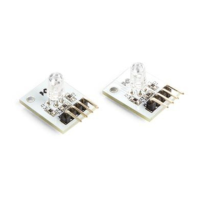
The VMA307 is an Arduino® compatible RGB LED module, provided in a pack of two pieces, designed to offer versatile lighting capabilities for various electronic projects. This module integrates an RGB LED with on-board current limiting resistors, simplifying its connection and operation with microcontrollers like Arduino. The primary function of the VMA307 is to produce a wide spectrum of colors by mixing red, green, and blue light, allowing users to create dynamic visual effects and indicators in their applications.

Function Description

The core functionality of the VMA307 revolves around its ability to emit light in red, green, and blue wavelengths, which can be combined in varying intensities to generate a vast array of colors. Each module features a single RGB LED, which is a common anode type, meaning its common pin is connected to the positive voltage supply (typically +5V), while the individual red, green, and blue pins are controlled by pulling them low. This design is complemented by integrated current limiting resistors for each color channel, which are crucial for protecting the LED from excessive current and ensuring its longevity when connected to a microcontroller's digital output pins.

The module is designed for seamless integration with Arduino boards. It typically connects via a 4-pin male header, providing dedicated pins for Ground (GND), Red (R), Green (G), and Blue (B). The GND pin connects to the Arduino's ground, while the R, G, and B pins connect to digital output pins on the Arduino. By controlling the voltage level (HIGH or LOW) on these digital pins, users can selectively turn on or off the red, green, and blue components of the LED. For instance, setting the red pin to LOW (assuming a common anode configuration where LOW turns the LED segment ON) and the green and blue pins to HIGH would illuminate the LED in red. Combinations like setting red and green to LOW and blue to HIGH would produce yellow light. Pulse Width Modulation (PWM) capabilities of Arduino's digital pins can be leveraged to control the brightness of each color component, thereby enabling the generation of millions of distinct colors. This makes the VMA307 an excellent choice for applications requiring customizable lighting, such as status indicators, ambient lighting, decorative elements, or even simple light shows.

Usage Features

The VMA307 module offers several usage features that enhance its versatility and ease of implementation in DIY electronics projects:

  • Arduino Compatibility: The module is explicitly designed to be compatible with Arduino microcontrollers, making it straightforward for hobbyists and educators to integrate into their projects. The provided example code snippets demonstrate how to control the RGB LED using standard Arduino functions like pinMode() and digitalWrite(), as well as more advanced color mixing techniques.
  • On-board Current Limiting Resistors: A significant advantage of the VMA307 is the inclusion of current limiting resistors directly on the module. This eliminates the need for external resistors, simplifying circuit design and reducing component count. Users can connect the module directly to their Arduino's digital pins without worrying about damaging the LED due to excessive current.
  • Common Anode Configuration: The common anode design is a standard for RGB LEDs and is well-supported by Arduino's digital output capabilities. This configuration means that to turn on a specific color segment, the corresponding control pin must be set to a LOW state, while a HIGH state turns it off. This is a common practice in digital electronics and is easily managed with Arduino's digital I/O.
  • Color Mixing Capabilities: The VMA307 allows for extensive color mixing. By independently controlling the intensity of the red, green, and blue components, users can generate a vast spectrum of colors. This is typically achieved using PWM, where the duty cycle of the PWM signal determines the perceived brightness of each color. The provided code examples illustrate how to define and display predefined colors (like RED, GREEN, BLUE, YELLOW, CYAN, MAGENTA, WHITE, BLACK) and even generate random colors, showcasing the module's dynamic potential.
  • Simple Wiring: With only four pins (GND, R, G, B), the module is easy to wire. The 4-pin male header ensures a secure connection, and the clear labeling of pins helps prevent incorrect hookups. This simplicity makes it suitable for beginners learning about LEDs and microcontrollers.
  • Compact Size: The module's small dimensions make it suitable for projects where space is a constraint. Its compact form factor allows for integration into various enclosures or tight layouts without adding significant bulk.
  • Multiple Modules: Being supplied as a pack of two, users have the flexibility to incorporate multiple RGB LEDs into a single project, enabling more complex lighting patterns or distributed visual feedback.

Maintenance Features

The VMA307 RGB LED module is designed to be a low-maintenance component, typical of solid-state electronic devices. However, general guidelines for handling and care apply to ensure its longevity and reliable operation:

  • Indoor Use Only: The device is intended for indoor use. It should be kept away from rain, moisture, splashing, and dripping liquids to prevent damage to the electronic components and ensure safe operation. Exposure to environmental elements can lead to short circuits, corrosion, and malfunction.
  • Temperature Considerations: It is important to protect the device from sudden changes in temperature. If the module has been exposed to cold temperatures, it should be allowed to reach room temperature before being switched on. This prevents condensation from forming inside the module, which could lead to electrical shorts or damage.
  • Physical Handling: While robust, the module should be handled with care. Avoid excessive physical shocks, falls, or bending of the pins, as these can damage the LED, the PCB, or the soldered connections. When inserting or removing the module from breadboards or connectors, apply gentle, even pressure.
  • Cleaning: For general cleaning, a dry, soft cloth is usually sufficient to remove dust. Avoid using liquid cleaners or solvents, as these can damage the plastic lens of the LED or the electronic components on the PCB.
  • No User Modifications: All modifications to the device are forbidden for safety reasons and will void the warranty. The module is designed with integrated resistors and specific pinouts, and altering these could lead to damage to the module itself or the connected microcontroller.
  • Proper Power Supply: Always ensure the module is powered within its specified voltage range (typically 5 VDC for Arduino compatibility). Supplying incorrect voltage can permanently damage the LED or the current limiting resistors.
  • Storage: When not in use, store the modules in a dry, static-free environment, preferably in their original packaging or an anti-static bag, to protect them from dust, moisture, and electrostatic discharge.
  • Environmental Disposal: At the end of its lifecycle, the module should not be disposed of as unsorted municipal waste. It contains electronic components and should be taken to a specialized company for recycling or returned to a local recycling service, adhering to local environmental rules. This ensures responsible disposal and minimizes environmental impact.

By following these usage and maintenance guidelines, users can ensure the VMA307 RGB LED module provides reliable and long-lasting performance in their Arduino projects.

Velleman ARDUINO VMA307 Specifications

General IconGeneral
Operating Voltage5V
Input Voltage (recommended)7-12V
Input Voltage (limits)6-20V
Digital I/O Pins14 (of which 6 provide PWM output)
Analog Input Pins6
DC Current per I/O Pin20 mA
DC Current for 3.3V Pin50 mA
Clock Speed16 MHz
Length68.6 mm
Width53.4 mm
Weight25 g
Flash Memory32 KB (ATmega328P) of which 0.5 KB used by bootloader
EEPROM1 KB (ATmega328P)
FeaturesUSB connection
CompatibilityArduino
TypeArduino-compatible control unit
SRAM2 KB (ATmega328P)

Related product manuals