1. Use specific Lithium Polymer charger only. Do not use a NiCd or NiMh charger - Failure to do so may
cause a fire, which may result in personal injury and property damage.
2. Never charge batteries unattended unless you charge inside a LiPo Safe. When charging Li-Po
batteries you should always remain in constant observation to monitor the charging process and react to
potential problems that may occur.
3. If at any time you witness a battery starting to balloon or swell up, discontinue charging process
immediately. Disconnect the battery and dispose of it safely. Continuing to charge a battery that has
begun to swell will result in fire. Likewise, never use a battery if you find it swollen or ballooned.
4. Since delayed chemical reaction can occur, it is best to observe the battery as a safety precaution.
Battery observation should occur in a safe area outside of any building or vehicle and away from any
combustible material.
5. Wire lead shorts can cause fire! If you accidentally short the wires, the battery must be placed in a safe
area for observation for approximately 1 hour. Additionally, if a short occurs and contact is made with
metal (such as rings on your hand), severe injuries may occur due to the conductibility of electric current.
6. A battery can still ignite even after 1 hour.
7. A battery that makes a hissing sound is almost certain to ignite. Consider your own safety and that of
your environment before attempting any action
8. In the event of a crash, after a 15 minute period to ensure the LiPo was not compromised, you must
remove battery and dispose of it safely.
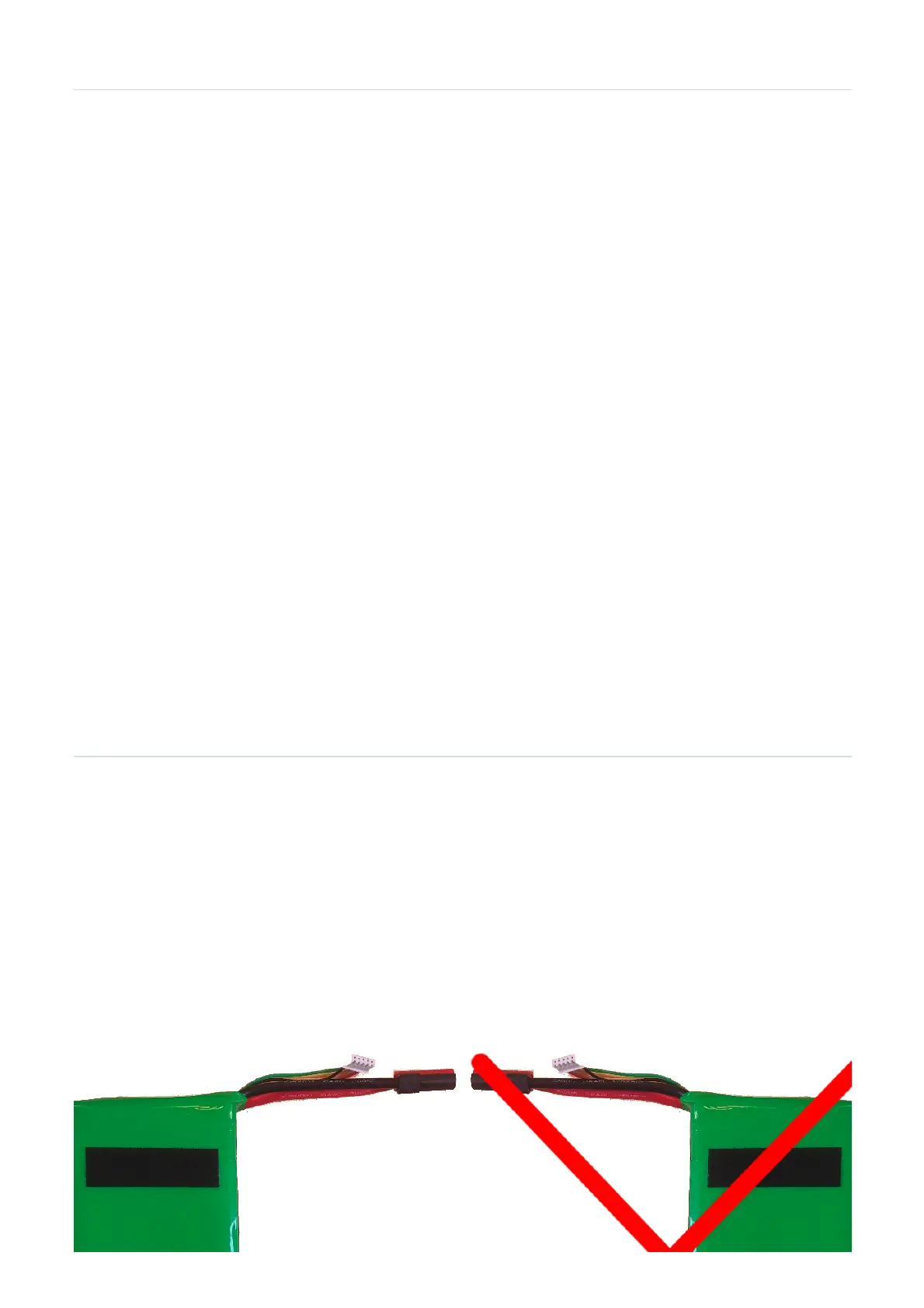
If you are not using the DeltaQuad LiPo battery, you will need to prepare your battery. Before you can install
your DeltaQuad LiPo you will need to attach 2 strips of Velcro. Some glue (instant contact adhesive like
UHU POR) should be applied to the battery surface where the Velcro will be attached. This will prevent the
Velcros adhesive from losing integrity. Make sure the Velcro is attached on the side that makes the power
wires exit from the top right. The hook (hard) side of the Velcro must be used as the fuselage contains the
loop (soft) side of the Velcro.


 To Next Page
 Loading...