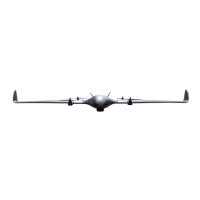
The DeltaQuad has been designed to fly autonomously, this is achieved by planning and executing
missions. Missions are set through the Ground Control Station. They can be created and sent to the vehicle
directly, loaded from an existing mission plan, or saved to a mission plan. This section covers the basics of
planning a mission for the DeltaQuad. For advanced usage of the mission planning features please review
the .QGroundControl mission planning documentation
1. A mission plan should only be executed after a thorough inspection of the entire mission on site. All
altitude differences and obstacles should be known and taken into account.
2. Missions must be allowed to be executed in accordance with local laws and regulations.
3. The mission path must be free of obstructions for at least 200 meters in each horizontal direction.
4. During fixed wing flight the vehicle should stay 50m above ground level, near the end of the mission, to
reduce landing energy consumed, an altitude of 25m above ground is recommended.
5. To ensure the safety systems can function properly, the takeoff altitude should be at minimum 60 meters
above ground level.
6. The takeoff and land sites must consist of a level, flat surface that is free of obstructions for at least 5x5
meters.
7. The takeoff altitude should be set high enough for the vehicle to be able to perform a transition in any
direction.
8. The weather conditions must fall within the . maximum allowed conditions
9. Both the front and back transition paths must be planned in such a way that the vehicle is pointing with
its nose towards the wind while performing the transition.
10. The intended mission should not consume more than 85% of the total energy available.
11. At any point in the mission the vehicle must be able to return to its takeoff point in a straight line on its
current altitude.
12. At any point in the mission the vehicle must be able to initiate an unscheduled landing without causing
damage to itself or its environment.


 To Next Page
 Loading...