This document describes the VEVOR Trailer Gate Lift Assist, a device designed to aid in the lifting and lowering of trailer tailgates or ramps. It comes in two models, 5807 and 5806, with varying weight capacities and installation types.
Function Description:
The VEVOR Trailer Gate Lift Assist is a mechanical system that uses springs and cables to reduce the effort required to lift and lower a trailer's tailgate or ramp. It is designed to make the operation of heavy tailgates safer and easier, preventing injury and damage. The system ensures that the tailgate is secured and locked in an upright position, and it helps to prevent the tailgate from dropping unexpectedly.
Important Technical Specifications:
| Model |
Weight of maximum tailgate or ramp |
Height of tailgate or ramp |
The height of the side rails above the trailer bed |
Length |
Installation site |
| 5807 |
360 pounds |
4 ft to 6 ft |
10 to 24 inches |
72 inches |
Bilateral |
| 5806 |
180 pounds |
4 ft to 6 ft |
10 to 24 inches |
72 inches |
Unilateral |
The device is compatible with trailer side rails made of round tubing larger than 2 inches in diameter. The installation process involves mounting housings, installing spring/cable assemblies, and attaching rollers and cables to the tailgate.
Usage Features:
The Trailer Gate Lift Assist is intended for use with trailers to facilitate the movement of heavy tailgates or ramps. Users should always ensure the tailgate is secured and locked in an upright position. The system is designed to prevent excessive force from being applied to raise or lower the tailgate. It is crucial to keep hands away from all openings, rollers, or cables during operation to avoid injury.
The installation process involves several steps:
- Installing the Housing A and the Housing B: This involves marking the hole positions for bolts before installation. The housings are placed and aligned on top of the trailer's side rail. The housings should be straight and level on the rail and flush against each other. The center of housing B's mounting holes should be marked as FIG1-1 and FIG1-2, and in most cases, L1=1/4 inch as FIG1-3. Housing B is then removed from the side rail without disturbing the placement of housing A, and the center of housing A's mounting holes is marked as shown in FIG1-4 and FIG1-5. Drill 1/2-inch holes (which are oversized) down through the side rail where the marks were made. It is critical to ensure that L1 is greater than 1/4 inch to prevent cables from rubbing against the end of side rails when lowering the tailgate all the way down to the ground. If L1 is too small (0<L2), it can lead to fraying and eventual breakage of the cables. The bolts are then inserted through the mounting holes, and the housings are secured. It is crucial to ensure that the mounting bolts are seated all the way down into their square holes and remain seated when connecting and tightening to the side rail. The oversized 1/2-inch holes allow for minor adjustments.
- Installing the Spring/Cable Assemblies: This involves sliding a spring/cable assembly into housings A and B. The pin is passed through the springs loop and housings A, as shown in FIG 2-1 and FIG 2-2. A locking ring is installed through the hole of the pin, and then a gentle rocking motion is applied to set the locking ring.
- Installing the Rollers: The rollers are installed as shown in FIG 3-1 and FIG 3-2. It is important to ensure the roller spins freely and smoothly. If not, check for any bends in the tube, burrs, or rough spots.
- Repeat the other above steps and assembly the other side of the Trailer Gate Lift Assist.
- Attaching the Cables to the Trailer's Tailgate: The tailgate is placed on the ground, and the approximate position of the hook on the tailgate is measured. In most cases, L is between 20 inches and 35 inches. A warning is given that if L is too great, the spring or cables will probably be broken when L>37 inches. The tailgate is secured and locked in the upright position. An S-Hook is attached to the looped end of each cable. Cables are adjusted enough to take the slack out of each and (using the S-Hooks) attach each of them to the mesh on both sides of the tailgate, doing so as close to the outer side support angles/tube as possible. S-Hooks are for installation purposes only, NOT for permanent use. The proper functioning of the Lift is ensured by slowly lowering the tailgate halfway down to the ground to check if the springs are moving freely. The tailgate should balance out in this position and move up and down with minimal effort. If this is not the case, the tailgate is returned to the upright position, and adjustments A or B are made. If there is not enough lifting power on the tailgate, the attachment points using the S-Hooks on both sides of the tailgate are raised while keeping both attachment points at the same height. If there is too much lifting power on the tailgate, and it will not go completely down or stay completely down, troubleshooting #2 is referred to. This involves using a marker or puncher to mark a mark on the tailgate side support tube/angle at the same height as the opening in the cable loop. A 1/2-inch hole is drilled at X. The cable thimble is slid onto the gate attachment bolt, and the cable is tightened as straight as possible when pulling, then the nuts are tightened. The two steps above on the other side are repeated.
Maintenance Features:
Regular maintenance is crucial for the longevity and safe operation of the Trailer Gate Lift Assist.
- Check the cable for breakage: Regularly inspect the cables for any signs of wear, fraying, or breakage. Replace spring/cable assemblies if breakage is found.
- Ensure all bolts and hardware are tight, secure, and sound: Periodically check all fasteners and hardware to ensure they are properly tightened and in good condition.
- Dust out the cable and roller regularly: Keep the cables and rollers clean from dirt and debris to ensure smooth operation.
- Reduce the small inner springs in the spring/cable assembly: If using only large outer springs, reattach both cables to the tailgate. It is important to never hook up small inner springs by themselves.
Troubleshooting Instruction:
- If a roller is not spinning freely: Check the housing and cable to ensure they are straight. Check the housing for deformation.
- If there is too much lifting power on your tailgate:
- Use S-Hooks to test different cable attachment positions and lifting power and adjust the value of L.
- Reduce the small inner springs in the spring/cable assembly. If using only large outer springs, reattach both cables to the tailgate. IMPORTANT: Never only hook up small inner springs by themselves.
The manual emphasizes that users should read all instructions carefully before operating the device and that VEVOR reserves the right to make clear interpretations of the user manual.

 Need help?
 General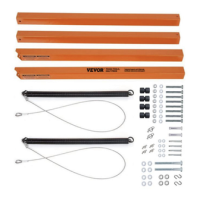

 To Next Page