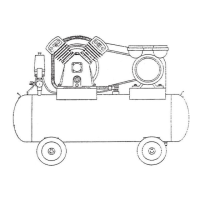
This document describes the VEVOR 80 Gallon Air Compressor, a robust tool designed for various applications requiring compressed air.
Function Description
The VEVOR 80 Gallon Air Compressor is a three-phase, oil-free electric air compressor. Its primary function is to compress air and store it in an 80-gallon (303L) gasholder for later use. The compressor is designed to provide a steady flow of compressed air for various tools and applications. It operates by drawing in ambient air through air filters, compressing it using a motor-driven pump, and then storing the compressed air in the gasholder. A pressure switch controls the motor's power supply based on the set pressure induction, ensuring efficient operation and preventing over-pressurization. The system includes safety features such as a safety valve, pressure gauges, and exhaust valves to ensure safe operation.
Important Technical Specifications
- Model: FB3500-10A300
- Net Weight (N.W.): 348.3 LBS (158 Kg)
- Gross Weight (G.W.): 401.2 LBS (182 Kg)
- Carton Size: 23.8 x 23.8 x 65.6 inches (605 x 605 x 1665 mm)
- Voltage: AC 220V/60Hz
- Capacity: 5HP (3.78kW ± 10%)
- Volume: 80 Gallon (303L)
- Flow: 15.5 SCFM ± 5% @ 90 PSI
- Motor Type: Three-phase motor
- Lubrication: Oil-free lubrication (no lubricating oil required or permitted)
Usage Features
Assembly and Installation:
The compressor requires proper assembly and installation to ensure safe and effective operation.
- Fixation: To prevent collision and collapse, the machine must be fixed to the ground using foot bolts before use.
- Air Filters: Four air filters need to be installed at the air compressor intake ports.
- Electrical Connection: The cover shell of the air pressure switch must be disassembled to connect the external three-phase five-core cable to the air pressure switch. After connection, the cover shell needs to be fastened again. It is crucial to check the motor rotation direction against the arrow on the main engine; if opposite, the two live wires must be switched. The wire diameter of the cable should be selected according to the power requirements, as detailed in Chapter 2 of the manual.
Electrical Safety Precautions:
- Grounding: The power supply environment must have a good grounding device, utilizing a three-core plug and a well-grounded three-hole socket.
- Power Supply Matching: Before powering on, ensure the provided power supply matches the input power information marked near the product's input port.
- Dedicated Socket: Do not share the socket with other electrical appliances to prevent voltage instability and potential damage.
- Power Disconnection: Always unplug the power cord to completely power off the product before any maintenance, repair, or cleaning operations.
- Cable Integrity: Regularly check the power cord and plug for damage and ensure the power cord is not squeezed by other items.
General Operation:
- Working Environment: Ensure no objects are within the compressor's travel range during operation.
- Drainage: The gas storage tank should be drained regularly, typically every one to two days. The discharged sewage must be treated in accordance with local laws and regulations.
- Silencer Cleaning: The silencer should be cleaned often.
Maintenance Features
General Maintenance:
- Oil-Free System: The compressor is designed for oil-free lubrication; adding any lubricating oil is strictly prohibited.
- Drainage and Filter Cleaning: The machine should be drained every one to two days, and the noise filter should be cleaned regularly.
- Overheat Protection: If the compressor stops suddenly due to overheating, the motor heat protector will automatically disconnect power. This is a normal protective measure. The compressor will restart automatically once the temperature decreases.
- Troubleshooting Start-up Issues: If the compressor does not start normally, check the power supply and plug contact. If issues persist, it may indicate a motor or control system fault, requiring professional assistance.
Common Fault Maintenance and Troubleshooting:
-
Motor Not Turning/No Sound:
- Possible Reasons: No power, disconnected pressure switch, blown fuse, overload protector in protection state, damaged pressure switch, burned motor stator winding, dropped/damaged time relay, damaged AC contactor.
- Treatment: Check plug/switch, reset switch (determine cause), replace fuse, allow motor to cool (it will restart), contact service center (for switch/stator/relay/contactor issues).
-
Motor Has Current Sound but Doesn't Run/Runs Slowly:
- Possible Reasons: Low voltage, reduced/damaged starting capacitor capacity, motor coil short circuit/open circuit.
- Treatment: Check voltage (must be ≥ 10% of rated), check/replace capacitor, contact service center for motor coil issues.
-
Overload Protector Repeatedly Cuts Off Power:
- Possible Reasons: Low voltage, poor ventilation/high temperature, three-phase motor inversion (high motor temperature).
- Treatment: Check voltage (must be ≥ 10% of rated), place compressor in a well-ventilated area, check and exclude motor inversion.
-
Pressure Drops After Shutdown:
- Possible Reasons: Loose/leaking air channel connection, open drainage valve, leaking check valve.
- Treatment: Check/remove drainage valve, tighten drainage valve, remove/clean drainage valve.
-
Discharged Gas Contains a Lot of Water:
- Possible Reasons: Large amount of water in gas storage tank, high humidity.
- Treatment: Drain water from gas storage tank, move compressor to a low-temperature area, or use an oil-water separator.
-
Air Compressor Keeps Running:
- Possible Reasons: Damaged air pressure switch, leakage.
- Treatment: Replace air pressure switch, check and remove leakage.
-
Air Compressor Vibrates:
- Possible Reasons: Loose fastener, damaged valve plate, damaged/lost support pad, motor out of phase.
- Treatment: Check/remove fasteners, check/replace valve plate, replace foot pad, check/remove motor out of phase.
-
Air Compressor is Slow or Cannot Reach Specified Pressure:
- Possible Reasons: Open drainage valve, blocked air filter, pipeline air leakage, poor valve plate action/foreign matter/air leakage, excessive piston ring/cylinder wear.
- Treatment: Tighten drainage valve, clean/replace filter element, check/remove filter, clean/replace filter, replace new product (for piston ring/cylinder wear).
-
High Operating Frequency:
- Possible Reasons: Pipeline leaks, gas consumption of equipment > gas production of compressor, sewage not discharged from gas storage tank.
- Treatment: Check/exclude leaks, replace with higher capacity compressor, exhaust water from air storage tank.
Important Maintenance Notes:
- Electrical Component Replacement: Power supply must be cut off when replacing electrical components.
- Professional Maintenance: Maintenance of the electric oil-free air compressor must be carried out by trained professional maintenance personnel. Untrained personnel should avoid operating the compressor to prevent wrong operations.
- Supervision: The elderly, children, and mentally disabled/ill individuals must be supervised by special persons to prevent damage caused by their control of the compressor.
- Safety Prohibition: Do not use the compressor if it is known or foreseen that it may cause harm to personnel.
- Disposal: After retirement, capacitance and electronic components should be processed according to local laws and regulations.
- Bolt Check: After two months of installation and use, check the connection bolts of the compressor. Tighten any loose bolts immediately. Recheck every six months thereafter.
- Pressure Discharge: The pressure in the air storage tank must be discharged before maintenance, moving, or transporting the compressor.
- Pressure Resistance Test: After six years of use, the air compressor storage tank should be tested for pressure resistance.
- Damage During Transport: If the compressor head or related parts (safety valve, pressure gauge, pressure controller, gas storage tank) are damaged during transport, they should be sent to relevant local departments for inspection or feedback to dealers for repair/replacement.
Disposal
This product should be disposed of in accordance with local regulations. If unsure, contact your local authority. Only qualified technicians are authorized to repair the Vertical Air Compressor. Always observe all safety notes and precautions in the manual.
Warranty
- Coverage: Covers claims for damage due to manufacturing faults.
- Claim Requirement: Proof of purchase, including the purchase date, is required for warranty claims.
- Customer Support: VEVOR's service team aims to reply to messages within 24 hours.
- Scope: VEVOR products are manufactured according to ISO9001 Quality Management procedures and are free of manufacturing defects.
- Duration: Covers manufacturing defects within 1 year from the date of purchase. Defective products will be replaced or repaired free of charge after inspection by a sales representative.
- Extension: A warranty claim does not extend the overall warranty period.
- Warranty Periods: Based on the warranty claim date.

 Need help?
 General

 To Next Page