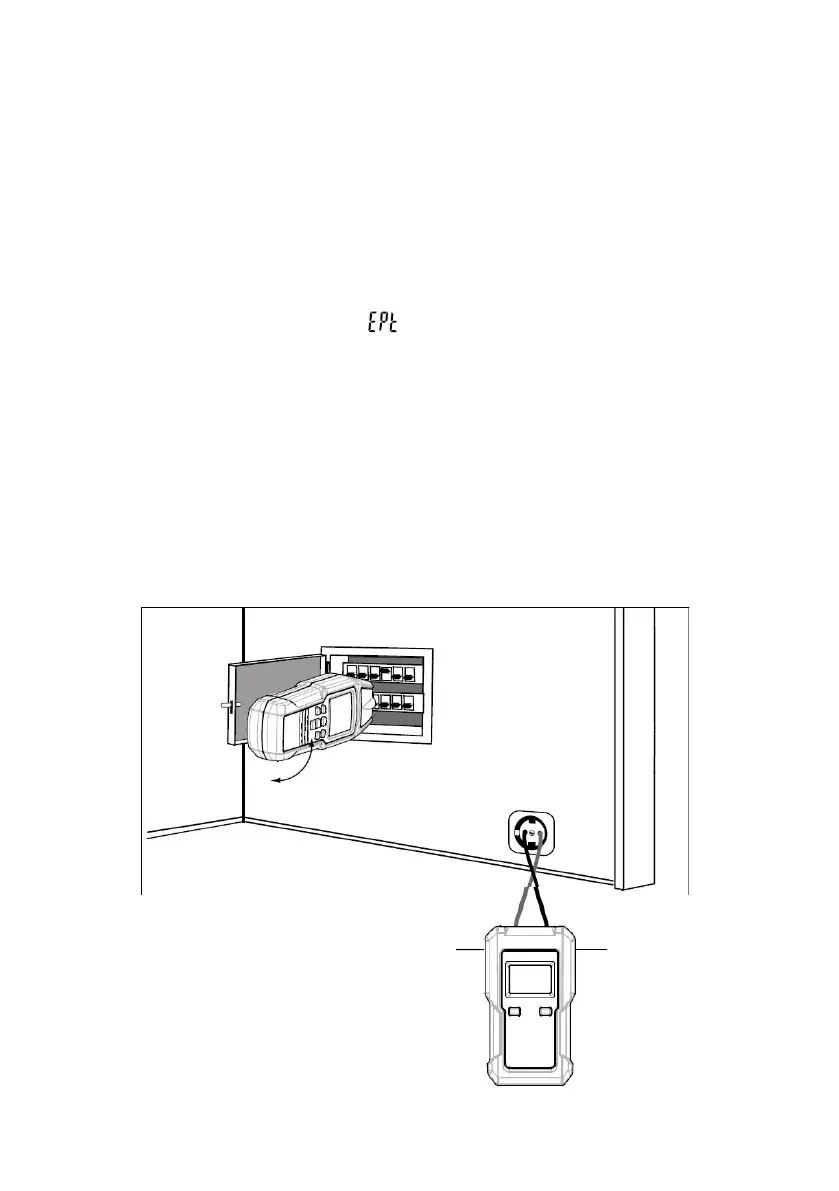
shown. Slowly move the receiver up and down over the rows of circuit
breakers or fuses. During this process, if two or more circuit breakers
( or fuses ) caused the receiver to give signal indication, decrease the
receiver's sensitivity and then scan slowly all breakers or fuses once
more.
When you finds the only one circuit breaker or fuse at which the
receiver gives signal indication, turn off the circuit breaker ( or remove
the fuse ). If the receiver stops giving audio and visual signal indications
and the transmitter displays " " instead of a voltage reading, the
circuit breaker ( or the fuse ) is the circuit breaker ( or fuse ) supplying
the outlet. If the transmitter still displays a voltage reading, it means that
the circuit breaker ( or the fuse ) is not the circuit breaker ( or fuse ) that
supplies the outlet.
The detection or assignment of the circuit breaker or fuse strongly
depends on the wiring realized within the distribution. To obtain a result
as precise as possible, the cover should be removed and the supply
line to the fuse should be traced.
Figure 12


 To Next Page