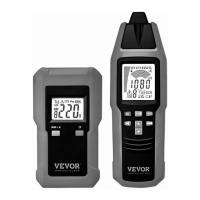
The test is performed in compliance with Figure 22. For this
application, no transmitter is required.
Select the mains voltage detection mode with the " NCV " button on
the receiver. ( When the mains voltage detection mode is selected, the
receiver displays the symbol " NCV " as an indicator. ) Move the
receiver probe close to the cable to be tested, and observe the receiver
to see where it gives signal indication.
The bargraph display indicating the signal intensity and the signal
sound frequency depend on the level of the voltage of the conductor
under test, the distance between the receiver and the live conductor,
the insulation of the conductor, etc.
The higher the frequency of the signal sound of the receiver, the
higher the voltage, or the lower the distance to the conductor.
Warning:
The signal intensity indicated by the receiver does not necessarily
indicate the level and type of the voltage of the conductor under test.
The value of a voltage can only be determined by a professional
measurement tool such as a multimeter.
The signal indication of the receiver is affected by the distance
between the receiver probe and the conductor under test, the voltage
of the conductor, the insulation of the conductor, etc. The conductor
under test may be live even if the receiver does not give any signal
indication. To avoid electric shock and personal injury, do not touch
any conductor with hand or skin.
Before and after each use, verify the receiver's operation by detecting
a known energized power socket. Do not use the receiver if it
operates abnormally or is damaged.
Non-contact mains voltage detection


 To Next Page
 Loading...