2021 RSS Manual all models.doc. Page 4 // 02/12/21
OPERATING INSTRUCTIONS:
UNPACKING-
Before placing the RSS into use, please observe the following Precautions.
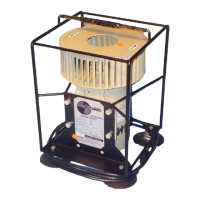
1. Remove the RSS from the case by pulling it upward by its frame, never the fan wheel.
2. Place it upright on its rubber feet on a firm floor or bench. The feet isolator bolt heads
should protrude above the steel plate by 1/8” – 3/16”. Adjust as needed
3. Inspect fan wheel for uniformity and firmness of shaft attachment. Use 4 mm Allen key
supplied to torque both wheel hub set screws to 30 inch-pounds if in doubt. (Access Allen
screw heads between fan wheel blades). Before plugging into AC power check that the fan
wheel turns freely and evenly by hand.
ACOUSTICAL APPLICATION-
Set the RSS on its feet at the desired location. Maintain its spacing from vertical surfaces
according to your applicable acoustical test requirements. The floor under the RSS should be
firm and not prone to act as a "sounding board" which can emit vibration induced sounds. The
spring-isolated feet should prevent this for wood joist floors. If the RSS is set on an elevated
flat horizontal surface that “baffle” surface should be at least 3' (1m) square or round to assure
that the calibrated sound power is emitted into the test area. That baffle should not be so light
(e.g. thin sheet metal) as to act as a sounding board despite the isolator spring action. If
vibration induced sound is still found to be radiated from such a thin sheet, then use additional
cushioning such as small foam rubber pads 1/2" to 1" thick under the feet of the RSS or use a
more massive baffle plate in place of, or over, the sheet metal.
Check RPM with a tachometer or strobe and compare to the nominal values in this manual or
the calibration documentation for your specific unit. If possible, operate the RSS on a variac
and adjust the input voltage as to match the nominal or calibrated RPM for the unit.
Generally, the RPM of an RSS will drop slightly after warming up for about 5 minutes. If the
stabilized RPM is lower than expected, then the AC line voltage source may be too low, or if
an extension cord is used, it may need to be shorter or have heavier gauge wire.
Operation at other RPM values can be corrected according to Corrections section of this
document.


 To Next Page
 Loading...