14
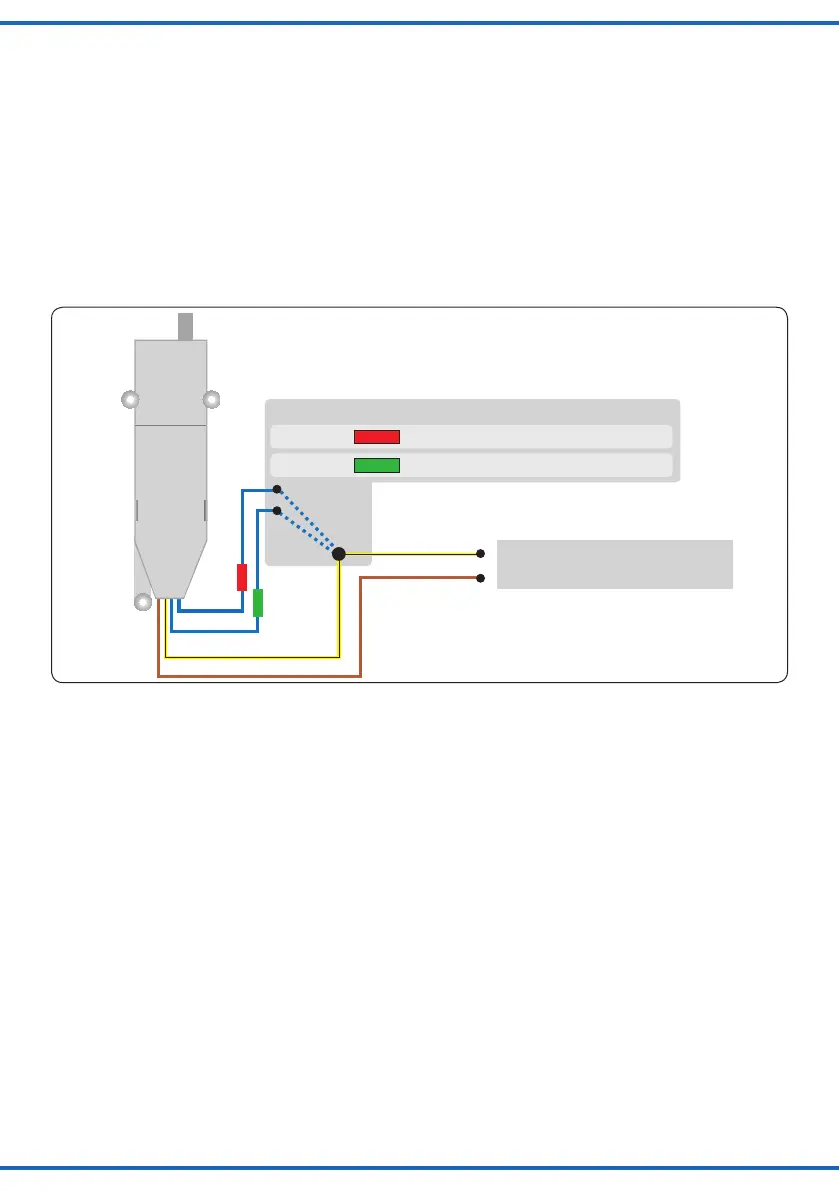
Mot. / DCC
4554
Motorola
DCC
gelb
Digitalzentrale
braun
Adresse einstellen
grünes Kabel verbinden
rotes Kabel verbinden
rot
grün
/ yellow
Digital command station
/ brown
/ Set address
/ connect green cable
/ connect red cable
green
red
Fig. 15
Abb. 15
4. Verbinden Sie die zweite (rot markierte) Steuerleitung
gleichfalls mit dem Gleis (s. Abb. 14).
5. Senden Sie mit der Digitalzentrale nun für die ge-
wünschte Motorola-Adresse einen Schaltbefehl.
Der Weichenantrieb empfängt den Befehl, registriert
die Adresse und quittiert dies durch Umschalten.
Damit ist der Weichenantrieb unter der neuen Adres-
se betriebsbereit. Falls Sie die Adresse künftig ändern
möchten, wiederholen Sie die Prozedur einfach.
Beachten Sie: Wenn Sie eine Zentrale einsetzen, die so-
wohl das DCC- als auch das Motorola-Format sendet, ist
die Programmierung des Weichenantriebs im DCC-For-
mat empfehlenswert.
4. Connect the second blue wire (red marker) to the
tracksignaltoo(seeg.14).
5. Use the digital command station to send a switch-
request for the desired Motorola-address. The switch
motor receives the request, registers the address as
it’s own and as a receipt, it switches the turnout.
The switch motor is now ready to be used with the new
digital address. If you want to change the address, you
just have to repeat the described procedure.
Notice: If you use a multiprotocol digital command sta-
tion, which is able to use the Motorola- as well as the
DCC-system simultaneuously, it is recommended to pro-
gram the switch motor on a DCC-address.
Stellungsrückmeldung per Relais
Der Weichenantrieb verfügt über einen Transistor-Schalt-
ausgang zur Rückmeldung der Weichenstellung. Damit
kann er beispielsweise bistabile Relais schalten. Der
Kontakt wird jeweils am Ende des Stellweges der Weiche
für ca. 250 ms eingeschaltet.
Sie können über diese, als Lötächen ausgeführten, Kon-
takte die Stellung der Weichenzunge an ein geeignetes
Steuerungssystem zurückmelden oder Schaltvorgänge
wie eine separate Herzstückpolarisierung auslösen.
Aufgrund der geringen Belastbarkeit und der kurzen
Schaltzeit nutzen Sie auf jeden Fall ein Relais wie z. B.
das Elektronische Relais von Viessmann (Art.-Nr. 5552).
Zum Anschluss siehe Abb. 16.
Stellungsrückmeldung per RailCom
Der Weichenantrieb sendet über RailCom
folgende Infor-
mationen an die Digitalzentrale:
- Eigene Digitaladresse
- Befehlsqittung mit Angabe der Sollstellung
Feedback via relais
The switch motor is equipped with a transistor-driven out-
put, which is able to feedback the position of the turnout.
This output is used to operate bistable relais. The contact
is turned on for approx. 250 ms, when the turnout reach-
es it’s respective end position.
By these contacts (soldering pads on the back of the cas-
ing), you may feedback the position of the turnout to a
suitable control system. The second use is to switch the
polarisation of the core of a turnout.
Due to the low maximum load of the contacts and the
short pulse length, it is important to use a relais (e. g. the
Viessmann electronic relay item-No. 5552) as shown in
g.16.
Feedback via RailCom
The switch motor sends via the RailCom protocol the fol-
lowing information to the digital command station:
- It’s own digital address
- A receipt with the requested turnout position


 To Next Page
 Loading...