Group
28
Ignition
systems
De
sign
and
function
General
A B
c
late
ignition
C.
Late
ign
it
ion
reduces
engine
power
since
the
pis
t
on
is t
ravelling
downwards
from
ToC
when
the
pr
essure
rise oc-
curs.
As
a
result
,
the
engine
does
not
utilize the
full
energy
content
of
the
fuel
.
Although
the
concentra
tions
of
unde
-
s
ira
ble
constituents
such
as HC,
CO,
NO
and
N0
2
are
lower
under
these
conditions,
the
engi
ne
require
s
more
fuel
to
deliver
the
same
outpu
t,
producing
a
greater
tota
l
volume
of
exhaust
gases.
Effects on cylinder
and
exhaust
gas
temperatures
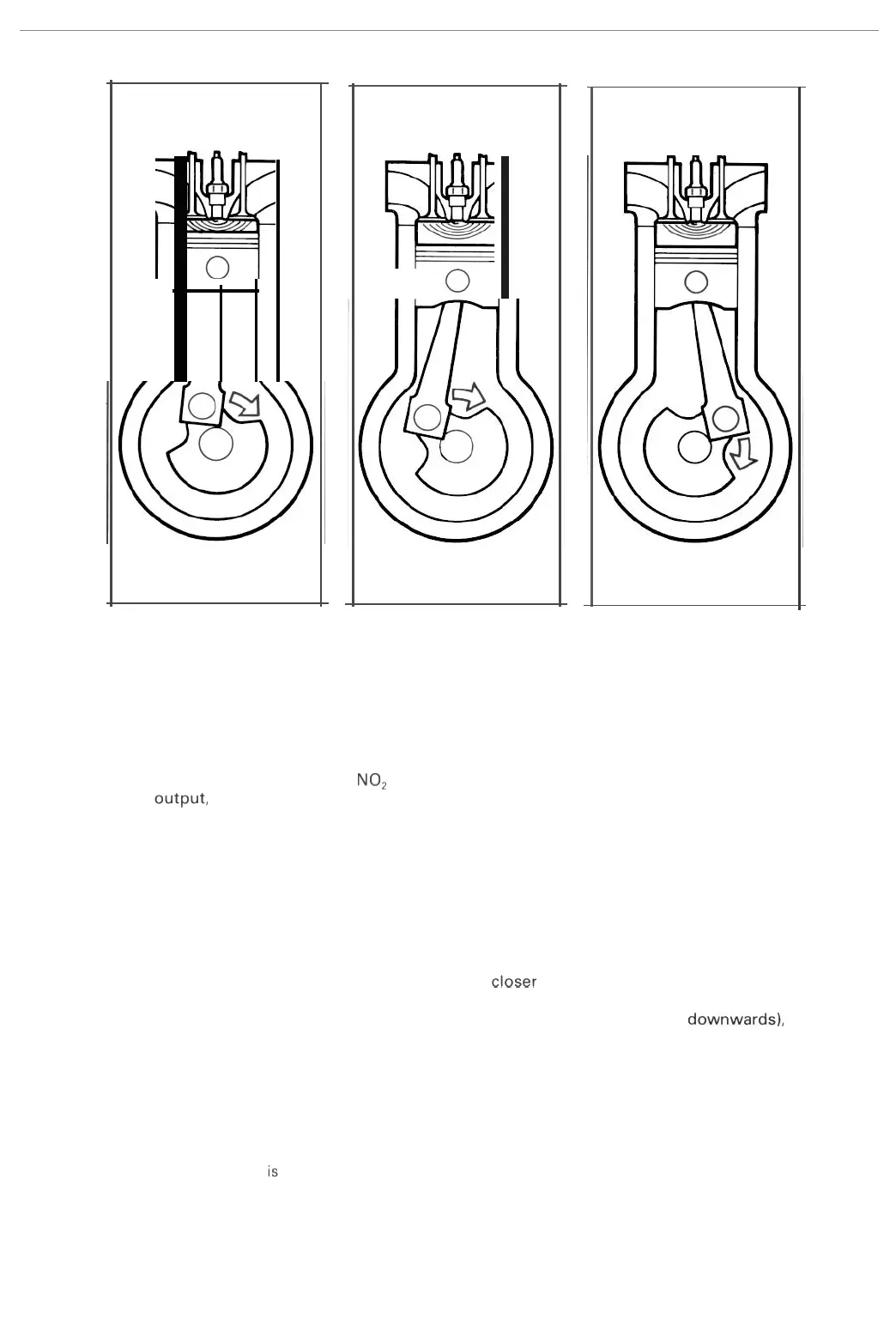
Advancing
the
ignition
(i.e.
generating
the
spark
to
ign
ite
the
fuel
/air
mixture
when
the
pis
ton
is
further
from
ToC
)
produ
ces a h
igher
combustion
temperature
and
a
low
er
exhaust
gas
temperature
than
when
the
tim
ing
is reta
rd
ed.
This is
due
to
the
fact
that
the
compression
produced
by
upward
movement
of
the
pis
t
on
reinforces
the
pressure
wave
developed
by
t
he
flame
front,
causing
the
cylinder
pressure
and
temperature
to
increase.
The
lower
ex
hau
st
gas
temperature
is
explained
by
the
somewhat
longer
interval
between
the
completion
of
combustion
and
th
e
open-
i
ng
of
the
exhaust
valve.
Re
tard
ing
the
igni
t
ion
(gene
rating
t
he
spark
when
the
piston
is
close
r
to
TD
C)
produces
a lo
wer
comb
us
ti
on t
em
per
-
a
ture
, but a
higher
exhaus
t
gas
temperature
than
when
the
timing
is
advanced.
Under
these
condi
tio
ns
, a hig
her
pro-
portion
of
t
he
energy
is released
during
the
expansion
stro
ke
(when
the
piston
is
moving
downwards),
r
educin
g
the
maximum
temperature
somewhat.
The
higher
exhaus
t gas t
emperature
is
explained
by
the
shorter interval
between
the
comple
ti
on
of
combustion
and
t
he
opening
of
the
exhaus
t valve.
-NOTE
; It is important
that
the follo
wing
terms
be
clearly understood in order to avoid confusion:
a)
Advancing the ignition timing means that the ignition pulse
is
delivered when the piston
is
at a point funher from
TOC.
b)
Retarding the ignition means that the ignition pulse
is
delivered when the piston
is
at a point closer to
TOC
.
• Under normal conditions, the aim
is to develop 'peak' pressure in the cylinder about
10
" after
TOC.
Under idling conditions, the
timing
is
advanced (to approx. 10-15" before
TOC)
to ensure smooth running.
•
The
foregoing discussion of how the emissions
are
affected by
th
e ignition timing
is
somewhat simplified, since there
are
natural·
Iy
many other factors which influence
th
e composition of the exhaust
gases.
10


 To Next Page