Group 28 Design and Function
Data Link System
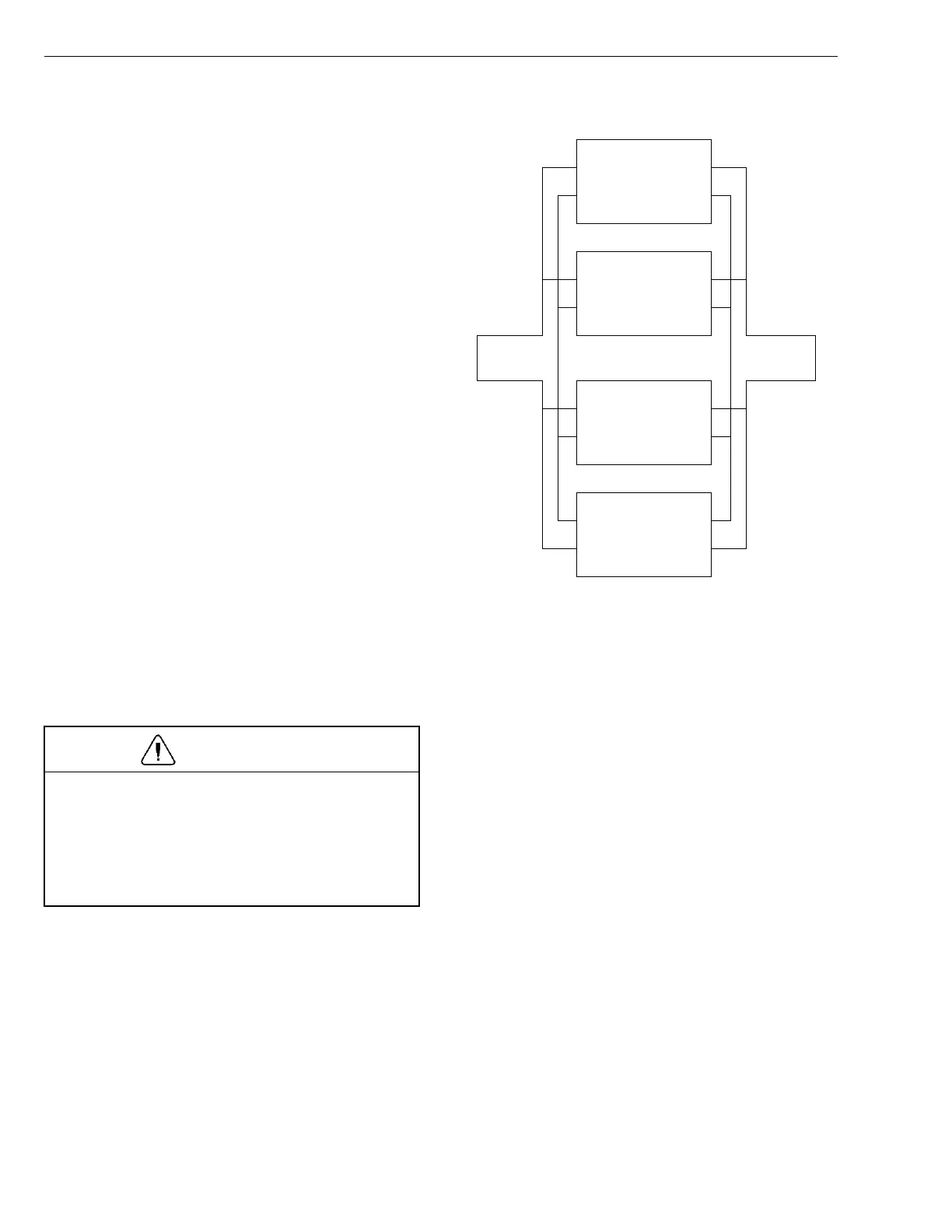
Volvo’s vehicle electronics are constructed on the princi-
ple that all communications between the control units in
the system are accomplished via two data links:
•
the J1939 Control Data Link
•
and the J1587/1708 Information Data Link
The vehicle’s main components have their own control
units that are connected to one or both links in order to
be able to communicate with each other.
Here is how the system works on a vehicle equipped
with a Volvo engine: when the driver wants to increase
the vehicle’s speed, a signal is sent from the accelerator
position sensor to the vehicle electronic control unit
(VECU). The signal is then transferred via the data link
to the engine electronic control unit (EECU).
The EECU communicates with its own sensors to verify
that the conditions exist to permit increased acceleration.
If the conditions are met, it carries out the VECU’s re-
quest.
The EECU communicates with the other control units via
the data links, either by requesting or by receiving direct
information that all prerequisites are met in order to be
able to carry out the request.
If an error should occur in any of the systems, a signal is
sent out on the J1587/1708 information data link, which
makes it possible to read the information, either on the
driver’s instrument cluster, or via a PC or diagnostic tool
(i.e. Pro-Link, VCADS or VCADS Pro) connected to the
diagnostic connector.
The data link system provides an extremely flexible solu-
tion with great potential for expansion.
CAUTION
No modifications or connections should be made to
wires 406 (yellow), 407 (green) or 408 (shielded).
These wires carry the high-speed communications be-
tween the electronic systems in the vehicle. Any
modification, connection to, or damage to these
wires can result in the failure of the vehicle’s elec-
tronic systems.
A
B
J1587
/1708
J1939
C
D
38


 To Next Page