EasyManua.ls Logo

VTdrive FWI-SS Series - User Manual

VTdrive FWI-SS Series
30 pages
Print Icon
To Next Page IconTo Next Page
Loading...
www.vtdrive.com
1
Soft Starter User Manual
Safety Clauses
1. The general of FWI-SS Series Soft Starter
1.1 The main function
1.2 The main characteristics
2. Code explanation and Check-up before using
3. Usage conditions and Installation directions
3.1 The Usage condition
3.2 The Installation requirement
3.3 The Installation Directions
4. Connection and External terminal
4.1 The diagram connection
4.2 The external terminal
4.3 The diagram of Main circuit connection
4.4 The communication interface
5. Control panel and its operation
5.1 The operation of control panel
5.2 Parameter set and explanation
5.3 The functions of "Programmable relay output"
5.4 The function of Automatic Re-start
5.5 Directions for other set items
5.6 Help message and explanation
6. Protection Functions and directions
6.1 Protection functions and theirs parameter
6.2 Protection classes and explanation
7. Test run and application
7.1 Set up electricity to test run
7.2 Starting modes and application
7.3 Stopping modes and application
7.4 Application example
Question and Answer IconNeed help?

Do you have a question about the VTdrive FWI-SS Series and is the answer not in the manual?

Summary

Safety Clauses

1. The General of FWI-SS Series Soft Starter

1.1 The main function

Explains the primary functions of the FWI-SS series soft starter.

1.2 The main characteristics

Details the key features and design aspects of the soft starter.

2. Code explanation and Check-up before using

3. Usage conditions and Installation directions

3.1 The Usage condition

Specifies the environmental and power requirements for using the soft starter.

3.2 The installation requirement

Outlines the necessary conditions and guidelines for installing the soft starter.

3.3 The Installation Dimensions

Provides external and installation dimensions for various soft starter models.

4. Connection and External terminal

4.1 The diagram connection

Illustrates the main circuit and external wiring connections for the soft starter.

4.2 The external terminal

Details the function and wiring of each external terminal on the soft starter.

4.3 The diagram of Main circuit connection

Shows the detailed main circuit diagram for the soft starter.

4.4 The communication interfaces

Describes the RJ-45 and DB9 communication ports and their functionalities.

5. Control panel and its operation

5.1 The operation of control panel

Explains how to operate the soft starter's control panel and interpret its indicators.

5.2 Parameters set and explanation

Details various parameter codes, their ranges, and special explanations for configuration.

5.3 The function of Programmable relay output

Explains the programmable relay output function and its operation modes.

5.4 The function of Re-start

Describes the automatic re-start function and its conditions.

5.5 Directions for other set items

Guides on setting other parameters like input way and display way using F8 item.

5.6 Help message and explanation

Explains how to access and use the help message feature on the control panel.

6. Protection Functions and directions

6.1 Protection Functions and theirs explanation

Details the various protection functions available in the soft starter.

6.2 Protection classes and explanation

Explains the different protection classes based on usage conditions.

7. Test run and application

7.1 Set up electricity to test run

Provides steps for setting up power and performing an initial test run.

7.2 Starting modes and application

Describes six different starting modes and their suitable applications.

7.3 Stopping modes and application

Explains the two stopping modes: soft-stopping and free-stopping.

7.4 Application example

Presents example parameters for different types of loadings.

Overview

This document describes the FWI-SS Series Soft Starter, a new generation of start-up equipment that integrates electric force, electronic techniques, computer technology, and modern control theory. It is designed to replace conventional Star-delta, Self-coupling voltage-drop, and Magnetic control voltage-drop starters.

Function Description:

The FWI-SS Soft Starter aims to optimize motor starting and stopping processes. Its main functions include:

  • Reduced Starting Current: Effectively lowers the motor's starting current and the power-distribution capacity required for the motor, leading to cost savings.
  • Extended Service Life: Minimizes starting stress on the motor and other loading equipment, thereby prolonging their operational life.
  • Soft Stopping: Addresses the surging problem often encountered in inertia systems during stopping, a feature not available in conventional motor starting equipment.
  • Comprehensive Protection: Provides robust and reliable protection features to ensure the safety of operators, the motor, and associated equipment.
  • Intelligent and Networked Operation: Incorporates intelligent and network techniques to align with the rapid development of automated electrical force technology.

Important Technical Specifications:

The FWI-SS series Soft Starter is designed for 3-phase asynchronous squirrel-cage motors.

  • Input Voltage: 3-phase AC 380V, 480V, or 660V ±10%, 50Hz or 60Hz. The power capacity must meet the motor starting requirements.
  • Matched Motor Power: Ranges from 5.5KW to 560KW, with specific models like FWI-SS3-5d5 (5.5KW), FWI-SS3-075 (75KW), FWI-SS3-400 (400KW), etc. The rated power of the matched motor should not exceed the maximum rated value of the soft starter.
  • Starting Frequency: Depends on the loading equipment.
  • Cooling Mode: Naturally wind cooling.
  • Protective Grade: IP20.
  • Environment Conditions:
    • Altitude: Less than 2000m.
    • Temperature: -25°C to 40°C.
    • Relative Humidity: Less than 90%, non-condensing.
    • Atmosphere: No vapor, flammable, volatile, corrosive gas, or electric dirt.
    • Installation: Indoor, ventilated, vibration less than 0.5G.
  • Output Load Resistance (for 0-20mA analogue output): Max 300Ω.
  • Communication Interfaces: RJ-45 standard web line socket and DB9 socket (with RS485 and RS232 interfaces).

Usage Features:

The soft starter offers a range of features for flexible operation and control:

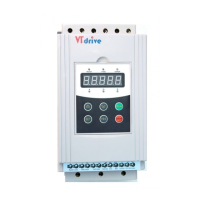
  • Control Panel: Features a display screen and keys for setting parameters and monitoring operation. It shows the current value of the motor during start/stop and displays set/help menus in other states.
  • Working States: Ready, Run, Fault, Start, and Stop.
  • Parameter Setting: Parameters are organized by function codes (e.g., P0 for voltage value, P1 for soft starting time, P6 for start-up limit current value, PB for starting modes).
  • Starting Modes: Six different starting modes can be chosen based on motor and load requirements:
    • Ramp Voltage to Start (F9=1): Output voltage rises gradually to the rated voltage. Suitable for smooth starts, especially with light loads.
    • Current-Limit to Start (F9=0): Output voltage rises quickly until the motor current reaches a set limit, then maintains it. Used when strict current limits are required during starting.
    • Torque Control to Start (F9=2 or 3): Provides a high voltage for a limited time to overcome static friction in heavy load conditions, then transitions to Ramp Voltage or Current-Limit mode. Note: This mode can cause significant current shock if not used carefully.
    • Ramp Current to Start (F9=4): Offers strong speed-up ability, suitable for bipolar motors and reducing starting time.
    • Double Closed Loop (F9=5): A composite mode combining Ramp Voltage and Current-Limit starting, adapting output voltage waveform based on motor and load.
  • Stopping Modes:
    • Soft-Stopping Mode (F2≠0): Gradually reduces output voltage to smoothly decrease motor speed, preventing mechanical shock. The soft-stopping limit-current value can be set via the FF item.
    • Free-Stopping Mode (F2=0): Cuts off power to the motor, allowing it to stop due to inertia. Recommended for extending the soft starter's service life when soft stopping is not critical.
  • Programmable Relay Output: Terminals 3 and 4 can be programmed for time sequence output (e.g., during starting, bypass operation, stopping) or state output (e.g., error state, operation state, ready state).
  • Automatic Re-start Function (FE≠0): Automatically restarts the soft starter after a power cut or fault, typically after a 60-second delay. This function is only effective with 2-wire external control connections.
  • Analogue Output: DC 0-20mA output (terminals 11 and 12) to display real-time motor current, with 20mA representing four times the rated current of the soft starter.

Maintenance Features:

  • Safety Clauses: Emphasizes careful reading of the manual, installation by technical personnel only, correct motor matching, avoiding capacitor connections to output terminals, sealing terminal insulation, fixed earthing, and powering off during maintenance.
  • Protection Functions:
    • Over-heat Protection: Activates when internal temperature exceeds 80°C ± 5°C, resets when temperature drops to 55°C.
    • Input/Output Failure-Phase Protection: Delayed time < 3s.
    • Three-Phase Unbalanced Protection: Activates if current difference among phases exceeds 50% ± 10% for > 3s.
    • Starting Over-Current Protection: Activates if current is > 5 times rated working current for a specified time.
    • Working Over-Load Protection: Inverse time thermal protection based on the maximum working current of the motor (set by F6).
    • Power Voltage Failure Protection: Activates if power voltage is < half of limited value or set value for < 0.5s or 3s.
    • Over-Voltage Protection: Activates if power voltage is > 130% of limited value or set value for < 0.5s or 3s.
    • Loading Short-Current Protection: Activates if current is > 10 times motor rated current for < 0.1s.
  • Protection Classes: Five classes (basic, light-load, standard, heavy-load, best protection) with varying levels of overload and over-current protection.
  • Fault Diagnosis: The control panel displays error codes (e.g., Err00 for fault removed, Err01 for external instantaneous stop terminal open, Err02 for soft starter too hot, Err03 for starting time too long, Err04 for input phase-failure, Err05 for output phase-failure, Err06 for three-phase unbalance, Err07 for starting over current, Err08 for running over load, Err09 for under voltage, Err10 for over voltage, Err11 for wrong parameters, Err12 for load short-circuit, Err13 for wrong automatic re-start connection, Err14 for wrong external terminal connection). A detailed table provides explanations and solutions for each error.
  • Preheating: If the ambient temperature is below -10°C, the starter should be preheated for 30 minutes before starting.
  • Parameter Recovery: Pressing the "Yes" key when opening the soft starter can restore set parameters to ex-factory values.
  • Help Menu: Accessible via the "Yes" key, providing explanations for various messages and settings.

VTdrive FWI-SS Series Specifications

General IconGeneral
BrandVTdrive
ModelFWI-SS Series
CategoryController
LanguageEnglish