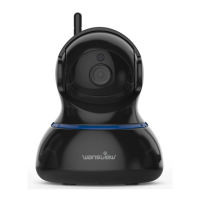
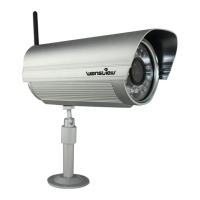
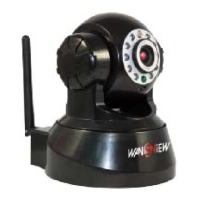
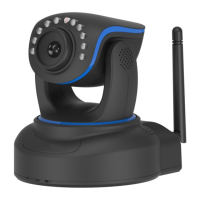
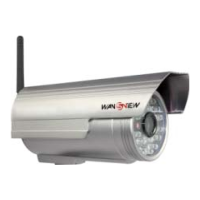
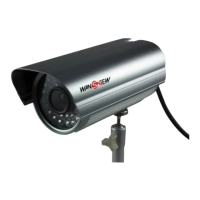
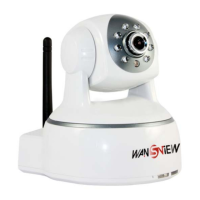
This document describes the Wansview IP Camera (M series), a versatile surveillance device suitable for various environments such as homes, shops, and office buildings. The manual emphasizes the professional nature of the camera's configuration and advises careful reading before use.
Function Description
The Wansview IP Camera offers comprehensive surveillance capabilities, including video streaming, audio communication, alarm settings, and various recording options. It supports multiple video streams (H.264 and MJPEG) simultaneously, allowing for local, internet, and cross-platform viewing. The camera features two-way intercom functionality with G.711 and G.726 audio encoding, enabling users to communicate through the device. For wireless monitoring, it integrates an 802.11b/g/n WiFi module and supports WPS/QSS for simplified wireless setup.
Alarm features include external alarm input, motion detection with adjustable sensitivity, and various alarm modes such as saving pictures/videos to an SD card or FTP server, triggering a relay, and sending email notifications. The camera also supports scheduled alarm times.
For remote access, the camera has a built-in web server and supports ONVIF and RTSP protocols, making it easy to integrate with Network Video Recorders (NVRs) or other client software. Each camera comes with a DDNS label for internet access. Wansview provides free client software for PCs, supporting multi-view, long-time recording, and video replay, as well as free mobile phone software for remote viewing.
Important Technical Specifications
- Video Resolution: Supports 1280x720, 640x360, and 320x180 resolutions.
- Video Streams: 3 kinds of H.264 video streams and 1 way MJPEG video stream simultaneously.
- Audio Encoding: G.711 and G.726.
- Wireless Protocol: 802.11b/g/n.
- Storage: Supports max. 32GB SD/TF card for alarm video/picture storage, timing snapshot, and recording. The SD card should be formatted to FAT32 before use.
- Network Protocols: ONVIF (version 2.0.1 at present) and RTSP.
- Power: Typically 5V or 12V, depending on the model.
- Operating Temperature: -10℃ to +50°C.
- Operating Humidity: Below 85%RH.
- HTTP Port: Configurable between 80 and 65535 (default 80).
- RTSP Port: Configurable (default 554).
- IR LED: Varies by model (e.g., 10 pcs, 11 pcs, 12 pcs, 36 pcs), providing night vision up to 5-25 meters.
- Lens: Varies by model (e.g., 3.6mm, 4mm, 8mm).
- PTZ Functionality: Available on certain models (e.g., NCM620W, NCM622W, NCM624W, NCM625W), supporting horizontal rotation up to 290-350° and vertical rotation up to 100-120°.
- Waterproof Rating: IP66 for outdoor models (e.g., NCM621W).
Usage Features
- Installation: Supports horizontal or wall mounting. Wired connection to LAN is established by connecting the camera to a router and using the provided "H&MSearch_en.exe" tool to configure its IP address.
- Wireless Connection: After wired setup, WiFi can be configured by selecting the wireless router, entering its password, and applying settings. WPS/QSS function is also supported for quick wireless setup.
- WAN Access: Achieved through port forwarding on the router and using the manufacturer's DDNS or a third-party DDNS service.
- Web Interface: Multi-languages web interface supporting 1/4/9 split screen for simultaneous viewing.
- Video Viewing: Users can select primary, second, or third video streams for viewing, with recommendations for different network conditions (LAN, WAN, mobile). PTZ control allows for camera movement and setting preset positions.
- Recording and Snapshots: "Snap" button saves pictures, "Record" button starts/stops video recording. "Check TF/SD card" allows browsing and downloading files from the SD card. "Playback" button opens a player for recorded videos.
- Video Parameters: Adjustable settings include power line frequency (to eliminate ripple), bit rate (influences fluency and bandwidth), and frame rate (influences image smoothness). Overlay options allow displaying time stamp and camera name on the monitoring image.
- Audio Parameters: Adjustable input/output volume. Choice between G.711 (better quality, more bandwidth) and G.726 (lower quality, less bandwidth) audio types. Audio capture can be enabled/disabled for each stream.
- Image Parameters: Brightness, saturation, contrast, flip, and mirror settings. IR LED control (Auto/Close) and Night Mode (On/Off) for enhanced night vision.
- User Management: Three levels of user authorization: Administrator (highest authority, default password "123456"), User (operate device but no settings, default password "user"), and Guest (view video only, default password "guest"). Users are advised to change default passwords for security.
- Auto Capture: Configurable interval for saving images to TF/SD card or FTP server.
- System Settings: Includes device information (ID, software version, MAC address, IP address, running time), date and time settings (manual or NTP server sync), initialize settings (reboot, restore factory default, backup/restore settings data), and firmware upgrade. System logs provide a record of device activities.
- Other Software Compatibility: Supports VLC player for RTSP streams and provides free PC client software (IPCMonitor) for multi-device management, real-time recording, and alarm functions.
Maintenance Features
- Troubleshooting: If issues arise, users are advised to contact the technology center.
- Firmware Upgrade: The manual mentions firmware upgrade functionality for updating system firmware and web UI.
- Factory Reset: The camera can be restored to factory default settings by holding the reset button for 10 seconds, which is useful if the user forgets login credentials or device parameters.
- SD Card Management: Users are instructed to insert the TF/SD card when the device is powered off to prevent damage and ensure proper reading. The SD card should be formatted to FAT32.
- Cleaning: For optical components, a clean, moistened cloth with alcohol can be used to gently wipe dirt. A dust cover should be used when the camera is not in use.
- Environmental Considerations: Keep the camera away from high temperatures, heat sources, direct sunlight, and damp environments. Avoid overheating or excessively cold conditions.
- Handling: Do not frequently move the camera between overheated and supercooled conditions to prevent frosting and extend service life. Do not move the camera when it is on to avoid damaging the main board.
- Power Supply: Always check the power adapter voltage before connecting to avoid damage.
- Physical Protection: Avoid banging the camera or subjecting it to strong impacts/shocks. Do not aim the camera directly into the sun or other intense light sources. Keep away from lasers when operating.
- Repair: If the equipment is not working properly, contact the store or service center. Unauthorized modification or repair is at the user's own risk.

 Need help?

 To Next Page
 General