EasyManua.ls Logo

WaveForm 4x4 MIMO - User Manual

WaveForm 4x4 MIMO
16 pages
Print Icon
To Next Page IconTo Next Page
Loading...
by
Your 4x4 MIMO External Antenna Kit is designed, sold, and
supported by Waveform and our team of Signal Specialists.
We’ve helped over 20,000 customers improve their signal
since our company was founded in 2007. We’ve installed and
congured thousands of devices in buildings across the country,
and we’re here to help. If you have any issues at all, please don’t
hesitate to reach out.
+1 (800) 761-3041
www.waveform.com
help@waveform.com
About Waveform
4x4 MIMO
External Antennas
We know, reading manuals isn’t always fun. But we promise its worth it.
We’ve helped thousands of customers improve signal to their cellular routers.
We’ve compiled everything we’ve learned in this manual.
Give it a read before you start: it’ll save you time and help you get the best
performance out of your 4x4 MIMO External Antenna.
PLEASE READ THIS FIRST:
3411 W. Lake Center Dr.,
Santa Ana, CA 92704

Other manuals for WaveForm 4x4 MIMO

Question and Answer IconNeed help?

Do you have a question about the WaveForm 4x4 MIMO and is the answer not in the manual?

Summary

PLEASE READ THIS FIRST

Introduction to the Manual

This section emphasizes the manual's value for improving signal and saving time by reading it before installation.

Install Manuals, Who Needs Em?

Contacting Waveform Support

Provides contact information and availability for customer support and feedback.

Before You Start

Usable Signal Definition

Defines what constitutes a 'usable' 4G LTE or 5G signal for antenna installation, requiring at least 0.1 Mbps.

How Much Improvement Should You Expect?

Expected Data Rate Improvements

Discusses the variable data rate improvements (10% to 200%) and the importance of location and direction.

Install Process Overview

Find Best Location and Direction

Emphasizes finding the optimal location and direction for significant performance impact.

Verify Performance and Hard-wire

Describes temporary testing and permanent wiring of the system.

Assembling the Antenna(s)

Mounting Orientation

Illustrates correct mounting orientation for drainage and arrow direction, with a link for detailed instructions.

Cross-Polarizing Log Periodic Antennas

Explains how to angle four Log Periodic Antennas for optimal 4x4 MIMO performance.

Positioning and Aiming the Antenna(s)

The Goal of Positioning

States the objective is to find the best location and direction to maximize data rates from the cellular router.

Running Speed Tests

How to Position & Aim

Your Data Rate Measurements

Assembling Your System

Complete Kit Setup Steps

Outlines the steps for assembling and installing the complete 4x4 MIMO External Antenna kit.

Test & Install Permanently

Surge Protection and Grounding

Explains the importance of surge protectors and grounding for antennas and mounts.

Advanced Optimization

Tower Search with eNB-ID

Guides on finding nearby towers using cellmapper.net and the router's eNB-ID.

Antenna Aiming and Band Testing

Details aiming antennas, running speed tests per band, and band locking for optimal performance.

Carrier Aggregation and Multi-Band Testing

Explains enabling multiple bands and carrier aggregation for potentially faster speeds.

Some Final Tips

Overview

This document is a user manual for the Waveform 4x4 MIMO External Antennas, designed to improve cellular signal and data rates for cellular routers and hotspots. The manual emphasizes the importance of reading it thoroughly to ensure optimal performance and avoid common installation pitfalls.

Function Description:

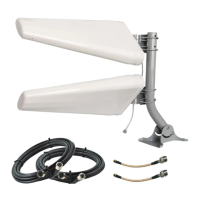
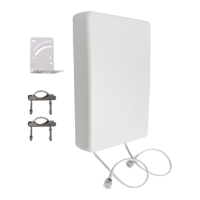
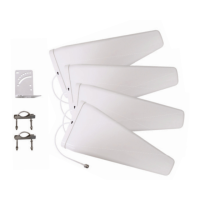
The Waveform 4x4 MIMO External Antennas are designed to enhance cellular signal reception and improve data rates for 3G, 4G LTE, and low/mid-band 5G services. The system utilizes Multiple-Input Multiple-Output (MIMO) technology, which involves using multiple antennas at both the transmitter and receiver to improve communication performance. The external antennas condition the outdoor signal, leading to better data rates for cellular routers and hotspots, particularly in areas with weak or obstructed signals. The kit is available with either a single 4x4 MIMO Panel Antenna or four Log Periodic Antennas, catering to different environmental conditions and signal requirements. The Log Periodic Antennas are recommended for line-of-sight to cell towers, while the Panel Antenna may perform better when surrounded by trees, buildings, or hills. The system is designed for outdoor installation, with cables routed indoors to connect to the cellular router.
Important Technical Specifications:

  • Antenna Types:
    • 4x4 MIMO Panel Antenna
    • Four Log Periodic Antennas (cross-polarized for optimal 4x4 MIMO connections)
  • Supported Bands:
    • AT&T: B2/n2, B4, B5/n5, B12, B17, B29, B30, B46, B66/n66, n77
    • Verizon: B2/n2, B4, B5/n5, B13, B46, B48/n48, B66/n66, n77
    • T-Mobile: B2, B4, B5, B12, B25, B26, B41/n41, B46, B66, B71/n71
    • CBRS: B48/n48
    • All supported LTE Bands: Band 1-10, Band 12-20, Band 23-30, Band 33-41, Band 46-48, Band 65-77, B85
    • All supported 5G Bands: n1, n2, n3, n5, n7, n8, n12, n14, n18, n20, n25, n26, n28, n29, n30, n34, n38, n39, n40, n41, n65, n66, n70, n71, n80, n81, n82, n83, n84, n86, n89, n90, n95
  • Cables: Quad-RS240 N-Male to SMA-Male Cables (included with complete kit).
  • Adapters:
    • 4x N-Male to SMA-Male Adapters (included with complete kit).
    • Pigtail Adapters (4x U.FL & 4x TS9) (optional, included with complete kit).
  • Mounting Hardware: J-Mount Bracket and Hardware, J-Mount Antenna Mount (2x for Log Periodic Kit).
  • Optional Accessories: 4x Lightning Protector Kits (recommended for grounding).
  • Grounding Cable Recommendation: At least 10 AWG (or thicker, e.g., 6 AWG, 8 AWG) for surge protectors and mount.
  • Tools Required for Assembly: Size-10mm wrench for mounting hardware; additional fasteners and tools for securing the J-Mount to the building.
  • Outdoor Connection Weatherproofing: N-Type connectors are outdoor rated, but wrapping with stretch-and-seal self-fusing silicone rubber tape is recommended for all outdoor N-type connections.

Usage Features:

  • Installation Process: The manual outlines a five-step installation process:
    1. Read the manual thoroughly.
    2. Assemble the antenna(s) to the mount.
    3. Find the best antenna location and direction through testing.
    4. Verify performance with temporary cable runs and then hard-wire everything.
    5. Provide feedback to Waveform.
  • Antenna Positioning and Aiming: This is highlighted as the most crucial step for maximizing data rates. Users are advised to test various outdoor locations (roof, side walls) and directions using speed tests. The manual suggests that the highest point on the roof isn't always best due to potential interference, and side-of-building mounting can offer shielding.
  • "Test Mode" Setup: Instructions are provided for setting up the antenna(s) and router outdoors for initial testing, either by bringing a battery-powered router outside or by using extension cables for the antenna(s) while the router remains indoors.
  • Speed Testing: Users are encouraged to use speed test apps (e.g., "Speedtest by Ookla" on phone, speedtest.net on laptop) to measure data rates and compare results across different antenna positions and directions.
  • Cross-Polarization (Log Periodic Antennas): If using four Log Periodic Antennas, they should be angled 45 degrees in opposite directions and spread 3-4 ft apart to achieve cross-polarization, which is crucial for 4x4 MIMO connections.
  • Pigtail Adapters: Guidance is provided for connecting U.FL and TS9 pigtail adapters, including tips for handling small U.FL connectors (using tweezers and a pencil eraser) and improving TS9 connector grip (lightly squeezing the end).
  • Cable Management: Users are advised to lay Quad-RS240 cables flat to straighten them before routing and to keep any excess cable in large loops (4 ft or wider) to minimize negative side-effects.
  • Advanced Optimization: For users seeking further optimization, the manual suggests:
    • Using cellmapper.net to identify nearby cell towers and their eNB-IDs.
    • Aiming antennas at specific towers and testing different bands.
    • Utilizing bandlocking and carrier aggregation features on cellular routers (if supported) to find the fastest band combinations.
  • Alternative Mounting Configurations (Log Periodic Antennas): For obstructed terrain, horizontal side-by-side mounting is suggested, while for open terrain, vertical top-to-bottom mounting can be tried for additional performance.

Maintenance Features:

  • Re-optimization: If data rates decrease over time, users are advised to re-optimize their system by re-aiming the antenna(s), as carriers may change tower configurations (bands, new towers, or decommissioning old ones).
  • Technical Support: Waveform offers lifetime technical support for every system sold. Users can contact support via phone (+1 (800) 761-3041), email (help@waveform.com), or by booking a meeting (waveform.com/meet) for troubleshooting, fine-tuning, or any installation issues. Support is available Monday to Friday, 9 am-5 pm PT.
  • Grounding: It is critical to ground both the antenna mount and any lightning surge protectors to protect the router from lightning strikes and high-voltage power. Recommended grounding cable is at least 10 AWG. Detailed instructions on grounding are available at waveform.com/grounding.
  • Weatherproofing: All outdoor N-type connections should be wrapped with stretch-and-seal self-fusing silicone rubber tape to prevent water ingress and potential issues.

WaveForm 4x4 MIMO Specifications

General IconGeneral
BrandWaveForm
Model4x4 MIMO
CategoryAntenna
LanguageEnglish

Related product manuals