
 Need help?
Do you have a question about the WaveForm Cel-Fi GO X and is the answer not in the manual?
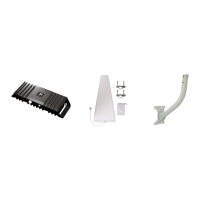
Lists the main Cel-Fi GO X amplifier and the outdoor directional antenna included in the kit.
Details the types of indoor antennas, cables, and signal splitters provided depending on the kit purchased.
Identifies miscellaneous components such as SMA pigtails, AC power adapter, and surge protector.
Defines what constitutes a 'usable' signal for the GO X installation, emphasizing call and data reliability.
Outlines the compatible cellular carriers, signal types (3G/LTE), and frequency bands for the GO X.
Explains how signal bars are displayed and why they are not the sole indicator of cellular performance.
Details Signal to Interference Plus Noise Ratio (SINR) and its impact on download speeds and system performance.
Explains Reference Signal Received Power (RSRP) and its significance for signal strength and coverage area.
Describes frequency bands used by cell carriers, their bandwidth, and how they affect data rates and penetration.
Offers solutions for common issues when pairing the Wave app with the GO X via Bluetooth.
Explains the meaning of the solid and blinking light patterns on the GO X unit indicating its status.
Details the sequence of activity light changes during the GO X device's startup process.
Instructions for setting up the GO X unit to function as a signal meter for antenna placement.
Guidance on utilizing the Wave app's 'Antenna Position Test' feature for optimal location finding.
Provides recommendations for the best location and direction to aim the outdoor antenna for maximum signal.
Information on panel antennas, their directional broadcast pattern, and recommended placement within a building.
Details on dome antennas, their omnidirectional broadcast pattern, and installation requirements for coverage.
Explains the importance of separation between indoor and outdoor antennas to prevent oscillation and improve gain.
Instructions on how to use the Wave app to monitor and ensure adequate antenna separation percentage.
Step-by-step guide on how to assemble the J-mount and securely attach the outdoor antenna to it.
Guidance on installing the lightning surge protector and proper grounding techniques for safety.
Recommendations for protecting outdoor cable connections using weather-resistant tape to prevent issues.
How to manage and test different cellular bands in the Wave app to optimize data rates.
The Cel-Fi GO X from Waveform is a powerful cellular signal booster designed to significantly improve signal strength and quality for various carriers, primarily focusing on Verizon, AT&T, and T-Mobile LTE and 3G bands. Unlike other boosters, the GO X doesn't blindly amplify every frequency; instead, it intelligently scans for and amplifies the best available signal for your chosen carrier, offering an industry-leading 100 dB of gain. This high level of amplification allows for a larger coverage area and stronger signal indoors.
The core function of the Cel-Fi GO X is to take a weak or low-quality cellular signal from outdoors, amplify it, and then rebroadcast a strong, high-quality signal indoors. This process helps users achieve better data rates, more reliable connections, and improved call quality within their buildings. The system works by utilizing an outdoor antenna to capture the existing cellular signal, a booster unit (the GO X amplifier) to process and amplify that signal, and one or more indoor antennas to distribute the boosted signal throughout the desired coverage area.
The GO X is designed to boost up to two frequency bands simultaneously. It actively listens and decodes cellular signals, ensuring that it amplifies the most optimal signal for your carrier. This intelligent scanning and amplification process is a key differentiator, as it helps to mitigate issues like "intra-cell interference" where multiple cell towers can interfere with each other, leading to poor signal quality. By carefully positioning and aiming the directional outdoor antenna, users can "shield" it from interfering towers, allowing the GO X to amplify a cleaner, higher-quality signal.
The device is compatible with AT&T 3G and LTE on Bands 2, 4, 5, 12, and 66; T-Mobile 3G and LTE on Bands 2, 4, 5, 12, and 66; and Verizon LTE on Bands 2, 4, 5, 13, and 66. While it does not support Verizon 2G/3G signal, this is generally not an issue for modern phones that support "HD Voice" or "Voice over LTE" (VoLTE). Cel-Fi has also indicated plans for a firmware update to enable 5G compatibility on the supported bands.
The installation and usage of the Cel-Fi GO X are guided by the Cel-Fi Wave app, which is a crucial tool for setup, monitoring, and optimization.
While the Cel-Fi GO X is designed for reliable operation, certain practices and components are included to ensure its longevity and optimal performance.
 General
| Model | Cel-Fi GO X |
|---|---|
| Type | Cellular Signal Booster |
| Category | Extender |
| Max Gain | 100 dB |
| Installation | Indoor/Outdoor |
| Frequency Bands | 700 MHz, 850 MHz, 1900 MHz |
| Coverage Area | Up to 15, 000 sq ft |
| Network Compatibility | 4G LTE |
| Connector Type | N-Type |
| Compatibility | Carrier-specific models available |
| Regulatory | FCC |

 To Next Page