Burst Power & Time Alignment
WHY?
Visual assessment of the burst and ramping time.
Measurement of transmitting power during the burst.
Test whether the mobile correctly executes a time align-
ment from the base station.
Requirement
Make the general test preparations. The channel type
must be To digital TC.
Initiate a call with
{MOBILE}
or
{CELL.}
(the mobile must be
in a digital traffic channel).
This is also possible in test mode of the mobile.
HOW?
Press
{BURSTS}
in the basic test mask.
Select in the scroll field whether the burst is to be shown
unfiltered (you see the signal on the input of the test
set) or filtered like from a base station (see IS-54
section 2.1.3.3).
Start the test with
{CONTIN}
(continuous measurement,
halted by
{STOP}
) or with
{1-SHOT}
(one measurement
frozen on display).
{RETURN} takes you back to the basic test mask.
Test Results
D
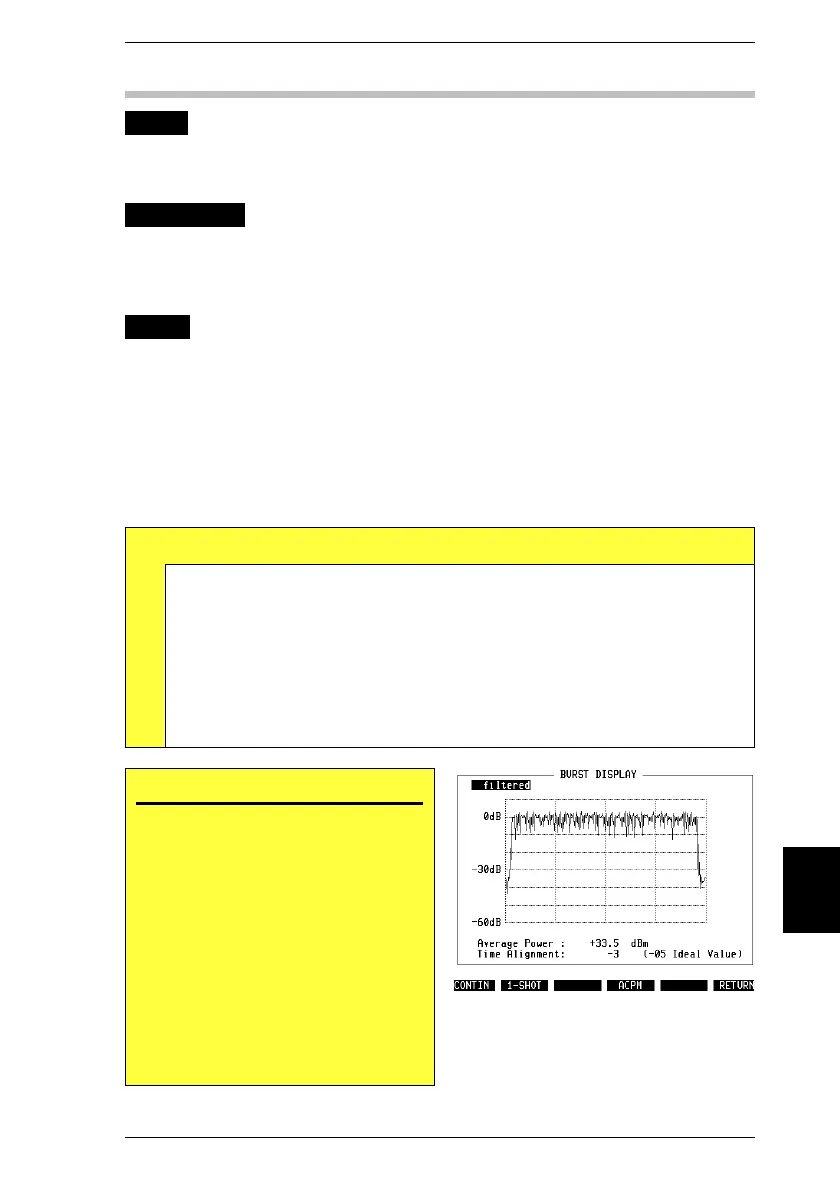
Burst from intact mobile should be similar to Fig. 10.23.
RESULt6 Averag. Power Average RF output power of mobile during burst
shown (missing measurement value? See box "No
PWR figure?" on page 10-24).
RESULt7 Time Alignment Time alignment assigned by test set (ideal value)
should be as close as possible to what is actually
measured. Display shows by how many units (1 unit
= 1 bit) mobile sends its bursts earlier (refered to time
alignment 0 = mobile is right near base station).
Why time alignment?
Without time alignment the bursts of
mobiles at different distances from the
base station would overlap. So, when re-
quested by the base station, mobiles
send "shorten" bursts that cannot cause
any interference because they are too
short. The base station computes the
time alignment from the propagation
delay of such bursts. The time alignment
is the amount of time by which a distant
mobile must transmit earlier than a close
one so that the normal bursts of both
mobiles fall precisely within the assigned
time slots.
Fig. 10.23: Burst display showing ramping
times and measured figures for power and
time alignment.
10
Burst Power & Time Alignment IS-136 MS
10-39



 To Next Page