EasyManua.ls Logo

Weed Eater WEF550B - Page 10

Weed Eater WEF550B
24 pages
Print Icon
To Next Page IconTo Next Page
To Previous Page IconTo Previous Page
Loading...
OPERATION
SPARK
PLUG
CHOKE
CONTROL
THROTTLE
=
You
will
find
tilling
much
easier
if
you
leave
a
row
untilled
between
passes.
Then
go
back
ove:
the
entire
area
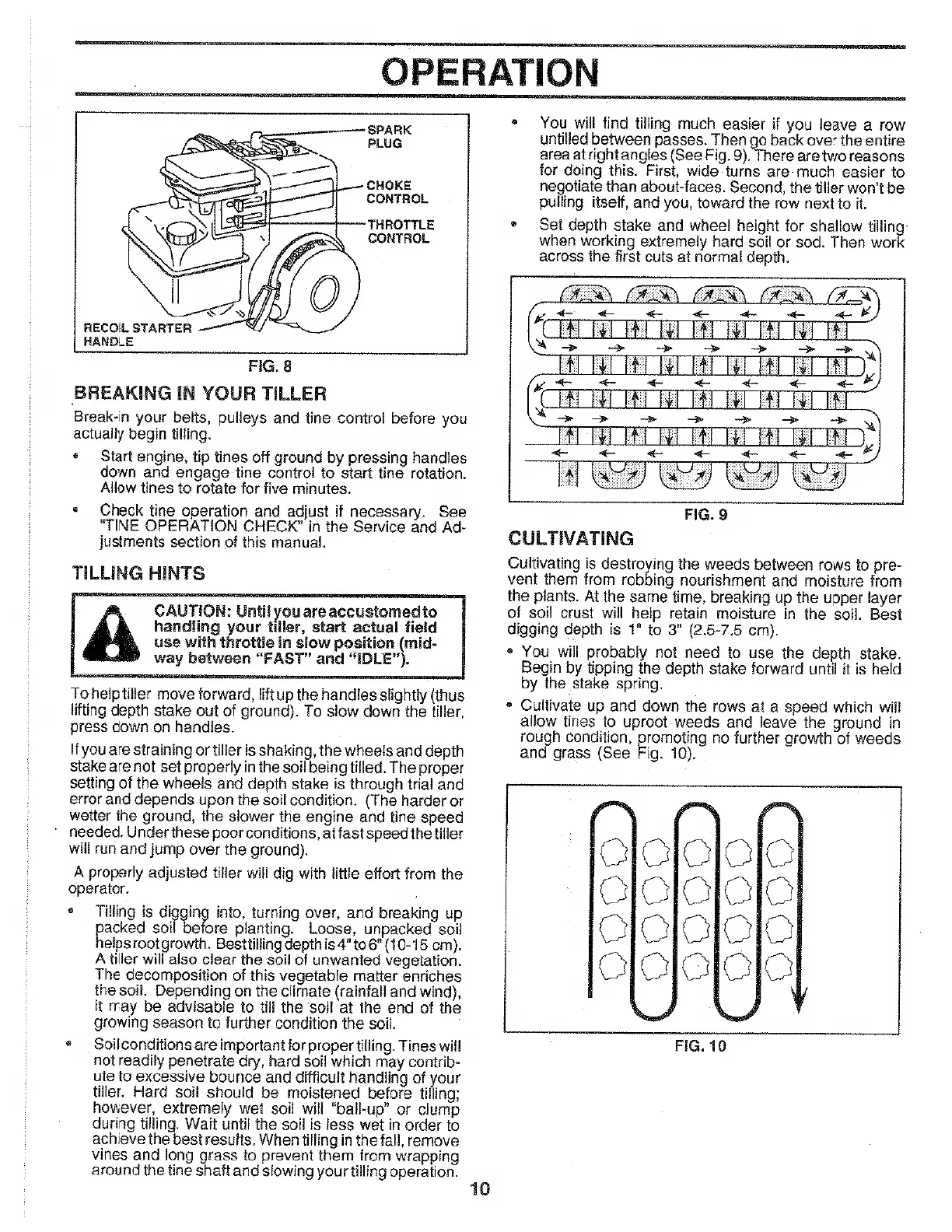
atrightangles
(See
Fig.
9).
There
are
two
reasons
for
doing
this.
First,
wide
turns
are-much
easier
to
negotiate
than
about-faces.
Second,
the
tiller
won't
be
pulling
itself,
and
you,
toward
the
row
next
to
it.
Set
depth
stake
and
wheel
height
for
shallow
tilling
CONTROL
when
working
extremely
hard
soil
or
sod.
Then
work
across
the
first
cuts
at
normal
depth.
(ES
(AR
FRO
FDG
*)
MENES
<
<
ps
<
<
K
RECOIL
STARTER
CA
RT
A
N
EROA
RTE
HANDLE
AW
>O
oe
>
>
FIG.
8
i
ELI
TAT
TAT
NT
ED,
MES
<
pz
<
<<
<—_
pn
BREAKING
IN
YOUR
TILLER
K
RT
HAA
ie
TF
Break-in
your
belts,
pulleys
and
tine
control
before
you
ee
> > > >
ya
actually
begin
tilling,
NAIRN
ARA
LEI
J
*
Start
engine,
tip
tines
off
ground
by
pressing
handles
et
ee
down
and
engage
tine
control
to
start
tine
rotation.
4
lz]
la
(a)
bzy
Allow
tines
to
rotate
for
five
minutes.
z
a
creck
Gee
ce
hate
ad
aos
eee
Ses
FIG.
9
Ps
ECK
int
>
E
ON
CHE!
in
the
Service
an
CULTIVATING
justments
section
of
this
manual.
TILLING
HINTS
CAUTION:
Until
you
areaccustomedto
handling
your
tiller,
start
actual
field
use
with
throttle
in
slow
position
(mid-
way
between
“FAST”
and
“IDLE”).
To
heiptiller
move
forward,
liftup
the
handles
slightly
(thus
lifting
depth
stake
out
of
ground).
To
slow
down
the
tiller,
press
down
on
handles.
Ifyou
are
straining
or
tiller
is
shaking,
the
wheels
and
depth
stake
are
not
set
properly
in
the
soil
being
tilled.
The
proper
setting
of
the
wheels.
and
depth
stake
is
through
trial
and
error
and
depends
upon
the
soil
condition.
(The
harder
or
wetter
the
ground,
the
slower
the
engine
and
tine
speed
`
needed.
Under
these
poor
conditions,
at
fast
speed
the
tiller
will
run
and
jump
over
the
ground).
A
properly
adjusted
tiller
will
dig
with
little
effort
from
the
operator.
e
Tilling
is
digging
into,
turning
over,
and
breaking
up
packed
soil
before
planting.
Loose,
unpacked
soil
helps
root
growth.
Besttilling
depth
is
4"
to6"
(10-15
cm).
A
tiller
will
also
clear
the
soil
of
unwanted
vegetation.
The
decomposition
of
this
vegetable
matter
enriches
the
soil.
Depending
on the
climate
(rainfall
and
wind),
it
may
be
advisable
to
till
the
soil
at
the
end
of
the
growing
season
to
further
condition
the
soil.
*
Soilconditions
are
important
for
proper
tilling.
Tines
will
not
readily
penetrate
dry,
hard
soil
which
may
contrib-
ute
to
excessive
bounce
and
difficult
handling
of
your
tiller.
Hard
soil
should
be
moistened
before
tilling;
however,
extremely
wet
soil
will
“ball-up”
or
clump
during
tilling.
Wait
until
the
soil
is
less
wet
in
order
to
achieve
the
bestresults.
When
tilling
in
the
fall,
remove
vines
and
long
grass
to
prevent
them
from
wrapping
around
the
tine
shaft
and
slowing
your
tilling
operation.
10
Cultivating
is
destroying
the
weeds
between
rows
to
pre-
vent
them
from
robbing
nourishment
and
moisture
from
the
plants.
At
the
same
time,
breaking
up
the
upper
layer
of
soil
crust
will
help
retain
moisture
in
the
soil.
Best
digging
depth
is
1"
to
3"
(2.5-7.5
cm).
e
You
will
probably
not
need
to
use
the
depth
stake.
Begin
by
tipping
the
depth
stake
forward
until
it
is
held
by
the
stake
spring.
e
Cultivate
up
and
down
the
rows
at
a
speed
which
wil
allow
tines
to
uproot
weeds
and
leave
the
ground
in
rough
condition,
promoting
no
further
growth
of
weeds
and
grass
(See
Fig.
10).
FIG.
10

Related product manuals