EasyManua.ls Logo

Weil-McLain CG-4 - SELECT THE BOILER LOCATION; INSTALLATION CLEARANCES

Weil-McLain CG-4
23 pages
Print Icon
To Next Page IconTo Next Page
To Previous Page IconTo Previous Page
Loading...
At
the
time
of
removal
of
an
existing
boiler,
the
following
steps
shall
be
followed
with
each
appliance
remaining
connected
to
the
common
venting
system
placed
in
operation,
while
the
other
appliances
remaining
connected
to
the
common
venting
system
are
not
in
operation.
a
Seal
any
unused
openings
in
the
common
venting
system.
b.
Visually
inspect
the
venting
system
for
proper
size
and
horizontal
pitch
and
determine
there
is
no
blockage
or
restriction,
leakage,
corrosion
and
other
deficiencies
which
could
cause
an
unsafe
condition.
c.
Insofar
as
is
practical,
close
all
building
doors
and
windows
and
all
doors
between
the
space
in
which
the
appliances
remaining
connected
to
the
common
venting
system
are
located
and
other
spaces
of
the
building.
Turn
on
clothes
dryers
and
any
appliance
not
connected
to
the
common
venting
system.
Turn
on
any
exhaust
fans,
such
as
range
hoods
and
bathroom
exhausts,
so
they
will
operate
at
maxi¬
mum
speed.
Do
not
operate
a
summer
exhaust
fan.
Close
fireplace
dampers.
d.
Place
in
operation
the
appliance
being
inspected.
Follow
the
lighting
instructions.
Adjust
thermostat
so
appliance
will
operate
continuously.
e.
Test
for
spillage
at
the
draft
hood
relief
opening
after
5
min¬
utes
of
main
burner
operation.
Use
the
flame
of
a
match
or
candle,
or
smoke
from
a
cigarette,
cigar
or
pipe.
f.
After
it
has
been
determined
that
each
appliance
remaining
connected
to
the
common
venting
system
properly
vents
when
tested
as
outlined
above,
return
doors,
windows,
exhaust
fans,
fireplace
dampers,
and
any
other
gas-burning
appliance
to
their
previous
conditions
of
use.
g.
Any
improper
operation
of
the
common
venting
system
should
be
corrected
so
the
installation
conforms
with
the
National
Fuel
Gas
Code,
ANSI
Z223.1
-
latest
edition.
When
resizing
any
portion
of
the
common
venting
system,
the
common
venting
system
should
be
resized
to
approach
the
minimum
size
as
determined
using
the
appropriate
tables
in
Appendix
G
in
the
National
Fuel
Gas
Code,
ANSI
Z223.1-
latest
edition.
Canadian
installations
must
comply
with
CAN/CGA
B
149.1
or
.2
Installation
Codes.
SELECT
THE
BOILER
LOCATION
Consider
all
connections
to
boiler
before
selecting
a
location.
Boiler
must
be
installed
so
that
gas
control
system
compo¬
nents
are
protected
from
dripping
or
spraying
water
or
rain
during
operation
or
service.
WARNING
To
avoid
personal
injury,
death
or
property
damage,
keep
boiler
area
clear
and
free
from
combustible
ma¬
terials,
gasoline
and
other
flammable
vapors
and
liquids.
INSTALLATION
CLEARANCES
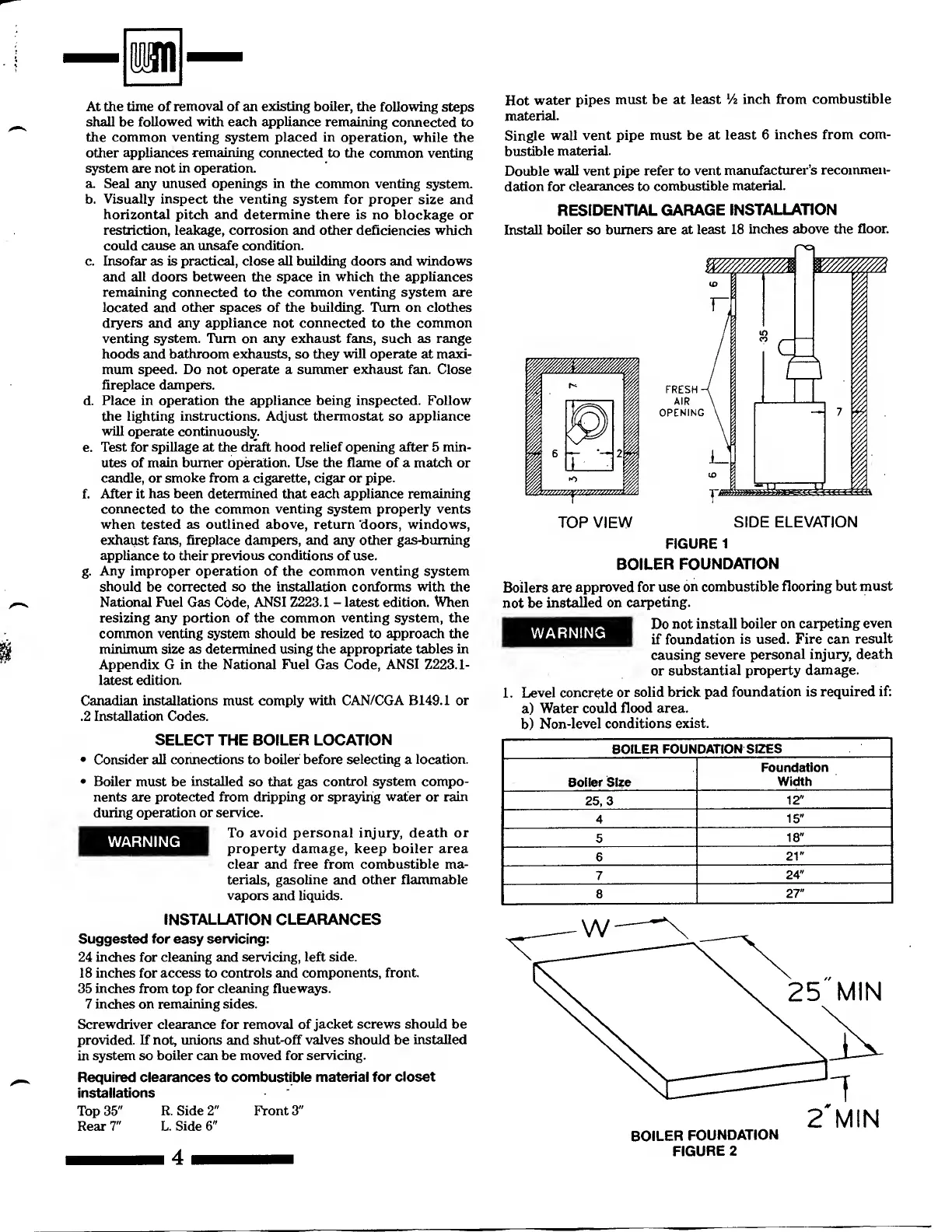
Suggested
for
easy
servicing:
24
inches
for
cleaning
and
servicing,
left
side.
18
inches
for
access
to
controls
and
components,
front.
35
inches
from
top
for
cleaning
flueways.
7
inches
on
remaining
sides.
Screwdriver
clearance
for
removal
of
jacket
screws
should
be
provided.
If
not,
unions
and
shut-off
valves
should
be
installed
in
system
so
boiler
can
be
moved
for
servicing.
Required
clearances
to
combustible
material
for
closet
installations
Top
35"
R.
Side
2"
Front
3"
Rear
7"
L.
Side
6"
Hot
water
pipes
must
be
at
least
l
A
inch
from
combustible
material.
Single
wall
vent
pipe
must
be
at
least
6
inches
from
com¬
bustible
material.
Double
wall
vent
pipe
refer
to
vent
manufacturer’s
recommen¬
dation
for
clearances
to
combustible
material.
RESIDENTIAL
GARAGE
INSTALLATION
Install
boiler
so
burners
are
at
least
18
inches
above
the
floor.
FIGURE
1
BOILER
FOUNDATION
Boilers
are
approved
for
use
on
combustible
flooring
but
must
not
be
installed
on
carpeting.
WARNING
Do
not
install
boiler
on
carpeting
even
if
foundation
is
used.
Fire
can
result
causing
severe
personal
injury,
death
or
substantial
property
damage.
1.
Level
concrete
or
solid
brick
pad
foundation
is
required
if:
a)
Water
could
flood
area.
b)
Non-level
conditions
exist.
2'M!N
4
BOILER
FOUNDATION
FIGURE
2

Related product manuals