EasyManua.ls Logo

Weil-McLain Evergreen Pro - User Manual

Weil-McLain Evergreen Pro
8 pages
Print Icon
To Next Page IconTo Next Page
Loading...
Part No. 550-100-268/1220
Hazard defi nitions
e following de ned terms are used throughout these Instructions to bring attention to the presence of hazards of
various risk levels or to important information concerning the life of the product.
Indicates presence of hazards that can cause severe personal injury, death or substantial property damage.
Indicates special instructions on installation, operation or maintenance that are important but not related
to personal injury or property damage.
Vent Category II Addendum Boiler Manual
KEEP THIS ADDENDUM WITH BOILER MANUAL
This Addendum adds to and supercedes items in the “Evergreen Boiler Manual”
(Part Number 550-100-131) and previously released Addenda’s.
Evergreen Boilers (EVG 220, EVG 299/300, and EVG 399) can now be vented in a Category II
confi guration.
In addition to the Evergreen boiler’s Category IV rating (positive pressure, likely to condense), Evergreen
boilers are approved for Category II (negative pressure, likely to condense) as well.
This new venting option includes / requires:
The Vent system for a Category II
Evergreen boiler is considered a Designed / Engineered vent system
and should be designed by a professional using accepted engineering practices in accordance to local
authority having jurisdiction.
Vertical Vent only.
Must not be installed into an existing common vent system with other appliances.
Combustion air must come from the boiler room. See Boiler Room Air opening requirements in this
Addendum.
Must increase venting to 6” using a 6” to 4” bell reducer at boiler vent adapter for Category II Vent
Connection.
The Vent System should be designed so that the pressure in the 6” vent pipe immediately following
the bell reducer is between the ranges provided in the Table 1, page 2, during all running (burner lit)
conditions (i.e., High Fire through Low Fire).
Flue gas temperature should not exceed 210°F; the boiler will shut down and recycle if it does. The
ue gas temperature should typically be within 20°F of the return water temperature of the boiler.
If there is the potential for a wide variation in return water temperatures, the lowest possible tem-
perature should be used for any calculations.
- continued on next page
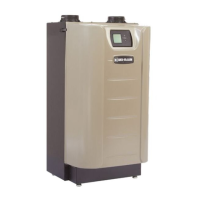
CONDENSING GAS BOILER
220/299/300/399
Question and Answer IconNeed help?

Do you have a question about the Weil-McLain Evergreen Pro and is the answer not in the manual?

Overview

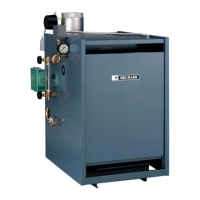
The Weil-McLain Evergreen Pro is a condensing gas boiler, available in models 220, 299/300, and 399. This addendum specifically details its operation in a Category II venting configuration, expanding upon the previously released Evergreen Boiler Manual (Part Number 550-100-131). While the Evergreen boiler is primarily rated for Category IV (positive pressure, likely to condense), it is also approved for Category II (negative pressure, likely to condense) applications.

Function Description:

The Evergreen Pro boiler heats water using natural gas, operating as a condensing unit. In a Category II configuration, it utilizes a designed/engineered vent system that operates under negative pressure and is likely to condense flue gases. This requires a vertical vent system that must not be installed into an existing common vent system with other appliances. Combustion air for Category II operation must be drawn from the boiler room itself, necessitating specific air opening requirements. The boiler's control system includes a Proof of Closure function, which can be wired to motorized air dampers to prevent firing if the damper is not fully open or to shut down the boiler if the damper closes during operation.

Important Technical Specifications:

  • Models and Input Btuh:
    • EVG 220: 220,000 Btuh
    • EVG 299: 299,000 Btuh
    • EVG 300: 300,000 Btuh
    • EVG 399: 399,000 Btuh
  • Stack / Vent Flow Rate (scfm) for Category II (at 9.25% CO2 and 210°F flue gas):
    • EVG 220: 61 scfm
    • EVG 299: 83 scfm
    • EVG 300: 83 scfm
    • EVG 399: 111 scfm
  • Negative Pressure at Vent Connection (Category II): Must be maintained between -0.001 to -0.100 inches w.c.
  • Vent Adapter Required for Category II: 6 inches for all models.
  • Flue Gas Temperature: Should not exceed 210°F. The boiler will shut down and recycle if this temperature is exceeded. Typically, flue gas temperature should be within 20°F of the return water temperature.
  • Vent Pipe Diameter: A 6-inch vent pipe diameter is required for Category II.
  • Vent Pipe Minimum Length: No minimum length for direct exhaust.
  • Clearances:
    • Vent termination must be at least 12 inches above the roof or snow line.
    • At least 6 feet from adjacent walls.
    • No closer than 5 feet below a roof overhang.
    • At least 3 feet above any forced air intake within 10 feet.
    • No closer than 48 inches below or horizontally from any door, window, or other gravity air inlet.
    • No closer than 4 feet horizontally from any electric meter, gas meter, regulator, relief valve, or other equipment.
    • Minimum clearance of 3/16 inch between vent pipe and any combustible wall or material.
  • Vent Pipe Slope: Horizontal piping must slope downward toward the boiler at least 1/4 inch per foot.
  • Combustion Air Opening Sizing: Varies based on the presence of other appliances and whether the air is drawn from outdoors, a ventilated attic, or a crawl space. Examples include 1 square inch per 1,000 Btuh of other appliances or 1 square inch per 4,000 Btuh of all appliances in the room (with specific conditions for single openings).
  • Tight Construction: ANSI Z223.1 defines unusually tight construction based on vapor retarders, weather-stripping, and caulking/sealants. Specific air opening requirements apply to such buildings.
  • Large Spaces Exception: No combustion air openings are needed if the boiler (and other appliances) are in a space with a volume no less than 50 cubic feet per 1,000 Btuh of all appliances, provided the building is not of tight construction.

Usage Features:

  • Category II Venting: Allows for vertical venting under negative pressure, suitable for installations where Category IV (positive pressure) venting may not be ideal or permitted.
  • Designed/Engineered Vent System: Requires professional design and adherence to accepted engineering practices and local codes.
  • Combustion Air from Boiler Room: Simplifies air intake by drawing directly from the installation space, but necessitates careful sizing of air openings to ensure adequate supply for all appliances and to prevent negative pressure conditions.
  • Carbon Monoxide Detector Requirement: A CO detector(s) is mandatory in the boiler room for Category II installations and must be wired on the same electrical circuit as the boiler.
  • Vent Pipe Reducer: Requires a 6-inch to 4-inch bell reducer at the boiler vent adapter to increase the vent pipe diameter to 6 inches.
  • Optional Venting Accessories: Weil-McLain recommends using a Variable Speed Chimney Fan/Power Venter and/or a Double Acting Barometric Damper or Modulating Damper to maintain appropriate negative pressure. A flow proving switch should be wired into the Proof of Closure jumper circuit on the boiler control when using such devices.
  • Thermal Spill Switch: Recommended when using any type of damper to detect exhaust flow into the boiler room. The Auto reset input on the boiler's control can be used for wiring.
  • Bird Screens: Required at all vent pipe terminations to prevent entry of birds or debris. These are not supplied with the boiler and must be purchased separately.
  • Contaminant Avoidance: Strict guidelines are provided to prevent the intake of corrosive contaminants (e.g., from swimming pools, laundry rooms, chemical storage) through the combustion air system, as these can damage the boiler.

Maintenance Features:

  • Annual Chimney Inspection (if used as a pipe chase): If a masonry chimney is used as a pipe chase for the vent pipe, it must be inspected at least once annually to verify its condition and ensure the sealed access opening is functional.
  • Regular Inspection of Vent and Air Piping: Thorough inspection of finished vent and air piping is required to ensure water-tightness and compliance with instructions and codes.
  • Monitoring Flue Gas Temperature: The boiler's control system monitors flue gas temperature, shutting down if it exceeds 210°F, which helps protect the system.
  • Cleanliness of Pipe Ends: Deburring, chamfering, and cleaning pipe ends are crucial during installation to ensure proper cement distribution and a secure, sealed joint, contributing to long-term system integrity.

Weil-McLain Evergreen Pro Specifications

General IconGeneral
BrandWeil-McLain
ModelEvergreen Pro
CategoryBoiler
LanguageEnglish

Related product manuals