15
Lathe Accessories
Three Jaw Universal Lathe Chuck
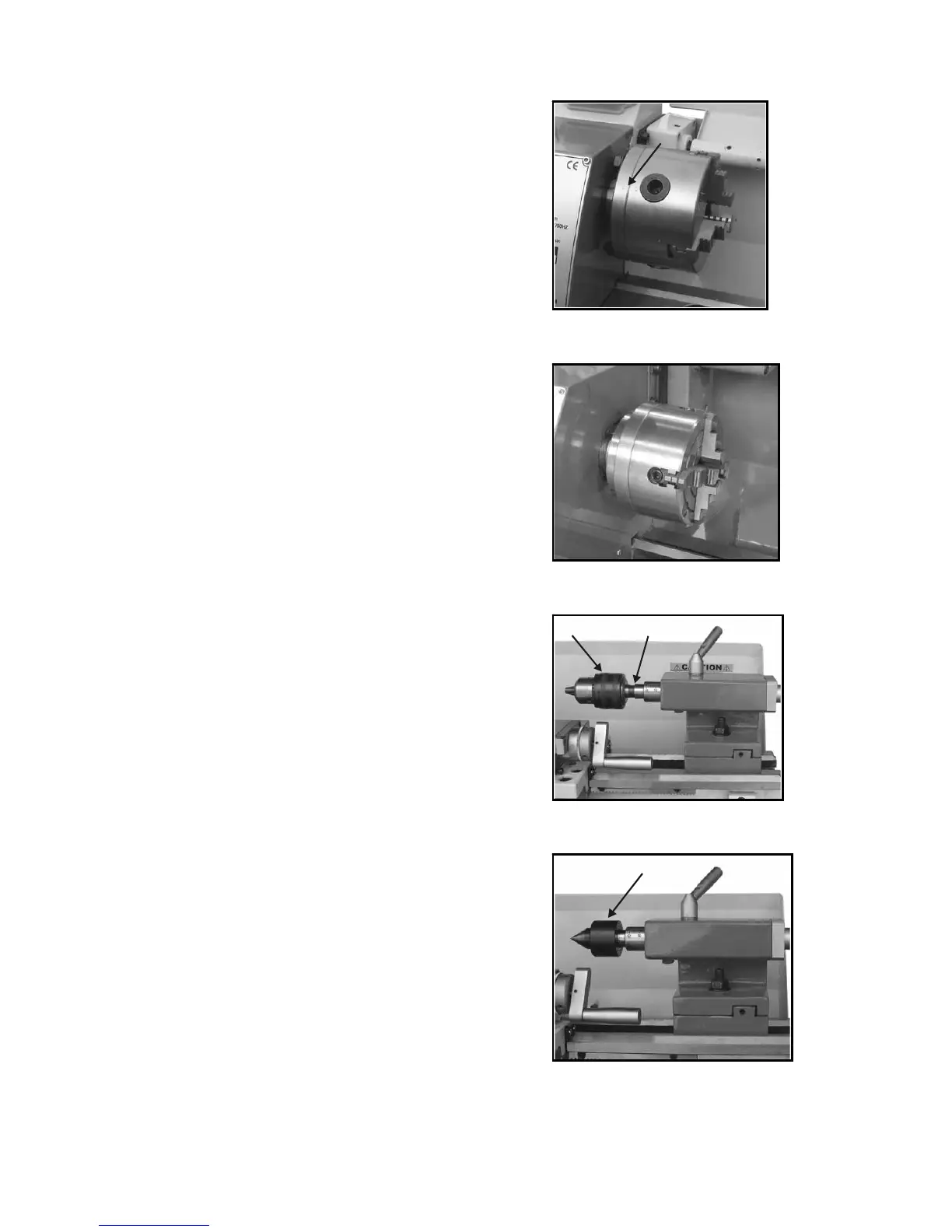
Using this universal chuck, round, triangular, square,
hexagonal octagonal, and twelve-cornered stock may
be clamped. (Fig.26)
Note: new lathes have very tight fitting jaws. This is
necessary to ensure accurate clamping and long
service life. With repeated opening and closing, the
jaw adjust automatically and their operation becomes
progressively smoother.
Note:
For the original 3-jaw chuck that mounted on the lathe,
the factory has mounted the chuck in the best way to
guarantee the holding accuracy with two “0” mark (A,
Fig.26) showed on the chuck and chuck flange.
There are two types of jaws: Internal and external
jaws. Please note that the number of jaws fit with the
number inside the chuck’s groove. Do not mix them
together. When you are going to mount them, please
mount them in ascending order 1-2-3, when you are
going to take them out, be sure to take them out in
descending order 3-2-1, one by one. After you finished
this procedure, rotate the jaws to the smallest diameter
and check that the three jaws are well fitted.
Four Jaw Independent Lathe Chuck
This special chuck has four independently adjustable
chuck jaws. These permit the holding of asymmetrical
pieces and enable the accurate set-up of cylindrical
pieces. (Fig.27)
Drill Chuck (Optional)
Use the drill chuck to hold centering drills and twist
drills in the tailstock. (B, Fig.28)
Morse Taper Arbor (Optional)
An arbor is necessary for mounting the drill chuck in
the tailstock. It has a No. 2 Morse taper. (C, Fig.28)
Live Center (Optional)
The live center is mounted in ball bearings. Its use is
highly recommended for turning at speeds in excess of
600 RPM. ( Fig.29)
Fig. 26
Fig. 27
Fig. 28
Fig. 29
A
CB
D


 To Next Page