Need help?
Do you have a question about the Weldclass WeldForce WF-180MST and is the answer not in the manual?
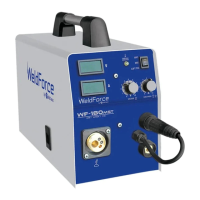
Displays actual voltage and current readings. Shows open circuit voltage when not welding.
Details on connecting the machine to a 10A 240V AC power supply.
Recommendations for using extension cords, including minimum cable core size.
Guidelines for using generators, including required size and quality ratings (THD).
Explains welding duty cycle as a percentage of active welding time.
Tips for resolving wire jamming issues, often caused by heat expansion or drive roll tension.
Information on spare parts for the supplied BZL 25 MIG Torch.
Details on the compatible Weldclass 9/17 TIG torch with valve.
Guidance on obtaining spare parts for the welding machine.
Instructions for storing the welder in a dry and frost-free environment.
Covers GMAW and FCAW processes, explaining basic MIG welding concepts.
Explains MIG welding, its variations, and application on steels and non-ferrous metals.
Details FCAW as an arc welding process using flux-filled wire.
Illustrates torch angles (push, vertical, drag pull) affecting weld width.
Discusses optimal electrode wire stick-out distance from the nozzle.
Explains the influence of travel speed on weld width and penetration.
Outlines preselected and primary adjustable variables controlling MIG welding parameters.
Guides selection of electrode wire size and shielding gas based on welding factors.
Addresses issues causing porosity in welds, often related to gas or contamination.
Lists faults and causes for wire feeding issues like slipping, tangling, or jamming.
Covers common MIG weld quality problems like undercut, lack of penetration, and cracking.
Discusses how electrode size is determined by metal thickness and machine capability.
Recommends storing electrodes in a dry place in their original containers.
Explains electrode connection to the holder and work lead for polarity.
Details how welding affects High Tensile Steel, Manganese Steels, and Cast Iron.
Classifies arc welding electrodes by application and lists common types.
Covers preparing steel sections for welding, including edge preparation and joint designs.
Provides basic MMA welding techniques, including striking the arc and maintaining arc length.
Explains the importance of arc length for weld quality, heat, and spatter.
Discusses adjusting travel speed for proper bead formation and preventing defects.
Guides on making butt welds, fillet welds, and vertical welds.
Details electrode polarity, types, and preparation for DCEN welding.
Lists recommended shielding gases for various alloys like carbon steel, stainless steel, and copper.
Provides recommended electrode angles and their corresponding current ranges.
A table detailing parameters for mild steel and stainless steel welding.
Instructions on pointing the electrode according to the welding current.
Lists general warnings and precautions for operating the welder.
Emphasizes proper setup and preparation before turning on the welder.
Stresses disconnecting power before any maintenance or cleaning.
Warns against touching live electrical components and recommends protective gear.
Advises on insulation and avoiding outdoor use to prevent electric shock.
Recommends ventilation and safety equipment to reduce exposure to dust.
Advises pacemaker users to consult a doctor before using the welder.
Guidelines for safely lifting and transporting the welding unit.
Stresses common sense and caution as essential factors for safe operation.
Advice on keeping the work area clean, lit, and free of obstructions.
Warns about intense heat and UV rays from arc rays and recommends protective gear.
Precautions for fire and explosion risks, including removing combustibles and watching for fire.
Highlights dangers of live electrical parts and emphasizes proper grounding and disconnection.
Warns about potential hearing damage from noise and recommends ear protection.
Warns that welding fumes and gases can be hazardous to health and require ventilation.
Details risks from sparks, spatter, hot metal, and potential ignition of flammables.
Recommends face shields, safety goggles, and protective clothing for chipping/grinding.
Warns about high pressure in gas cylinders and provides safety guidelines for handling.
 General
| Input Voltage | 240V |
|---|---|
| Efficiency | 85% |
| Power Factor | 0.7 |
| Insulation Class | F |
| Protection Class | IP21S |
| Welding Processes | MMA |
| Output Current Range | 10-180A |

 To Next Page