Operation
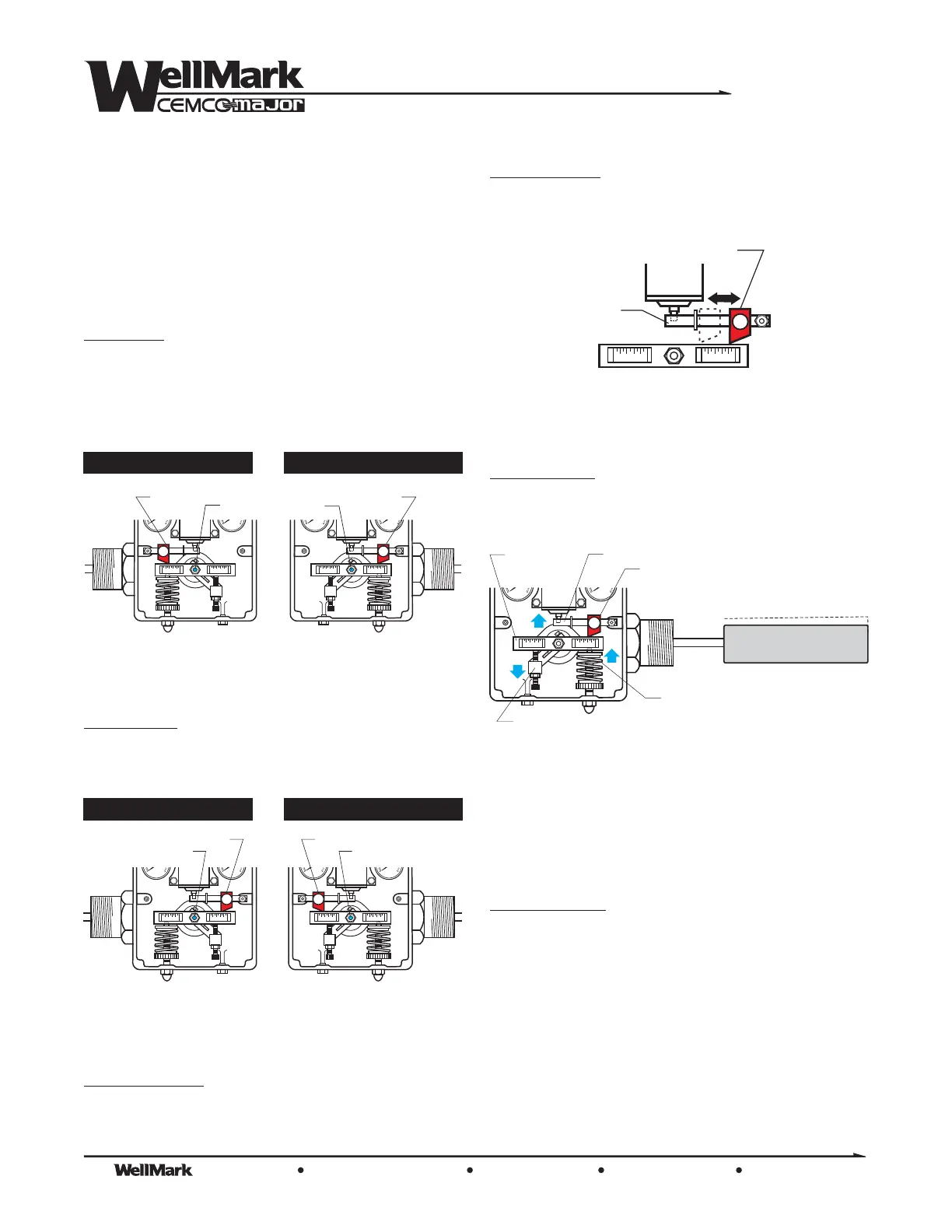
The 2001NB Level Control utilizes a balanced method, whereby a
spring acting on a lever balances the weight of the displacer in the
vessel. As liquid rises in the vessel, force is made available via the
Torque Bar (16) and Fulcrum (26), to the pilot proportional to the
weight of the displaced liquid. As the liquid level rises the amount of
force increases to the pilot.
configuration, whereby rising level Pilot
output. When the unit is configured for Direct-Acting operation the
Fulcrum will be located either left or right of the pivot depending upon
whether the unit is Left Hand Mount or Right Hand Mount as
illustrated below.
configuration (rising level Pilot output)
can be accomplished by moving the Fulcrum to the opposite side as
shown below.
refers to the differential between ON and OFF.
This is determined by the position of the Fulcrum along the Torque
Bar.
Direct-Acting
Reverse-Acting
Span or Dump Span
increases
decreases
The Company, L.L.C. Oklahoma City, Oklahoma Tel: (405) 672-6660 Fax: (405) 672-6661
wellmarkco.com
© The WellMark Company • Litho USA • All registered trademarks are the property of their respective owners. • IOM-2001NB 091007
2
2001NB
Series
REVERSE-ACTING
Rising level DECREASES Pilot output
FULCRUM
PIVOT
PIVOT
FULCRUM
LEFT HAND MOUNT RIGHT HAND MOUNT
psi psipsi psi
DIRECT-ACTING
Rising level INCREASES Pilot output
FULCRUM
PIVOT PIVOT
FULCRUM
LEFT HAND MOUNT RIGHT HAND MOUNT
psi psi psipsi
Proportional Band, when referring to a throttling control, is the ratio
of displacer actually used as compared to the overall length of the
displacer. For instance, a 50% proportional band would utilize 6” of a
12”displacer to achieve a 3-to-15 psi output.
FULCRUM
PILOT
FLAPPER
BAR
The Dump Span and Proportional Band are adjusted by moving the
Fulcrum along the Flapper Bar as necessary to achieve the desired
result.
- The Displacer’s weight is held in balance by the
Spring (21). Since the Displacer is buoyant, as the level rises the
apparent weight or of the Displacer decreases. As a result of
Level Adjustment
mass
psipsi
SPRING
ADJUSTMENT ARM
Differential force increases
as Displacer is unweighted
Rotates down, relieving
pressure on Torque Bar
Displacer’s apparent weight
decreases as fluid level rises
FLAPPER BAR
FULCRUM
PILOT
TORQUE
BAR
the rising Displacer the Adjusting Bar rotates, relieving pressure on
the Torque Bar. This results in an increase in differential Spring
force, transmitting that force to the Pilot poppet via the Fulcrum and
Flapper Bar. Increasing tension on the Spring lowers the sensed
level. Conversely, decreasing the spring force raises the sensed
level.
Some systems require control at the interface distinction between the
hydrocarbon and water. This is referred to as . It
is possible to adjust the Spring to a point at which the hydrocarbon
liquid completely envelopes the displacer without transmitting
enough force to engage the pilot and produce any output.
Water has a higher specific gravity than hydrocarbon and naturally
separates lower, with hydrocarbon liquid rising above it. When
properly adjusted, water can rise to a level on the displacer, changing
its apparent weight and causing enough force to engage the pilot,
which will then result in output. The 2001NB unit’s broad range of
control allows liquid interface sensing.
Interface Operation
interface operation


 To Next Page
 Loading...