The Company, L.L.C. Oklahoma City, Oklahoma Tel: (405) 672-6660 Fax: (405) 672-6661
wellmarkco.com
© The WellMark Company • Litho USA • All registered trademarks are the property of their respective owners. • IOM-2001NB 091007
3
2001NB
Series
Pilot Operation
IMPORTANT!
Snap-Acting Pilot • No-Bleed On/Off FlowAction
Throttle Pilot • No-Bleed Modulating FlowAction
Although the 2001NB Level Control is appropriately referred to
as , all pneumatic systems require that the
diaphragm operated motor valve exhausts or pressure off
the diaphragm once the valve has completed its actuation cycle.
This vented gas, along with the gas within the lines leading from
the control to the valve will vent back through the control. This
clear distinction, between gas and gas must be
made and understood. As with any or control, the
intent is to stop the unnecessary bleed of gas between valve
actuation cycles. The 2001NB Level Control will accomplish
this task. It will not however, nor will any other or
device stop the required venting of gas from the diaphragm and
lines once the valve has cycled.
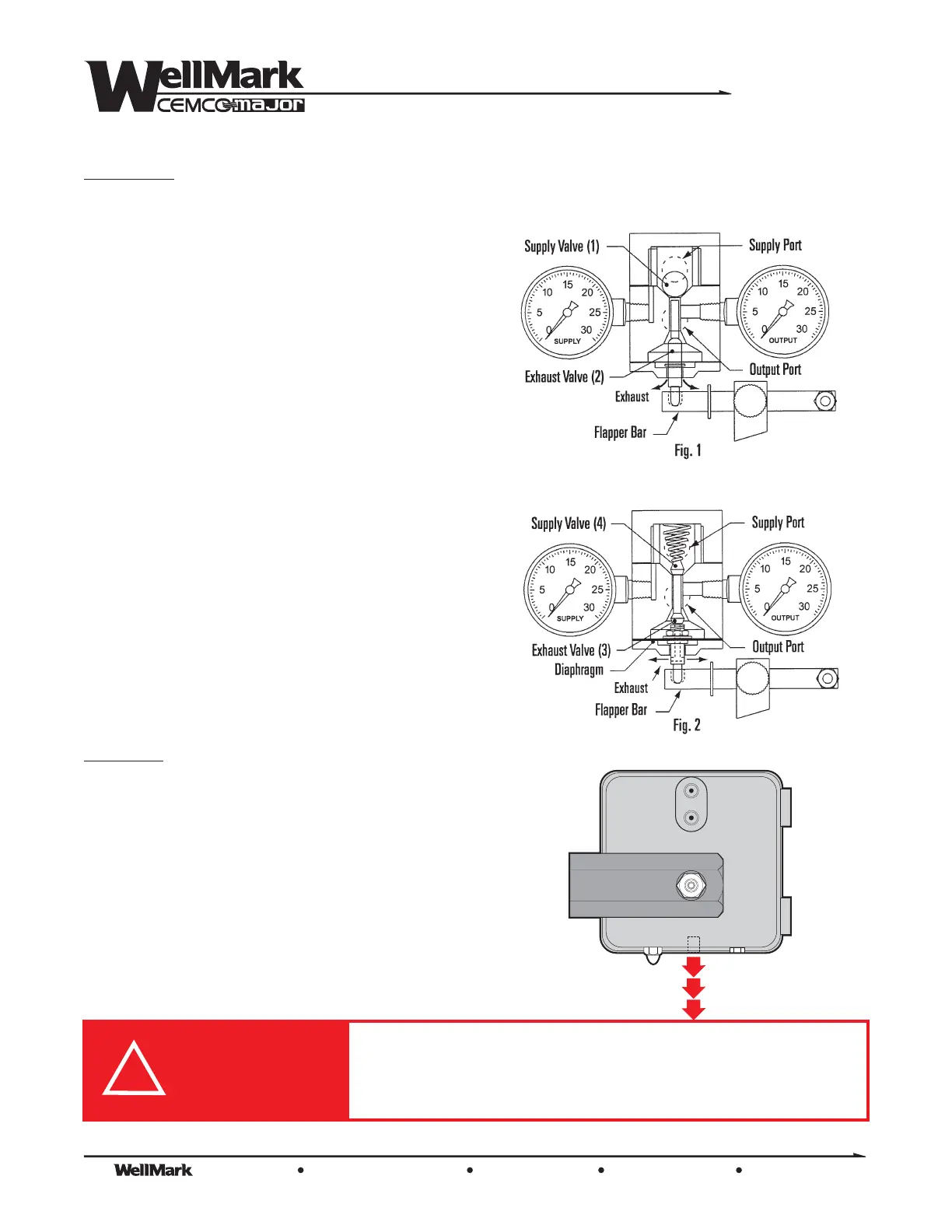
The Snap-Acting Pilot is comprised of two inner valves. Valve (1)
admits system supply gas to output. Valve (2) controls system
exhaust from output. Valve (1), as shown in the closed position (Fig.
1), is held closed by force exerted from supply gas. When upward
Flapper Bar forces transferred to Valve (2) is sufficient enough to
overcome supply force, the ball snaps upward, allowing supply
pressure to communicate to output port, which operates the
diaphragm motor valve (not shown). The spherical end of Valve (2)
closes the exhaust port the instant the ball snaps upward and
remains seated against supply pressure until force on the valve
diminishes. As force is removed from Valve (2), causing it to unseat,
a simultaneous action occurs, causing Valve (1) to seat instantly,
closing the supply port to ouput and opening output to exhaust,
thereby allowing the diaphragm motor valve to reverse it’s action.
The Throttle Pilot utilizes a diaphragm, which creates a forced
balance Pilot (Fig. 2). Output pressure acts upon the diaphragm
causing it to push back at the same force being applied to the lower
seat. More force on the seat produces a proportionate increase in
Pilot pressure. When the Flapper Bar of the control exerts upward
force on the lower valve seat, it forces the lower seat closed against
valve body and opens the supply valve. Supply pressure enters the
system, increasing until the control and diaphragm motor valve (not
shown) pressure equals the Flapper Bar force and produces a forced
system balance. The control will stay in this position until a decrease
in the tank level reduces the force allowing exhaust, or an increase in
the level produces an action as described. System supply gas does
not flow while the Pilot is in balance.
“No-Bleed”
vents
“bleed” “vent”
no- low-bleed
no- low-bleed
The 2001NB Level Control has a sealed box which allows the user to pipe vent gas
away from the facility as needed. This is highly recommended if the control is to
be mounted inside an enclosure that might result in a dangerous build up of gas.
Failure to do so may result in damage to equipment, personal injury or death.
!
CAUTION!
SUPPLY
OUTPUT


 To Next Page
 Loading...