Light
Emitter on
the ring
turns red.
the O2Ring
only has one
light emitter.
The device
screen
displays
“Error 1”.
Errors occur
during data
analysis.
Connect the power
supply and plug in
the charging cable,
press and hold the
touch key for 3s to
reset the hardware.
For more information about O2Ring, please visit:
https://getwellue.com/pages/faqs
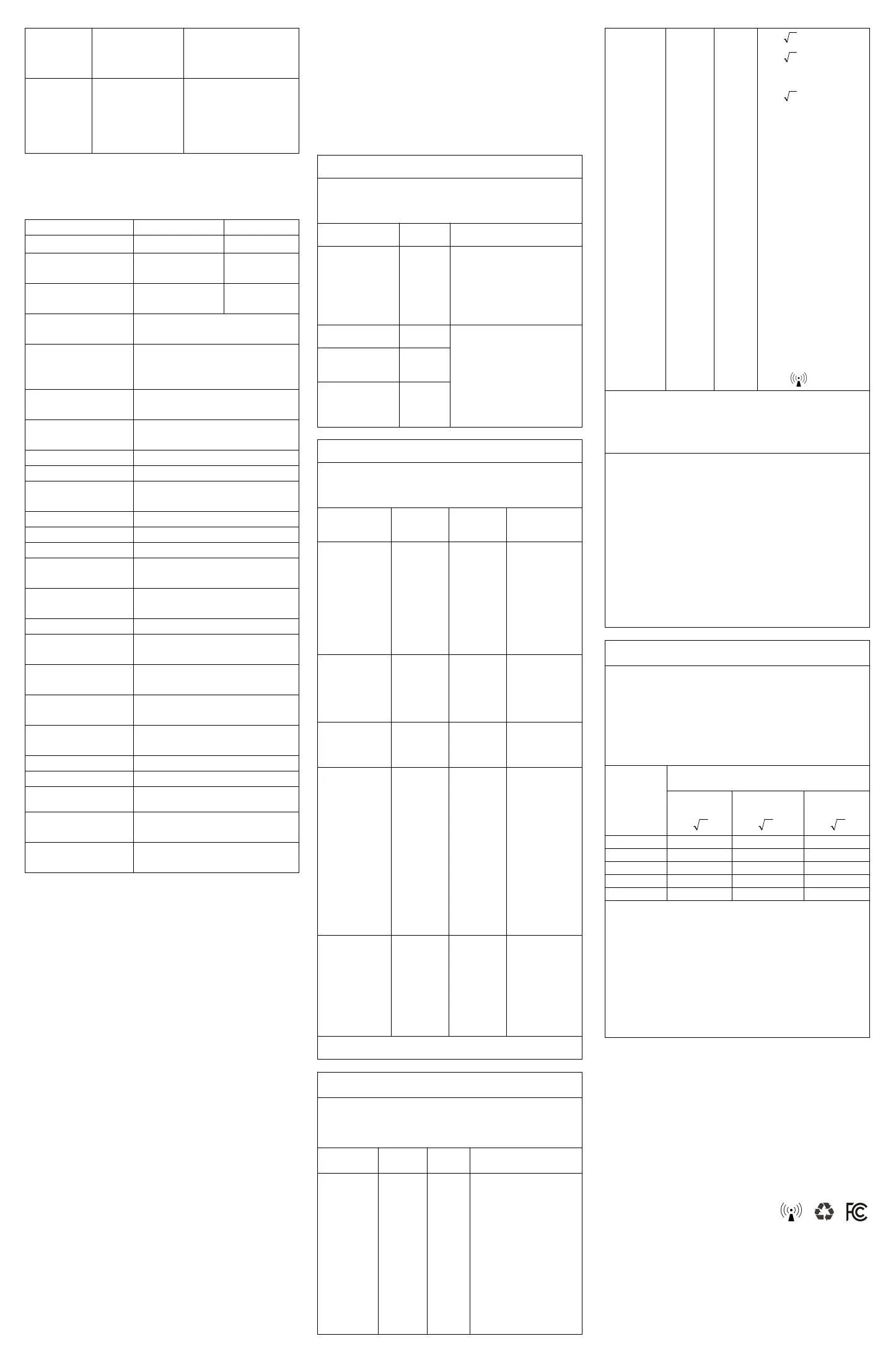
7. Specifications
Relative humidity
(non-condensing)
Protection against
electric shock
Internally powered equipment
Degree protection
against electrical
shock
Electro-magnetic
compatibility
Degree of dust &
water resistance
3.7Vd.c., Rechargeable
Lithium-polymer
12-16 hours for typical use
Oxygen level
Accuracy (Arms)
±2 bpm or ±2%, whichever is
greater
low oxygen level;
high/low pulse rate
4 sessions, up to 10 hours for
each
iOS 9.0 or above,
iPhone 4s/ iPad 3 or above
Android 5.0 or above,
with Bluetooth 4.0 BLE
8.
FCC Statement
FCC Warning:
FCC ID: 2ADXK-8326
Any Changes or modifications not expressly Approved
by the party responsible for compliance could void
the user's authority to operate the equipment.
This device complies with part 15 of the FCC Rules.
Operation is subject to the following two conditions:
(1) This device may not cause harmful interference,
and
(2) this device must accept any interference received,
including interference that may cause undesired
operation.
Note: This equipment has been tested and found to
comply with the limits for a Class B digital device,
pursuant to part 15 of the FCC Rules. These limits are
designed to provide reasonable protection against
harmful interference in a residential installation. This
equipment generates uses and can radiate radio
frequency energy and, if not installed and used in
accordance with the instructions, may cause harmful
interference to radio communications. However,
there is no guarantee that interference will not occur
in a particular installation. If this equipment does
cause harmful interference to radio or television
reception, which can be determined by turning the
equipment off and on, the user is encouraged to try
to correct the interference by one or more of the
following measures:
-Reorient or relocate the receiving antenna.
-Increase the separation between the equipment and
receiver.
-Connect the equipment into an outlet on a circuit
different from that to which the receiver is
connected.
-Consult the dealer or an experienced radio/TV
technician for help.
The device has been evaluated to meet general RF
exposure requirement. The device can be used in
portable exposure condition without restriction.
9. Appendix EMC
The equipment meets the requirements of IEC
60601-1-2:2014.
Table 1
Guidance and manufacturer ’s declaration-electromagnetic
emission
The Pulse Oximeter is intended for use in the electromagnetic
environment specified below. The customer or the user of the
Pulse Oximeter should assure that it is used in such an
environment.
Electromagnetic
environment-guidance
The Pulse Oximeter uses RF
energy only for its internal
function. Therefore, its RF
emissions are very low and are
not likely to cause any
interference in nearby
electronic equipment.
The Pulse Oximeter suitable
for use in all establishments,
including domestic
establishments and those
directly network that supplies
buildings used for domestic
purposes.
Harmonic
emissions
IEC61000-3-2
Voltage
fluctuations/flicker
emissions
IEC61000-3-3
Guidance and manufacturer ’s declaration-electromagnetic
emission
The Pulse Oximeter is intended for use in the electromagnetic
environment specified below. The customer or the user of the
Pulse Oximeter should assure that it is used in such an
environment.
Electromagnetic
environment
-guidance
Electrostatic
discharge(ESD)
IEC61000-4-2
Floors should be
wood, concrete
or ceramic tile. if
floors are
covered with
synthetic
material, the
relative humidity
should be at
least 30%
Electrical fast
transient/
burst
IEC61000-4-4
±2kV for
power
Supply lines
±1 kV for
input/output
lines
±1kV line (s)
to line(s)
±2kV line(s)
to earth
Voltage dips,
short
interruptions
and voltage
variations on
power supply
input lines
IEC61000-4-11
<5% UT
(>95% dip in
UT) for 0.5
cycle
<40% UT
(60% dip in
UT) for 5
cycles
<70% UT
(30% dip in
UT) for 25
cycles
<5% UT
(>95% dip in
UT) for 5 s
Power frequency
(50Hz/60Hz)
magnetic field
IEC61000-4-8
Power frequency
magnetic fields
should be at
levels
characteristic of
a typical location
in a typical
commercial
environment.
NOTE: UT is the a.c. mains voltage prior to application of the
test level.
Guidance and manufacturer’s declaration – electromagnetic
immunity
The Pulse Oximeter is intended for use in the electromagnetic
environment specified below. The customer or the user of The
Pulse Oximeter should assure that it is used in such an
electromagnetic environment.
Electromagnetic
environment -guidance
Portable and mobile RF
communications
equipment should be used
no closer to any part of
The Pulse Oximeter,
including cables, than the
recommended separation
distance calculated from
the equation applicable to
the frequency of the
transmitter.
Recommended separation
distance
800MHz to
2.5GHz
Where P is the maximum
output power rating of
the transmitter in watts
(W) according to the
transmitter manufacturer
and d is the
recommended separation
distance in metres (m). b
Field strengths from fixed
RF transmitters, as
determined by an
electromagnetic site
survey ,a should be less
than the compliance level
in each frequency range .b
Interference may occur in
the vicinity of equipment
marked with the following
symbol.
NOTE 1: At 80 MHz and 800 MHz, the higher frequency range
applies.
NOTE 2: These guidelines may not apply in all situations.
Electromagnetic propagation is affected by absorption and
reflection from structures, objects and people.
a: Field strengths from fixed transmitters, such as base stations
for radio (cellular / cordless) telephones and land mobile
radios, amateur radio, AM and FM radio broadcast and TV
broadcast cannot be predicted theoretically with accuracy. To
assess the electromagnetic environment due to fixed RF
transmitters, and electromagnetic site survey should be
considered. If the measured field strength in the location in
which The Pulse Oximeter is used exceeds the applicable RF
compliance level above, The Pulse Oximeter should be
observed to verify normal operation. If abnormal performance
is observed, additional measures may be necessary, such as
re-orienting or relocating The Pulse Oximeter.
b: Over the frequency range 150 kHz to 80 MHz, field strengths
should be less than 3V/m.
Recommended separation distances between portable and
mobile RF communication the equipment
The Pulse Oximeter is intended for use in an electromagnetic
environment in which radiated RF disturbances are controlled.
The customer or the user of The Pulse Oximeter can help
prevent electromagnetic interference by maintaining a
minimum distance between portable and mobile RF
communications equipment (transmitters) and the Pulse
Oximeter as recommended below, according to the maximum
output power of the communications equipment.
Rated
maximum
output power
of transmitter
W(Watts)
Separation distance according to frequency of
transmitter M(Meters)
For transmitters rated at a maximum output power not listed
above, the recommended separation distance in metres (m) can
be determined using the equation applicable to the frequency
of the transmitter, where P is the maximum output power
rating of the transmitter in watts (W) according to the
transmitter manufacturer.
NOTE 1: At 80 MHz and 800 MHz, the separation distance for
the higher frequency range applies.
NOTE 2: These guidelines may not apply in all situations.
Electromagnetic propagation is affected by absorption and
reflection from structures, objects and people.
Copyright
This manual is written by our company and all rights
reserved. Without our company's prior written
consent, no part of this manual may be reproduced
or copied in any form or method.
Illustration
All illustrations provided in this manual are for
reference only, and the settings or data in the
illustrations may not be exactly the same as the
actual display you see on the product.
Product name: Pulse Oximeter Model: PO2
Version: A Date: Sep. 28, 2020


 To Previous Page
 Loading...