Need help?
Do you have a question about the Wen 31110 and is the answer not in the manual?
Guidelines for maintaining a clean, well-lit, and safe work environment to prevent accidents.
Precautions related to power sources, cords, and avoiding electrical hazards during operation.
Recommendations for operator alertness, protective equipment, and proper attire for safe tool use.
Best practices for using tools correctly, maintenance, and storage to ensure safety.
Instructions for qualified service personnel and the importance of using identical replacement parts.
Information on potential chemical exposures and health risks associated with certain construction activities.
Safety measures for the scaffolding work area, emphasizing cleanliness and hazard avoidance.
Personal safety precautions, including PPE and alertness, when using scaffolding.
Guidelines for the safe setup, operation, and maintenance of scaffolding.
Steps for attaching and securing the swivel casters to the end frames.
Procedure for attaching side rails to end frames and ensuring platform levelness.
How to operate the pins for adjusting platform height or securing components.
Instructions for placing and securing the work platform onto the assembled scaffolding.
Guidance on safely stacking an additional scaffold stage, including required precautions.
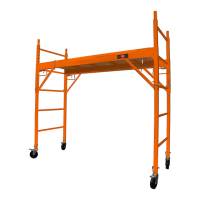
The WEN 1000-Pound Capacity Scaffolding is a versatile and robust tool designed for various construction and maintenance activities, offering a stable and elevated work platform. This scaffolding is engineered to meet WEN's high standards for dependability, ease of operation, and operator safety, promising years of rugged, trouble-free performance when properly cared for and used according to its intended purpose.
The WEN Scaffolding serves as a temporary elevated work platform, allowing users to safely reach heights for tasks such as painting, repairs, construction, and other activities that require working above ground level. It is designed for both single and two-stage configurations, providing flexibility for different height requirements. The scaffolding features swivel casters for mobility, L-shaped pins for height adjustments, and a wooden platform that can be securely fastened. Its primary function is to provide a stable and secure surface for workers and materials, enhancing safety and efficiency on job sites.
The scaffolding is designed for straightforward assembly and adjustment, though it requires two people for safe setup. The casters are easily mounted by sliding them into the end frame legs and securing them with locking pins. These casters are also equipped with a lock mechanism, allowing users to press "ON" to lock them in place for stability during work and "OFF" to unlock them for movement.
Side rails are attached to the end frames using L-shaped pins, which must be fully engaged in the frame holes for security. Additional locking pins further secure these connections. It is crucial to ensure both side rails are positioned at the same height to maintain a level platform, which can be verified with a bubble level. The L-shaped pins allow for easy adjustment of the platform height; pulling them out disengages them for adjustment, and releasing them ensures they fully engage into the frame holes, locking the platform at the desired height.
The plywood platform is laid over flange pins extending from the side rails and secured with platform hold-downs. Platform clips rotate into an engaged position to further secure the platform. For tasks requiring greater height, a second scaffold (sold separately) can be attached, using the first scaffold as a stable base. When stacking, the lower stage must be fully assembled and its caster wheels locked to provide structural support and prevent movement. The second stage end frames are inserted over the first stage's end frames and secured with locking and L-shaped pins. Side rails for the second stage are then attached, and the wooden platform is laid and secured.
It is critical to secure the scaffold to a stable structure using ties and/or braces when stacking, especially at the third horizontal beam of the second scaffolding. These attachments must be rated to at least four times the scaffolding's capacity. When moving the scaffolding, it should be grasped and pushed at points no higher than five feet from the floor to prevent tipping. The scaffolding must only be used on a flat, level surface capable of supporting the entire load, preferably concrete or asphalt. All casters must be locked before use, and the wooden platform's levelness should be verified with a level.
Accessing the platform requires rechecking all lock pins for full engagement and ensuring the platform is properly seated and clips are engaged. If accessing from a ladder, both the scaffolding and ladder must be secured from movement. Ladders should not be used above the platform to gain greater heights and must meet OSHA requirements. For work more than 10 feet above a lower level, fall protection, such as personal fall arrest systems or guardrail systems (available separately), is required. A gap of no more than 14 inches should exist between the platform and the structure being worked on, except for lathing or plastering, where an 18-inch gap is permitted. If toe-boards, guardrails, or canopies are used to prevent falling object hazards, the areas below must be barricaded. All plug-in electric tools used on the scaffold must be protected by GFCI outlets or plugs.
Regular maintenance is essential for ensuring the scaffolding's safety and longevity. Before each use, a thorough inspection of the scaffold's general condition is recommended. This includes checking for any cracking or deterioration of the reinforced wood platform, as well as cracked or loose wheels or wheel locks. The straightness and levelness of the platform and scaffolding should be verified, along with checking for loose screws, misalignment of parts, and any cracked, bent, or broken components. Any condition that might affect safe operation must be addressed.
Periodically, the wood decking and rails should be coated with a transparent (penetrating) wood preservative. It is important not to paint or use opaque surface sealants, as these can conceal underlying problems that might compromise the structural integrity of the wood.
Users must exercise extreme care around acids and other corrosive substances, as these materials can severely affect the integrity of the scaffolding by corroding metal parts and decreasing their strength. If the scaffolding is exposed to excessive heat, such as fire, it must be immediately removed from use and discarded, as this can lead to a loss of structural integrity. Oil, grease, or other slippery materials should not be allowed to accumulate on climbing or gripping surfaces, and any spills on the wood platform should be cleaned immediately to prevent slips and falls.
After use, the external surfaces of the scaffolding should be cleaned with a cloth, and the unit should be stored indoors in a safe, dry area, out of reach of children. For replacement parts and accessories, only identical components should be used to ensure a longer lifespan and maximize safety. These parts can be purchased by contacting WEN customer service.
When the tool, accessories, and packaging reach the end of their useful life, they should be sorted for recycling rather than disposed of with household waste. Taking them to a local recycling facility ensures responsible disposal and minimizes environmental impact.
 General
| Model | 31110 |
|---|---|
| Category | Construction Equipment |
| Input Voltage | 120 V |
| Blade Diameter | 14 inches |
| Output Current Range | 12 A |
| Duty Cycle | Continuous |

 To Next Page