EasyManua.ls Logo

Westerbeke W-46 - Page 70

Westerbeke W-46
114 pages
Print Icon
To Next Page IconTo Next Page
To Previous Page IconTo Previous Page
Loading...
FUEL
SYSTEM
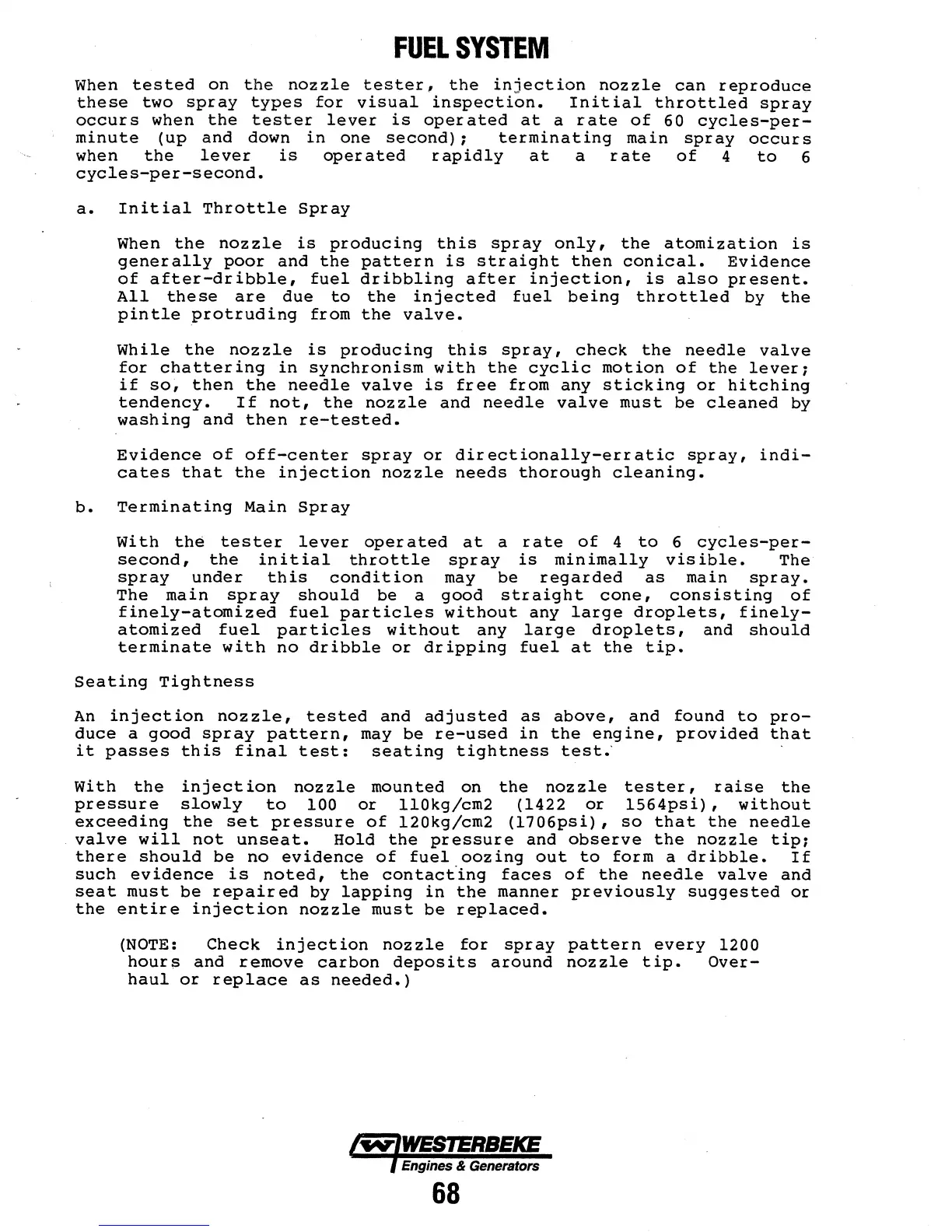
When
tested
on
the
nozzle
tester,
the
injection
nozzle
can
reproduce
these
two
spray
types
for
visual
inspection.
Initial
throttled
spray
occurs
when
the
tester
lever
is
operated
at
a
rate
of
60
cycles-per-
minute
(up
and
down
in
one
second);
terminating
main
spray
occurs
when
the
lever
is
operated
rapidly
at
a
rate
of
4
to
6
cycles-per-second.
a.
Initial
Throttle
Spray
When
the
nozzle
is
producing
this
spray
only,
the
atomization
is
generally
poor
and
the
pattern
is
straight
then
conical.
Evidence
of
after-dribble,
fuel
dribbling
after
injection,
is
also
present.
All
these
are
due
to
the
injected
fuel
being
throttled
by
the
pintle
protruding
from
the
valve.
While
the
nozzle
is
producing
this
spray,
check
the
needle
valve
for
chattering
in
synchronism
with
the
cyclic
motion
of
the
lever;
if
so,
then
the
needle
valve
is
free
from
any
sticking
or
hitching
tendency.
If
not,
the
nozzle
and
needle
valve
must
be
cleaned
by
washing
and
then
re-tested.
Evidence
of
off-center
spray
or
directionally-erratic
spray,
indi-
cates
that
the
injection
nozzle
needs
thorough
cleaning.
b.
Terminating
Main
Spray
With
the
tester
lever
operated
at
a
rate
of
4
to
6
cycles-per-
second,
the
initial
throttle
spray
is
minimally
visible.
The
spray
under
this
condition
may
be
regarded
as
main
spray.
The
main
spray
should
be a
good
straight
cone,
consisting
of
finely-atomized
fuel
particles
without
any
large
droplets,
finely-
atomized
fuel
particles
without
any
large
droplets,
and
should
terminate
with
no
dribble
or
dripping
fuel
at
the
tip.
Seating
Tightness
An
injection
nozzle,
tested
and
adjusted
as
above,
and
found
to
pro-
duce
a
good
spray
pattern,
may
be
re-used
in
the
engine,
provided
that
it
passes
this
final
test:
seating
tightness
test.'
With
the
injection
nozzle
mounted
on
the
nozzle
tester,
raise
the
pressure
slowly
to
100
or
110kg/cm2
(1422
or
1564psi),
without
exceeding
the
set
pressure
of
120kg/cm2
(1706psi),
so
that
the
needle
valve
will
not
unseat.
Hold
the
pressure
and
observe
the
nozzle
tip;
there
should
be
no
evidence
of
fuel
oozing
out
to
form a
dribble.
If
such
evidence
is
noted,
the
contactlng
faces
of
the
needle
valve
and
seat
must
be
repaired
by
lapping
in
the
manner
previously
suggested
or
the
entire
injection
nozzle
must
be
replaced.
(NOTE:
Check
injection
nozzle
for
spray
pattern
every
1200
hours
and
remove
carbon
deposits
around
nozzle
tip.
Over-
haul
or
replace
as
needed.)
68

Related product manuals