EasyManua.ls Logo

Westerbeke W-46 - Alternator and Regulator Service; Alternator Description and Troubleshooting; Testing Alternator Charging Voltage

Westerbeke W-46
114 pages
Print Icon
To Next Page IconTo Next Page
To Previous Page IconTo Previous Page
Loading...
ALTERNATOR/REGULATOR
SERVICE
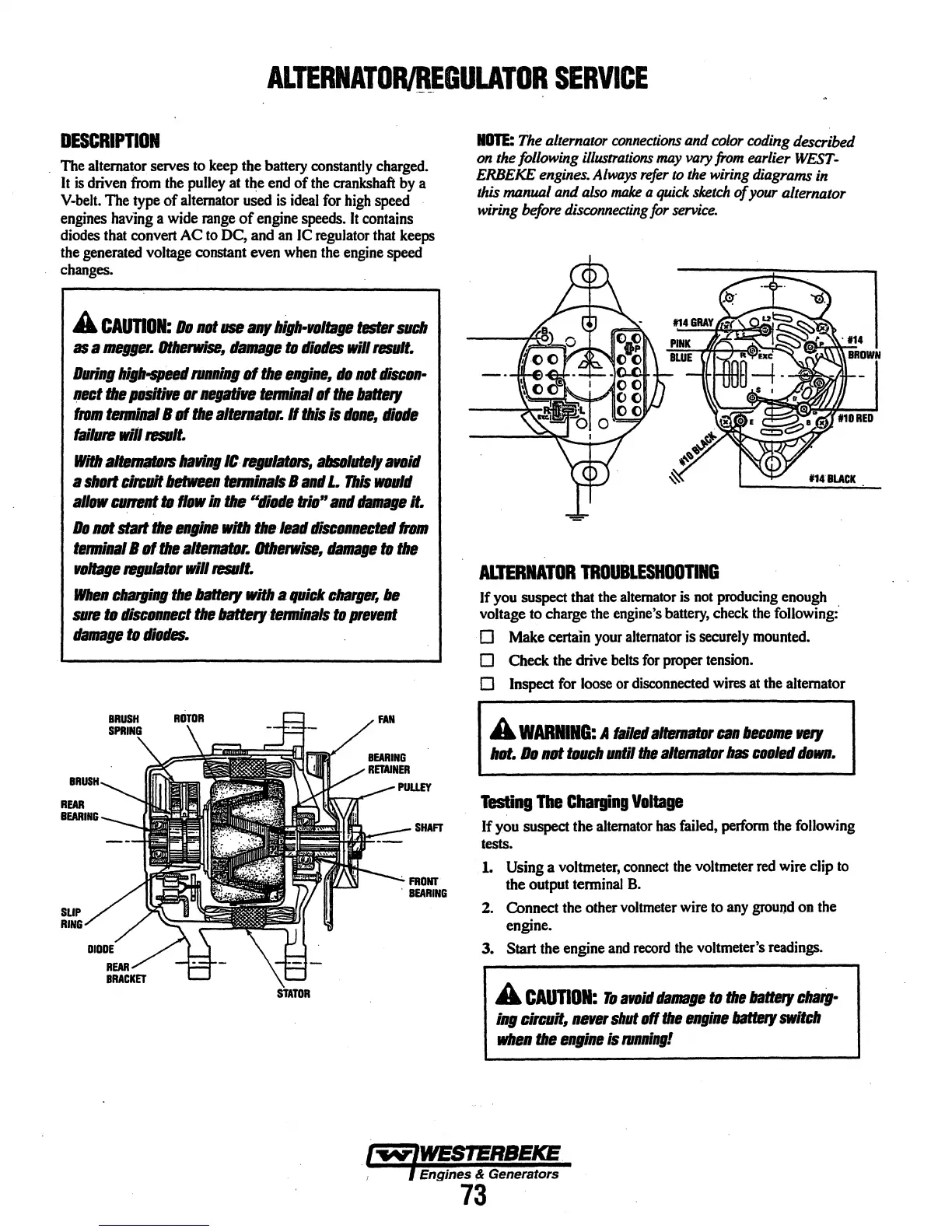
DESCRIPTION
The alternator serves to
keep
the battery
constantly
charged.
It
is
driven
from
the
pulley
at the end
of
the
crankshaft
by
a
V-belt.
The type of alternator used
is
ideal
for
high
speed
engines having a wide
range
of
engine speeds.
It
contains
diodes
that convert AC
to
DC, and
an
JC
regulator
that
keeps
the
generated voltage constant even
when
the
engine
speed
changes.
A
CAUDON:
Do
not
DSe
any
hlgh·voltage
tester
such
as
a
megg111.
Bthiii'Wise,
damage
to
diodes
will
result.
During
high-speed
running
of
the
engine.
do
not
dlscon·
nect
the
PDSitlve
or
negati1111
tennlnal
of
the
baltery
from
terminal
B of
the
altemator.
II
this
Is
done,
diode
failure
will
teSIIII.
With
altematotS
hafling
IC
tegulatotS,
absolutely
avoid
a
short
cimllit
between
lelminals
Band
L.
This
would
allow
current
to
flow
in
the 'lliDIIe
trio
11
and
damage
it.
Do
not
start
the
engine
with
the
lead
disDDnnected
from
terminal
B
of
the
alternator.
Otherwise,
damage
to
the
roltage
regulator
wiiii'IJSII/1.
When
charging
the
battery
with a
quit:k
charger,
be
sure
to
disconnect
the
battery
tenninals
to
prevent
damage
to
diodes.
NOTE:
The alternator
connections
and
color
coding described
on
the following
illustrations
may
vary
from
earlier
WEST-
ERBEK.E
engines. Always
refer
to
the
wiring
diagrams
in
this
manual and
also
make
a
quick
sketch
of
your alternator
wiring before
disconnecting
for
service.
ALTERNATOR
TROUBLESHOOnNG
If you suspect that
the
alternator
is
not
producing
enough .
voltage
to
charge
the
engine's
battery,
check
the
following:
0 Make certain
your
alternator
is
securely
mounted.
0 Check
the
drive
belts
for
proper
tension.
0 Inspect
for
loose
or
disconnected
wires
at
the
alternator
A
WARNING:
A
failed
altel'llafor
can
become
very
hot.
Do
not
touch
until
the
alternator
has
t:DDied
down.
Testing
The
Charging
Voltage
SHAFT
If you suspect the
alternator
has
failed,
perform
the
following
tests.
SUP
RING
1.
Using a voltmeter,
connect
the
voltmeter
red
wire
clip
to
the output
terminal
B.
2.
Connect the other
voltmeter
wire
to
any
ground
on
the
engine.
3.
Start the engine
and
record
the
voltmeter's
readings.
A
CAUnON:
To
avoid
damage
to
the
battery
charg·
lng
circuit,
never
shut
o"
the
engine
battery
switch
when
the
engine
is
running!
Engines & Generators
73

Related product manuals