ZF
MARINE
TRANSMISSIONS
INITIAL
OPERATION
All
ZF
marine transmissions are test-run on a test stand with
the engine at the factory prior to delivery. For safety reasons
the fluid is drained before shipment.
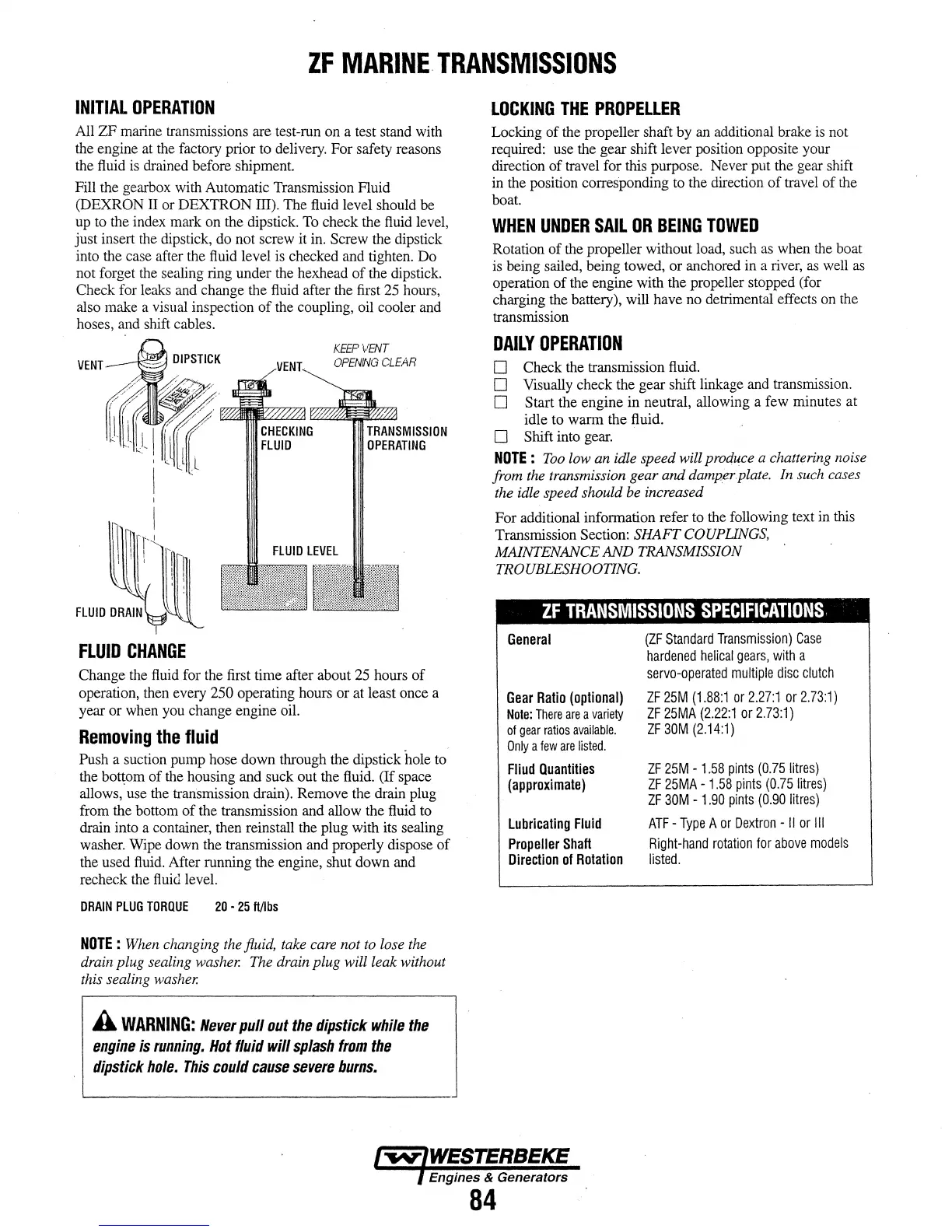
Fill the gearbox with Automatic Transmission Fluid
(DEXRON
IT
or
DEXTRON
ill). The fluid level should be
up to the index mark
on
the dipstick. To check the fluid level,
just insert the dipstick,
do
not screw it in. Screw the dipstick
into the case after the fluid level is checked and tighten.
Do
not forget the sealing ring under the hexhead
of
the dipstick.
Check for leaks and change the fluid after the first 25 hours,
also make a visual inspection
of
the coupling, oil cooler and
hoses, and shift cables.
KEEP
\lENT
VENT
OPENING
CLEAR
CHECKING
TRANSMISSION
FLUID
OPERATING
FLUID
LEVEL
FLUID
CHANGE
Change the fluid for the first time after about 25 hours
of
operation, then every 250 operating hours
or
at least once a
year
or
when you change engine oil.
Removing
the
fluid
Push a suction pump hose
down
through the dipstick hole to
the
boqom
of
the housing and suck out the fluid. (If space
allows, use the transmission drain). Remove the drain plug
from the bottom
of
the transmission and allow the fluid to
drain into a container, then reinstall the plug with its sealing
washer. Wipe down the transmission and properly dispose
of
the used fluid. After running the engine, shut down and
recheck the fluid level.
DRAIN
PLUG
TORQUE
20
•
25
Mbs
NOTE
: When changing the fluid, take care not to lose the
drain
plug
sealing washer. The drain
plug
will leak without
this sealing washer.
A
WARNING:
Never
pull
out
the
dipstick
while
the
engine
is
running.
Hot
fluid
will
splash
from
the
dipstick
hole.
This
could
cause
severe
burns.
LOCKING
THE
PROPELLER
Locking
of
the propeller shaft
by
an additional brake is not
required: use the gear shift lever position opposite your
direction
of
travel for this purpose. Never put the gear shift
in the position corresponding to the direction
of
travel
of
the
boat.
WHEN
UNDER
SAIL
OR
BEING
TOWED
Rotation
of
the propeller without load, such as when the boat
is being sailed, being towed,
or
anchored
in
a river, as well as
operation
of
the engine with the propeller stopped (for
charging the battery), will have no detrimental effects on the
transmission
DAILY
OPERATION
0 Check the transmission fluid.
D Visually check the gear shift linkage and transmission.
0 Start the engine
in
neutral, allowing a few minutes
at
idle to
wann
the fluid.
D Shift into gear.
NOTE
:
Too
low
an
idle
speed
will proquce a chattering noise
from the transmission
gear
and
damper.plate. In such cases
the idle speed should
be
increased
For additional information refer to the following text in this
Transmission Section:
SHAFT
COUPliNGS,
MAINTENANCE
AND
TRANSMISSION
TROUBLESHOOTING.
ZF
TRANSMISSIONS
SPECIFICATIONS
General
Gear
Ratio
{optional)
Note:
There
are
a
variety
of
gear
ratios
available.
Only
a
few
are
listed.
Fliud
Quantities
(approximate)
Lubricating
Fluid
Propeller
Shaft
Direction
of
Rotation
(ZF
Standard
Transmission)
Case
hardened
helical
gears,
with
a
servo-operated
multiple
disc
clutch
ZF
25M
(1.88:1
or
2.27:1
or
2.73:1)
ZF
25MA
(2.22:1
or
2.73:1)
ZF
30M
(2.14:1)
ZF
25M
•
1.58
pints
(0.75
litres)
ZF
25MA-
1.58
pints
(0.75
litres)
ZF
30M-
1.90
pints
(0.90
litres)
ATF-
Type
A
or
Dextran
-
II
or
Ill
Right-hand
rotation
for
above
models
listed.
Engines & Generators
84


 To Next Page
 Loading...