EasyManua.ls Logo

Westinghouse WGen9500TFc - User Manual

Westinghouse WGen9500TFc
108 pages
Print Icon
To Next Page IconTo Next Page
Loading...
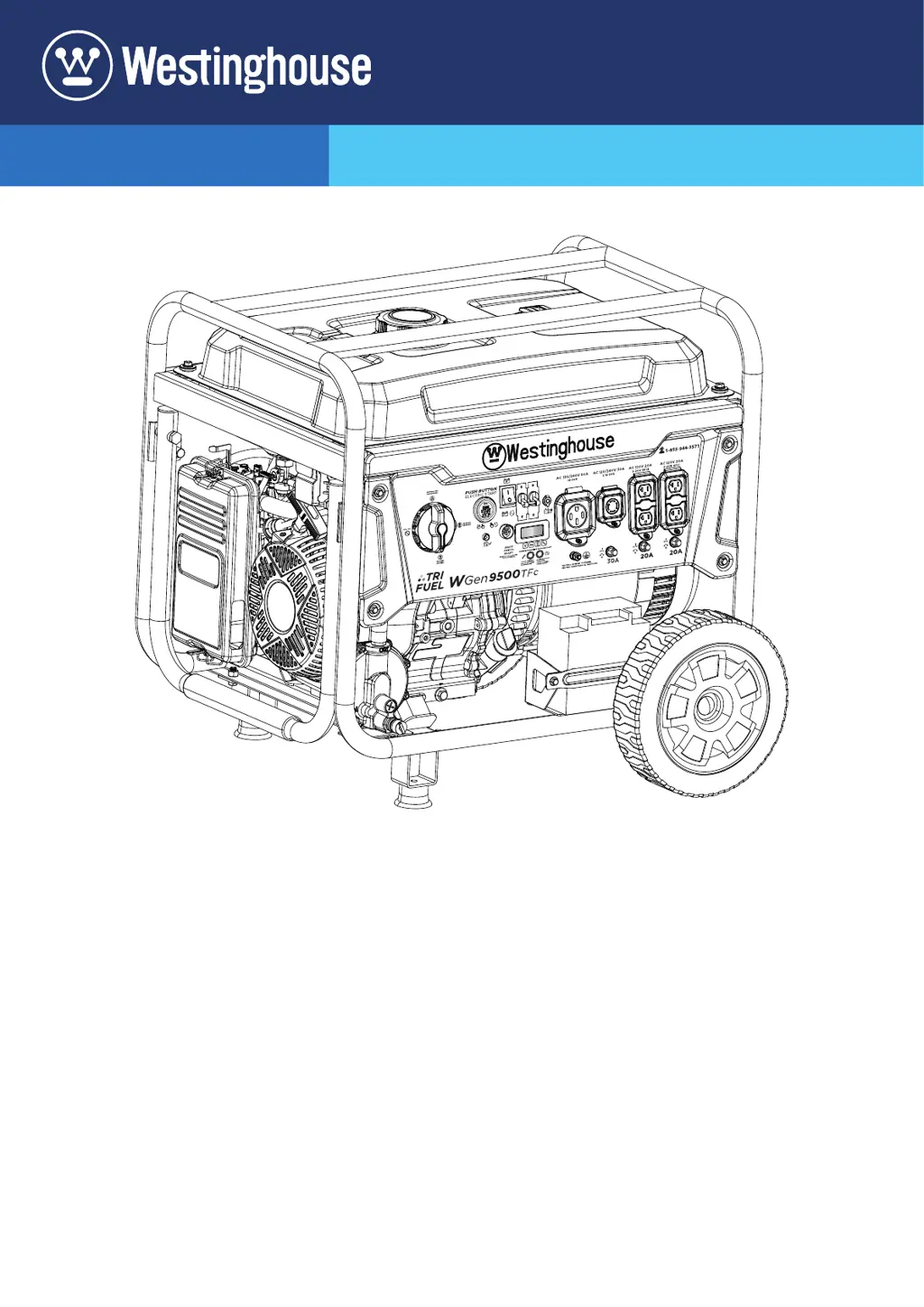
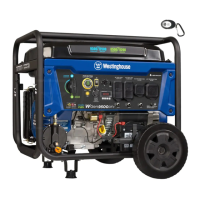
WGen9500TFc
PORTABLE GENERATOR
GASOLINE: 9500 RUNNING WATTS | 12500 PEAK WATTS
PROPANE: 8500 RUNNING WATTS | 11200 PEAK WATTS
NATURAL GAS: 7500 RUNNING WATTS | 9500 PEAK WATTS
DO NOT RETURN THIS PRODUCT TO THE STORE
If you have questions or need assistance, please call customer
service at 855-944-3571.
USER MANUAL

Questions and Answers

  • K
    Kathryn BurtonAug 12, 2025
    Why does my Westinghouse Portable Generator engine lack power?
    • K
      Kristina WrightAug 12, 2025
      If your Westinghouse Portable Generator engine lacks power, it could be due to: * A restricted air filter. Clean or replace the air filter. * The choke lever being in the wrong position. Move the choke lever to the correct position.
  • R
    Ryan HarrisAug 18, 2025
    What to do if there is no power at AC receptacles on my Westinghouse WGen9500TFc Portable Generator?
    • A
      Amanda ScottAug 19, 2025
      If there is no power at the AC receptacles of your Westinghouse Portable Generator: * Check if the AC circuit breaker(s) have tripped. If so, check the AC loads and reset the circuit breaker(s). * A power tool or appliance could be faulty. Replace or repair the tool or appliance. Stop and restart the engine.
  • K
    Keith ReynoldsAug 25, 2025
    Why does my Westinghouse WGen9500TFc start then shut down?
    • A
      Anthony BarnesAug 25, 2025
      Your Westinghouse Portable Generator might start and then shut down due to several reasons: * The fuel level could be low or depleted. Add gasoline, connect a natural gas hose, or connect a propane cylinder. * The engine oil level might be low. Fill the oil to the proper level, making sure the generator is on a level surface. * The air filter could be dirty. Clean the air filter. * The fuel source could be contaminated. Drain the gasoline and refill the fuel tank, replace the propane cylinder, or have a professional clean the natural gas line.
  • P
    Patrick NguyenAug 31, 2025
    What to do if my Westinghouse WGen9500TFc engine runs rough or bogs when load applied?
    • M
      Michael FloresAug 31, 2025
      If your Westinghouse Portable Generator runs rough or bogs when a load is applied, consider the following: * The air filter may be dirty. Clean the air filter. * The generator might be overloaded. Unplug some devices. * A power tool or appliance could be faulty. Replace or repair the tool or appliance, then stop and restart the engine.
  • Z
    zwyattNov 5, 2025
    What to do if my Westinghouse WGen9500TFc will not start?
    • Q
      qlucasNov 5, 2025
      If your Westinghouse Portable Generator won't start, there are several potential causes: * The fuel level may be low or depleted. Add gasoline, connect a natural gas hose, or connect a propane cylinder. * The gasoline may be stale. Drain the gasoline tank and refuel with fresh gasoline. * The air filter may be dirty. Clean the air filter. * The engine oil level may be low. Fill the oil to the proper level and ensure the generator is on a flat, level surface. * The spark plug may be wet with fuel (flooded engine). Wait five minutes, turn the fuel selector switch to the FUEL OFF position, and pull the recoil handle rapidly several times. If it still doesn't start, remove and dry the spark plug. * The spark plug may be faulty, fouled, or improperly gapped. Gap or replace the spar...

Summary

Introduction

Product Registration

Register your product for warranty and support.

Specifications

Detailed technical specifications and operating parameters.

Manual Updates

Information on manual updates and availability.

Safety

Safety Definitions and Symbols

Understand safety alert meanings and visual symbols for safe operation.

Important Safety Instructions

Critical guidelines for safe generator operation and handling.

Grounding and Electrical Safety

Procedures for safe electrical grounding and shock prevention.

Disconnecting Bonded Neutral

Procedure for disconnecting the generator's bonded neutral connection.

Gasoline and Vapor Safety

Precautions for handling gasoline and its flammable vapors safely.

LPG;Propane Safety

Safety precautions for using liquid petroleum gas (LPG/Propane).

Natural Gas Safety

Safety precautions for using natural gas (NG).

Leak Testing Procedures

Instructions for performing leak tests on gas connections.

CO Sensor Information and Warnings

Information on the CO sensor and carbon monoxide hazard warnings.

Safety Labels and Decals

Explanation of the safety labels and decals found on the generator.

Electrical

Generator Capacity and Management

Understand generator limits and power management for longevity.

Extension Cord Usage and Sizing

Guidelines for safely using and sizing extension cords with the generator.

Components

Generator Parts Overview

Identification of major generator components and their functions.

Electrical Outlets and Ports

Description of power receptacles, battery charging port, and indicator lights.

Control Panel Features

Explanation of indicators, switches, data center, and start/stop functions.

Assembly

Carton Contents and Initial Setup

Steps for unpacking, checking parts, and initial assembly.

Installing Generator Wheels and Feet

Instructions for attaching the generator's wheels and support feet.

Battery Connection and Handle Adjustment

Procedure for connecting the battery and adjusting the generator handle.

Operation

Safe Location and Operation

Guidelines for safely positioning and operating the generator.

Regulations and Fuel Requirements

Understanding regulations and specifications for fuels.

Fueling Procedures

Instructions for adding gasoline, LPG, and natural gas, plus using stabilizer.

LP Gas Cylinder Handling

Requirements and steps for connecting an LP gas cylinder.

Natural Gas Supply Connection

Procedure for connecting the generator to a natural gas supply.

Fuel Source Selection

How to switch between gasoline, propane, and natural gas.

High Altitude Operation

Adjustments for operating the generator at higher altitudes.

Generator Monitoring and Control

Using the data center, key fob, and understanding the break-in period.

Starting and Stopping the Generator

Detailed instructions for starting and safely shutting down the generator.

Generator Transport

Guidelines for safely moving and transporting the generator.

Care and Maintenance

Engine Air Filter and Spark Plug Service

Procedures for cleaning/replacing the air filter and spark plug.

Engine Oil and Spark Arrestor Maintenance

Guidelines for changing engine oil and cleaning the spark arrestor.

Fuel System Maintenance

Procedures for draining fuel, cleaning carburetor, and replacing fuel valve.

Valve Clearance Adjustment

Checking and adjusting engine valve clearance.

Battery Care and Replacement

Maintenance and replacement procedures for the generator battery.

Storage and Maintenance Schedule

Proper storage methods and a comprehensive maintenance schedule.

Schematics

Electrical Schematics

Diagrams illustrating the generator's electrical system and wiring.

Westinghouse WGen9500TFc Specifications

General IconGeneral
ModelWGen9500TFc
TypePortable Generator
Starting Wattage12500 Watts
Running Wattage9500 Watts
Fuel TypeGasoline
Engine Displacement457 cc
Run Time at 50% Load12 hours
Run Time at 25% Load18 hours
Fuel Tank Capacity6.6 gallons
Voltage120/240V
Frequency60 Hz
Noise Level74 dBA
Wheel KitYes
Battery IncludedYes
CARB CompliantYes
Engine Type4-Stroke
Start TypeElectric
Outlet Types5-20R, L5-30R, 14-50R
Warranty3 years

Related product manuals