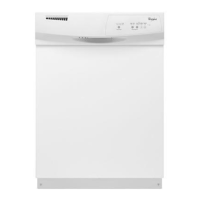
This document describes the Estate Under Counter Dishwasher, models TUD6710S and TUD6750S, manufactured by Whirlpool Corporation. It provides comprehensive information on its function, features, usage, maintenance, and troubleshooting.
Function Description:
The Estate Under Counter Dishwasher is designed to clean dishes, pots, pans, casseroles, and utensils. It operates by spraying water and detergent onto soiled items, followed by rinsing cycles. The dishwasher offers various wash cycles and options to accommodate different soil levels and item types, aiming for efficient and thorough cleaning. It includes features like a detergent dispenser, rinse aid dispenser, and a drying system.
Important Technical Specifications:
- Water Temperature: The dishwasher typically operates with hot water. For optimal performance, the incoming water temperature should be at least 120°F (49°C). Some cycles, like "Heavy" and "Pots & Pans," recommend 140°F (60°C) for enhanced cleaning.
- Detergent Usage: The amount of detergent required varies based on water hardness and soil level. The manual provides a chart for recommended detergent amounts (in tablespoons or mL) for both main wash and pre-wash, categorized by soil level (Lightly soiled, Normally soiled, Heavily soiled) and water hardness (Soft to Medium, Medium to Hard).
- Rinse Aid: The rinse aid dispenser holds 6 oz (175 mL) of rinse aid, which lasts for about 3 months. Rinse aid is crucial for spot-free drying and improved drying performance.
- Cycle Times: Cycle times vary depending on the selected wash cycle, options, water temperature, and soil level. For example, the "Normal" cycle with a 140°F (60°C) wash can take approximately 62 minutes, consuming about 4.8 gallons (18.2 liters) of water. The "Heavy" cycle can take up to 72 minutes and use 6.9 gallons (26.1 liters) of water.
- Electrical Requirements: The dishwasher requires a grounded electrical connection. It can be either cord-connected or permanently connected. For cord-connected units, a 3-prong grounding plug must be inserted into an appropriate outlet. For permanently connected units, a grounded metal, permanent wiring system or an equipment-grounding conductor must be run with the circuit conductors.
- Water Pressure: Adequate water pressure is necessary for proper operation.
- Dimensions: While not explicitly stated with numerical values, the "Under Counter" designation implies standard dimensions suitable for installation beneath kitchen countertops.
Usage Features:
- Control Panel: Features cycle selectors (Light, Normal, Heavy, Pots & Pans) and options (Hi-temp wash, Air dry, Reset options). There's also a rotary knob for selecting specific cycles (Normal/Light Wash, Heavy Wash, Pots & Pans, Rinse & Hold, Off) and a "Plate Warmer" option.
- Loading:
- Top Rack: Designed for cups, glasses, and smaller items. Items should be placed with open ends facing down. Plastic items marked "dishwasher safe" should be loaded in the top rack. Delicate items like china and crystal should not touch each other.
- Bottom Rack: Designed for plates, pans, casseroles, and utensils. Soiled surfaces should face inward towards the spray. Large items like cookie sheets and cake pans should be loaded at the sides and back to avoid blocking the detergent dispenser or silverware basket.
- Silverware Basket: Can be loaded while in the bottom rack or removed for loading on a counter/table.
- Detergent Dispenser: Has two sections: a main wash section (larger) and a pre-wash section (smaller). The main wash section automatically empties during the main wash.
- Rinse Aid Dispenser: Located on the inner door panel. It should be filled regularly to ensure spot-free drying. An "E" indicator becomes visible when the dispenser is empty.
- Cycle Selection: Users can choose from various wash cycles (Normal, Light, Heavy, Pots & Pans, Rinse & Hold) and customize them with options like "Hi-Temp Wash" for increased water temperature and "Air Dry" for energy savings.
- Stopping Your Dishwasher: A cycle can be stopped by opening the door, turning the cycle control knob to "Off," or pressing "Cancel."
- Adding Items During a Cycle: Items can be added during a cycle by opening the door, adding the item, closing the door, and allowing the cycle to resume.
- Delay Hours: Allows delaying the start of a wash cycle for a set number of hours.
- Plate Warmer: An option to warm dishes or dinner plates.
- Drying System: Uses residual heat from the wash cycle to dry dishes. The "Air Dry" option can be selected for energy savings, though it may result in less dry dishes.
- Overfill Protection Float: A safety feature that prevents the dishwasher from overfilling.
Maintenance Features:
- Cleaning the Exterior: Use a soft, damp cloth and mild detergent. For stainless steel exteriors, a stainless steel cleaner is recommended.
- Cleaning the Interior: Hard water minerals can cause a white film. A paste of powdered dishwasher detergent can be used to clean the interior. Alternatively, liquid automatic dishwasher detergent or a damp sponge and clean water can be used. Vinegar rinses can also help.
- Drain Air Gap: Regularly check and clean the drain air gap (if installed) to ensure proper drainage and prevent blockages.
- Storing for the Summer: Protect the dishwasher during summer months by turning off the water supply and power.
- Winterizing your Dishwasher: Protect the dishwasher and home against water damage due to freezing water lines if the dishwasher is left in a seasonal dwelling or could be exposed to near freezing temperatures. This involves having the dishwasher winterized by authorized service personnel.
- Troubleshooting: The manual includes a comprehensive troubleshooting section to address common issues like dishes not being clean, detergent remaining in the dispenser, water not draining, and unusual noises. It provides solutions and guidance on when to contact customer service.
- Special Items Care: Provides guidance on washing various materials (Aluminum, Disposable Aluminum, Bottles and Cans, Cast Iron, China/Stoneware, Crystal, Gold, Glass, Hollow-Handle Knives, Pewter/Brass/Bronze, Disposable Plastics, Plastics, Stainless Steel, Sterling Silver/Silver Plate, Tin, Wooden Ware), indicating whether they are dishwasher safe and any specific precautions.
The manual emphasizes important safety instructions, including warnings about potential hazards like tip-over, electrical shock, and hydrogen gas accumulation in hot water systems. It advises against using the dishwasher for unintended purposes, keeping children away, and proper loading to prevent injury or damage. Grounding instructions for both cord-connected and permanently connected dishwashers are provided to prevent electrical shock.

 Need help?
 General

 To Next Page